Prøve GULL - Gratis
MOVE IN FOR THE CULL
The New Yorker
|June 17, 2024
The complicated calculus of killing some wild creatures to protect others.

We've upset the balance between predator and prey. Should we try to right it?
The northern spotted owl is about a foot and a half high, with very dark eyes, a greenish beak, and a rim of feathers, called a facial disk, that makes it appear to be regarding the world with worried perplexity. Like most owls, northern spotteds are nocturnal, but, unlike most of their brethren, they are picky. They can live only in old-growth forests in the Pacific Northwest. Their diet is restricted and seems to consist mainly of f lying squirrels. They’re incapable of building nests of their own, and so, to raise their young, they rely on tree cavities or on basketlike growths that are produced by arboreal infections and known, evocatively, as witches’ brooms.
The spotted owl’s fastidiousness produced one of the great environmental conflicts of the twentieth century. By the late nineteen-eighties, it was estimated that only fifteen hundred breeding pairs survived. Since the owls depended on old growth, the only way to save them, according to biologists, was to preserve the Northwest’s remaining stands of ancient trees. The timber industry countered that leaving those trees untouched would cost thousands of jobs. The two sides adopted increasingly confrontational tactics. Loggers raced to cut down the most valuable timber before their opponents could secure court injunctions. Protesters blocked forest-access roads and chained themselves to tree trunks. The police brought in heavy machinery to bulldoze their encampments. Environmentalists dressed up as owls and shouted, “No more clear-cuts!” Sawmill workers drove around with bumper stickers that read “I Like Spotted Owls . . . Fried.”
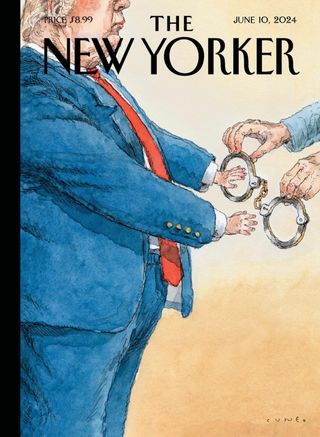

Denne historien er fra June 17, 2024-utgaven av The New Yorker.
Abonner på Magzter GOLD for å få tilgang til tusenvis av kuraterte premiumhistorier og over 9000 magasiner og aviser.
Allerede abonnent? Logg på
FLERE HISTORIER FRA The New Yorker
The New Yorker
CONTRIBUTORS
Eliza Griswold (\"Young Americans,\" p. 12) is a contributing writer.

1 mins
June 29, 2026

The New Yorker
THE READERS
Early in my treatment, we decided that you wouldn't read my work.
24 mins
June 29, 2026

The New Yorker
URBAN LEGEND
Closing out a crime trilogy about a changing New York, Colson Whitehead excavates his own foundations.
33 mins
June 29, 2026
The New Yorker
ABOUT TOWN
POST-ROCK | Last year, the Chicago instrumental post-rock band Tortoise returned with \"Touch,\" its first album in nearly a decade, the further explorations of an inquisitive nature.
3 mins
June 29, 2026

The New Yorker
GOINGS ON JUNE 24-30, 2026
What we're watching, listening to, and doing this week.
1 min
June 29, 2026
The New Yorker
LONGING FOR ITHACA
There’s a reason Homer’s homecoming epic has long defeated the directors.
16 mins
June 29, 2026

The New Yorker
HOT PURSUIT
The repo man coming for your ride.
35 mins
June 29, 2026
The New Yorker
WILD THINGS
Why do animals have sex, anyway?
14 mins
June 29, 2026
The New Yorker
PRICKLY PAIRS - “The Invite.”
“The Invite” begins with an aphorism: “One should always be in love.
6 mins
June 29, 2026
The New Yorker
BRAVE NEW WORLD DEPT.INSTANCING
Wednesday evenings at Hex&Co., board-game café and bar in Morningside Heights, are dedicated to \"RPG Encounters,\" in which fans of role-playing games gather to create collaborative stories over espresso drinks.
3 mins
June 29, 2026
Listen
Translate
Change font size