
Gå ubegrenset med Magzter GOLD
Få ubegrenset tilgang til over 9000 magasiner, aviser og premiumhistorier for bare
Prøve GULL - Gratis
The Parent Trap
Writer’s Digest
|September/October 2025
Writing Responsibly About Your Child
My memoir-in-progress, Hypervigilant, is about my transformation from living on constant high alert to trusting my ability to navigate uncertainty, finding beauty and agency in the process. The catalyst: my daughter's life-threatening illness, cystic fibrosis.
My daughter was an adult when I began writing about her childhood. Though focused on my personal arc, my story overlaps hers—making privacy another issue I've had to navigate. She gave me her blessing, and I promised to delete anything that made her uncomfortable.
Writing about your child can be tricky—ethical questions arise with no clear answers. Like, when is a child truly capable of consent? Is a parent naturally entitled to expose details about their child? Where's the line between authenticity and exploitation?
Yet, our stories are important. Raising a child with a physical or mental illness is often painfully isolating, and parenting memoirs can be a powerful source of solace, offering validation, hope, and a sense of community.
I spoke with seven nonfiction writers whose work examines how they dealt with a child’s illness, disability, addiction, or death. We discussed their approaches to privacy and consent, what drove them to share their stories, and advice they'd give other writers. I've edited their responses for clarity and length.
PRIORITIZE CONSENT
Most of the writers waited years to start their memoirs. By then, their children were grown. They asked for consent (including the use of real names), agreed to change or remove content upon request, and kept their kids' current lives off limits to protect their privacy as adults.
One exception was Jaclyn Greenberg, who is writing a parenting book about accessibility and has published numerous articles featuring her 12-year-old son, who is disabled and nonverbal. Because he “doesn't fully understand the implications” of consent, Greenberg consults her husband and oldest child instead.
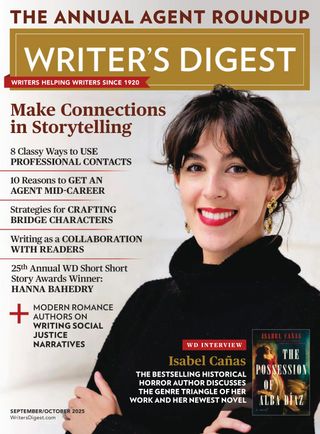

Denne historien er fra September/October 2025-utgaven av Writer’s Digest.
Abonner på Magzter GOLD for å få tilgang til tusenvis av kuraterte premiumhistorier og over 9000 magasiner og aviser.
Allerede abonnent? Logg på
FLERE HISTORIER FRA Writer’s Digest
Writer’s Digest
Fate and Prophesy
Defying destiny may be just as hazardous as succumbing to it.”

5 mins
May / June 2026

Writer’s Digest
How to Pitch in Person Without Losing the Plot
Conference-ready tips to make sure your story stands out.
5 mins
May / June 2026
Writer’s Digest
How to Handle Money as a Writer
That is, in case you actually make any ...
8 mins
May / June 2026

Writer’s Digest
Dress Your Manuscript for the Job You Want It to Have
Dress Your Manuscript for the Job You Want It to Have How often have you heard the adage “dress for the job you want”? Probably often enough that it’s a cliché.
5 mins
May / June 2026

Writer’s Digest
Mike Chen
The award-winning science-fiction author discusses the importance of fandom, writing for IP giants like Star Wars, and tackling his biggest project yet: a space opera.
13 mins
May / June 2026
Writer’s Digest
Outlaw Openers
There was a time when starting a sentence with And, But, or So felt like breaking the law.
2 mins
May / June 2026
Writer’s Digest
Collaborate to Create
Why co-authoring nonfiction is a pro strategy worth considering.
7 mins
May / June 2026
Writer’s Digest
The Life-Changing Magic of Tidying Up Your Writing Portfolio
Creating an organized online home for your nonfiction writing samples gives you a strategic advantage.
5 mins
May / June 2026
Writer’s Digest
20 Elevator Pitches for Recently Published Books
One of the most important professional skills an author can develop is the ability to craft an enticing elevator pitch for their book.
5 mins
May / June 2026
Writer’s Digest
On Writing & Newsroom Autobiography
Today, the rise of 24-hour cable news has dramatically reshaped how we consume information.
2 mins
May / June 2026
Listen
Translate
Change font size