
Gå ubegrenset med Magzter GOLD
Få ubegrenset tilgang til over 9000 magasiner, aviser og premiumhistorier for bare
Unfair fields of cotton
Down To Earth
|February 16, 2021
Asymmetric World Trade Organization rules that allow the US to inflate its cotton subsidies, much to the peril of farmers in India and elsewhere, must be reformed

Cotton bales being loaded at a farm in the US. Large-scale farmers and corporations garner most of the cotton subsidies provided by the US government
COTTON SUBSIDIES have remained a contentious issue in international trade and negotiations at the World Trade Organization (WTO). Farmers of developing and least developed countries (ldcs) complain that the massive support provided by developed countries, especially the US, has rendered cotton production uncompetitive in the Global South, leading to a disastrous impact on agricultural growth, export earnings, and farmers’ welfare. The impact is particularly palpable in countries like India, where the crop plays a crucial role in livelihood, poverty reduction, and agriculture development. Hence, the implications of the US’ massive support to its cotton farmers and the failure of WTO rules in disciplining cotton subsidies merit a discussion.
Let’s compare the US and India. The US has some 8,100 cotton farmers with an average farm size of 624 hectares (ha). By comparison, India has 9 million cotton farmers with an average farm size of 1.2 ha. Despite the prevalence of small and fragmented landholdings, the cost of cultivation here is less than that of the US. Yet, the US is a significant player in global cotton production and exports. In 2020, its share in global production was 14.5 percent; with 85 percent of output exported, the US’ share in global exports was even higher—35 percent.
The artificial comparative advantage the US enjoys can be gauged from the fact that its performer cotton support is a massive $1,17,494 compared to India’s $27 (see “Cotton shocks”, p56).
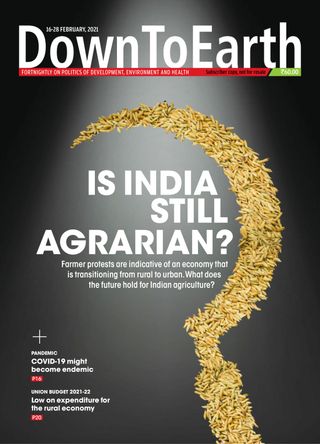

Denne historien er fra February 16, 2021-utgaven av Down To Earth.
Abonner på Magzter GOLD for å få tilgang til tusenvis av kuraterte premiumhistorier og over 9000 magasiner og aviser.
Allerede abonnent? Logg på
FLERE HISTORIER FRA Down To Earth
Down To Earth
KING OF BIRDS
Revered for centuries, western tragopan now needs protection as its forests shrink, human pressures mount

3 mins
December 16, 2025

Down To Earth
WHISKERS ALL AQUIVER
Climate change threatens creatures that have weathered extreme environments for thousands of years
2 mins
December 16, 2025

Down To Earth
GOLDEN SPIRIT
Survival of the shy primate is closely tied to the health of Western Ghats
3 mins
December 16, 2025

Down To Earth
RINGED EYES IN THE CANOPY
Rapid habitat destruction forces arboreal langur to alter habits
2 mins
December 16, 2025

Down To Earth
HANGING BY THE CLIFF
The Himalaya's rarest wild goat is on the brink of local extinction
2 mins
December 16, 2025

Down To Earth
ANGEL OF THE BEAS
Conservation reserves, citizen science, and habitat protection give the Indus River dolphin a fighting chance in India
2 mins
December 16, 2025

Down To Earth
UNDER MOONLIT SCRUB
Survival of this hidden guardian tells us whether our scrublands still breathe
2 mins
December 16, 2025

Down To Earth
SYMBOL OF SILENT VALLEY
Lion-tailed macaque remains vulnerable despite past victories
2 mins
December 16, 2025

Down To Earth
THE APE IN OUR STORIES
India's only non-human ape species is a cultural icon threatened by forest fragmentation
2 mins
December 16, 2025

Down To Earth
SENTINEL OF THE HIGH COLD DESERT
The bird's evocative call may not continue to roll across the cold desert valley for long
3 mins
December 16, 2025
Translate
Change font size