
استمتع بـUnlimited مع Magzter GOLD
احصل على وصول غير محدود إلى أكثر من 9000 مجلة وصحيفة وقصة مميزة مقابل
يحاول ذهب - حر
Unfair fields of cotton
February 16, 2021
|Down To Earth
Asymmetric World Trade Organization rules that allow the US to inflate its cotton subsidies, much to the peril of farmers in India and elsewhere, must be reformed

Cotton bales being loaded at a farm in the US. Large-scale farmers and corporations garner most of the cotton subsidies provided by the US government
COTTON SUBSIDIES have remained a contentious issue in international trade and negotiations at the World Trade Organization (WTO). Farmers of developing and least developed countries (ldcs) complain that the massive support provided by developed countries, especially the US, has rendered cotton production uncompetitive in the Global South, leading to a disastrous impact on agricultural growth, export earnings, and farmers’ welfare. The impact is particularly palpable in countries like India, where the crop plays a crucial role in livelihood, poverty reduction, and agriculture development. Hence, the implications of the US’ massive support to its cotton farmers and the failure of WTO rules in disciplining cotton subsidies merit a discussion.
Let’s compare the US and India. The US has some 8,100 cotton farmers with an average farm size of 624 hectares (ha). By comparison, India has 9 million cotton farmers with an average farm size of 1.2 ha. Despite the prevalence of small and fragmented landholdings, the cost of cultivation here is less than that of the US. Yet, the US is a significant player in global cotton production and exports. In 2020, its share in global production was 14.5 percent; with 85 percent of output exported, the US’ share in global exports was even higher—35 percent.
The artificial comparative advantage the US enjoys can be gauged from the fact that its performer cotton support is a massive $1,17,494 compared to India’s $27 (see “Cotton shocks”, p56).
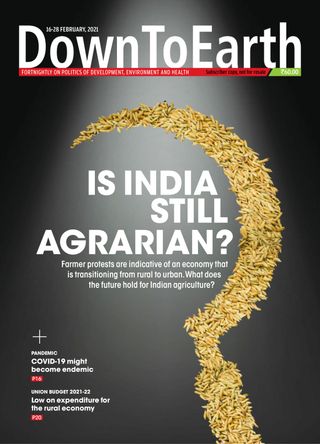

هذه القصة من طبعة February 16, 2021 من Down To Earth.
اشترك في Magzter GOLD للوصول إلى آلاف القصص المتميزة المنسقة، وأكثر من 9000 مجلة وصحيفة.
هل أنت مشترك بالفعل؟ تسجيل الدخول
المزيد من القصص من Down To Earth

Down To Earth
MILES TO GO
As impacts of climate change accelerate, climate finance remains trapped in incrementalism

6 mins
April 16, 2026

Down To Earth
Hope for revival of the great Indian bustard
The birth of a great Indian bustard chick in the Kutch region of Gujarat has created history in the world of conservation, reviving hope.
2 mins
April 16, 2026
Down To Earth
IN MAHUA TERRITORY
Once mahua starts to flower, every thing else takes a back seat for tribal communities in forests of central India
6 mins
April 16, 2026

Down To Earth
CAUGHT IN THE ENERGY GAP
Kitchens across rural India reflect a peculiar reality: energy is within reach but affordability remains a concern. PUJA DAS travels across 15 villages in Madhya Pradesh, Chhattisgarh and Uttar Pradesh to investigate why rural households still rely on traditional fuels like firewood, dung cakes and crop residue that pose a health risk, and why their energy bills are rising.
12 mins
April 16, 2026
Down To Earth
Lake or wetland?
While villages around Almora's Tadag Tal want the seasonal lake to be developed into a perennial waterbody, experts say the area is a wetland and should not be disturbed
5 mins
April 16, 2026

Down To Earth
World far from curbing maternal deaths
INDIA HAS cut its maternal mortality ratio (MMR) by 80 per cent since 1990, according to a recent analysis published in The Lancet.
1 min
April 16, 2026
Down To Earth
Energy in times of war
THE DISASTROUS US-Israel war against Iran has disrupted energy supply across the world. Governments in both rich and poor countries are warning their people of dire times ahead, unlike anything seen before by this generation: acute energy scarcity, rationing and even the prospect of cars and aeroplanes running out of fuel. The question is what will the future energy map look like?
3 mins
April 16, 2026

Down To Earth
Unfinished business
Land consolidation is globally considered a critical component of land reforms and holds the key to improve agrarian productivity. But it is yet to be undertaken in meaningful ways in most parts of the country, reports
6 mins
April 16, 2026

Down To Earth
Roots of revival
Chhattisgarh's Baiga community mounts conservation efforts to keep alive a traditional art form at risk of vanishing due to ecological changes
2 mins
April 16, 2026
Down To Earth
A mass human capital loss
ADULT HEIGHT across countries, including India, is no longer increasing.
2 mins
April 16, 2026
Translate
Change font size