Prøve GULL - Gratis
Google's Moonshot Factory
The Atlantic
|November 2017
What the secretive Silicon Valley lab can teach America about the science of breakthroughs and the lost art of invention

A snake-robot designer, a balloon scientist, a liquid-crystals technologist, an extra dimensional physicist, a psychology geek, an electronic-materials wrangler, and a journalist walk into a room. The journalist turns to the assembled crowd and asks: Should we build houses on the ocean?
The setting is X, the so-called moonshot factory at Alphabet, the parent company of Google. And the scene is not the beginning of some elaborate joke. The people in this room have a particular talent: They dream up far-out answers to crucial problems. The dearth of housing in crowded and productive coastal cities is a crucial problem. Oceanic residences are, well, far-out. At the group’s invitation, I was proposing my own moonshot idea, despite deep fear that the group would mock it.
Like a think-tank panel with the instincts of an improve troupe, the group sprang into an interrogative frenzy. “What are the specific economic benefits of increasing housing supply?” the liquid-crystals guy asked. “Isn’t the real problem that transportation infrastructure is so expensive?” the balloon scientist said. “How sure are we that living in densely built cities makes us happier?” the extra dimensional physicist wondered. Over the course of an hour, the conversation turned to the ergonomics of Tokyo’s high-speed trains and then to Americans’ cultural preference for suburbs. Members of the team discussed common sense solutions to urban density, such as more money for transit, and eccentric ideas, such as acoustic technology to make apartments soundproof and self-driving housing units that could park on top of one another in a city center. At one point, teleportation enjoyed a brief hearing.
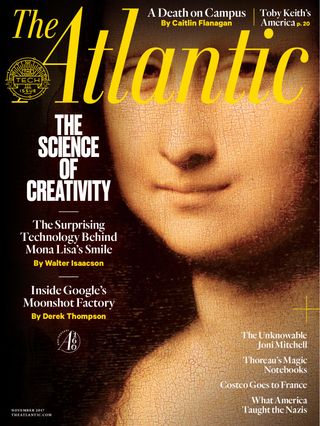

Denne historien er fra November 2017-utgaven av The Atlantic.
Abonner på Magzter GOLD for å få tilgang til tusenvis av kuraterte premiumhistorier og over 9000 magasiner og aviser.
Allerede abonnent? Logg på
FLERE HISTORIER FRA The Atlantic

The Atlantic
You Had to Be There
An emerging field of history asks if we can ever really understand how our forebears experienced love, anger, fear, and sorrow.

23 mins
January 2026

The Atlantic
By the Horns
The week before the biggest bullfight of her career, in Cádiz, Spain, this past July, 24-year-old Miriam Cabas posted a carefully produced video on Instagram.
1 mins
January 2026

The Atlantic
The New German War Machine
After World War II, Germany embraced pacifism as a form of atonement. Now the country is arming itself again.
18 mins
January 2026
The Atlantic
The Eloquence
The prime minister was watching a disaster movie when we found him.
4 mins
January 2026

The Atlantic
What's for Dinner, Mom?
The women who want to change the way America eats
12 mins
January 2026

The Atlantic
How Terror Works
A 1947 German novel explores the sometimes corrosive, sometimes energizing nature of fear.
8 mins
January 2026

The Atlantic
Yesterday's Idea of a Modern Man
Sam Shepard, a self-made cowboy, was also a poet of masculine angst.
7 mins
January 2026

The Atlantic
ACCOMMODATION NATION
America's colleges have an extra-time-on-tests problem.
11 mins
January 2026

The Atlantic
Respect the Drummer
A new history of rock, told through its overlooked heroes
5 mins
January 2026

The Atlantic
THE MOST POWERFUL MAN IN SCIENCE
WHY IS ROBERT F. KENNEDY JR. SO CONVINCED HE'S RIGHT?
42 mins
January 2026
Translate
Change font size