Versuchen GOLD - Frei
Google's Moonshot Factory
The Atlantic
|November 2017
What the secretive Silicon Valley lab can teach America about the science of breakthroughs and the lost art of invention

A snake-robot designer, a balloon scientist, a liquid-crystals technologist, an extra dimensional physicist, a psychology geek, an electronic-materials wrangler, and a journalist walk into a room. The journalist turns to the assembled crowd and asks: Should we build houses on the ocean?
The setting is X, the so-called moonshot factory at Alphabet, the parent company of Google. And the scene is not the beginning of some elaborate joke. The people in this room have a particular talent: They dream up far-out answers to crucial problems. The dearth of housing in crowded and productive coastal cities is a crucial problem. Oceanic residences are, well, far-out. At the group’s invitation, I was proposing my own moonshot idea, despite deep fear that the group would mock it.
Like a think-tank panel with the instincts of an improve troupe, the group sprang into an interrogative frenzy. “What are the specific economic benefits of increasing housing supply?” the liquid-crystals guy asked. “Isn’t the real problem that transportation infrastructure is so expensive?” the balloon scientist said. “How sure are we that living in densely built cities makes us happier?” the extra dimensional physicist wondered. Over the course of an hour, the conversation turned to the ergonomics of Tokyo’s high-speed trains and then to Americans’ cultural preference for suburbs. Members of the team discussed common sense solutions to urban density, such as more money for transit, and eccentric ideas, such as acoustic technology to make apartments soundproof and self-driving housing units that could park on top of one another in a city center. At one point, teleportation enjoyed a brief hearing.
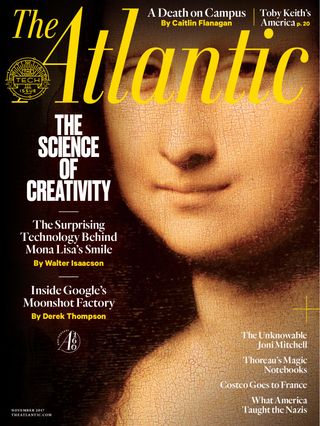

Diese Geschichte stammt aus der November 2017-Ausgabe von The Atlantic.
Abonnieren Sie Magzter GOLD, um auf Tausende kuratierter Premium-Geschichten und über 9.000 Zeitschriften und Zeitungen zuzugreifen.
Sie sind bereits Abonnent? Anmelden
WEITERE GESCHICHTEN VON The Atlantic

The Atlantic
Deadlier Than Gettysburg
How the cruelty of the Confederacy's prison camps gave rise to the rules of war

10 mins
March 2026

The Atlantic
THE MAN WHO BROKE PHYSICS
One of the pleasures of watching Ilia Malinin, apart from his indifference to gravity, is to witness him becoming.
16 mins
March 2026

The Atlantic
How Toni Morrison Saw History
In her novels, she located the missing story of Black America.
12 mins
March 2026

The Atlantic
The Madness of Lord Tennyson
The Victorian poet was startlingly modern.
5 mins
March 2026

The Atlantic
THE PLOT AGAINST THE HUMANITIES
What is the Andrew W. Mellon Foundation doing to higher education?
22 mins
March 2026

The Atlantic
Why Do Democrats Hate Winning?
Ken Martin has one of those resting dread faces, as if he's bracing for someone to dump a bucket of rocks on his head.
37 mins
March 2026

The Atlantic
ROD DREHER'S DEMONS
HE DERIDES THE ENLIGHTENMENT, SECULARISM, AND THE MODERN WORLD. CONSERVATIVES-INCLUDING THE VICE PRESIDENT-ARE JOINING HIM ON A MARCH BACK TO THE MIDDLE AGES.
20 mins
March 2026

The Atlantic
Every Nation for Itself
President Trump wants to return to the 19th century's international order. He will leave America less prosperous—and the whole world less secure.
19 mins
March 2026

The Atlantic
The Secrets of Indigenous Art
Major exhibits are upending the way people understand Native American and Aboriginal artists.
14 mins
March 2026

The Atlantic
The Novel as Extended Op-Ed
If anyone could write good fiction about immigration, it would probably be Lionel Shriver. Instead, her latest book goes off the rails.
10 mins
March 2026
Translate
Change font size