Prøve GULL - Gratis
SYNTHESIZING THE PRECIOUS METALS
Rock&Gem Magazine
|February 2020
Gold, silver, and platinum.

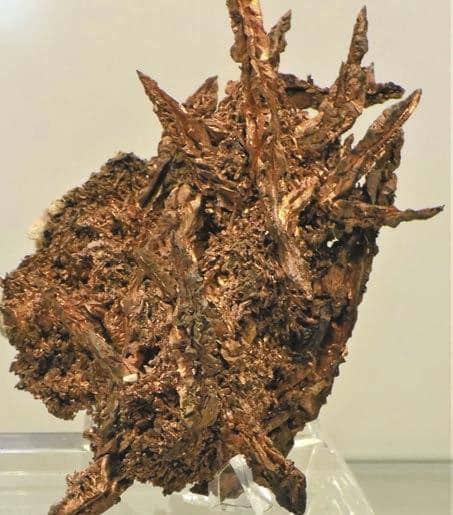
The big three of the precious metals realm. They are rare, beautiful, expensive, and typically smaller-sized specimens are represented in most collections. Most collectors are only able to be awestruck and take pictures of such large cabinet pieces that high-end collectors can possess.
Whether it is for investment purposes or having something akin to owning a Rembrandt or Picasso, it is no secret that precious metals are highly sought after. Despite their beauty and high value, it seems like the true scientific value of the precious metals tends to be overlooked. With that, we shall dive into the true origins of these prized metals, and how their placement on the Periodic Table not only makes them precious, but rather unusual!
EXPLORING NUCLEOSYNTHESIS
As with any other chemical element, the precious metals were born billions of years ago when our galaxy began to take shape with the Big Bang. Element nuclei are synthesized in the center of stars at temperatures of millions of degrees and a level of pressure that makes forming diamonds in laboratories sound like a cakewalk; a process known as stellar nucleosynthesis. Atoms of hydrogen and helium, the simplest two elements by atomic number and what comprises 99% of the universe, are fused to build bigger nuclei of increasing atomic number.
This process within stars continues until the iron is synthesized (atomic number 26), wherein iron nuclei are so tightly bound that fusion cannot continue at existing temperatures and pressures. Secondly, the fusion of iron atoms does not produce additional energy, as a byproduct, as lighter elements do. Without a continuous energy (or fuel) source, a star’s days become numbered where a supernova will soon follow.
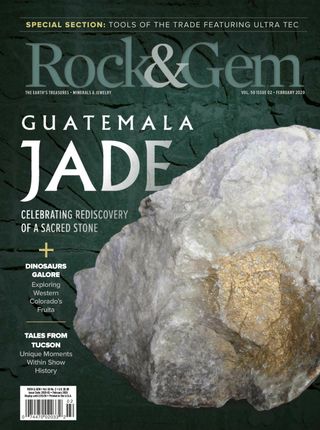

Denne historien er fra February 2020-utgaven av Rock&Gem Magazine.
Abonner på Magzter GOLD for å få tilgang til tusenvis av kuraterte premiumhistorier og over 9000 magasiner og aviser.
Allerede abonnent? Logg på
FLERE HISTORIER FRA Rock&Gem Magazine

Rock&Gem Magazine
A New Amber Locality Fills a Gap
A sandstone quarry in central Ecuador has yielded the first significant deposit of Mesozoic amber from South America.

1 min
January / February 2026

Rock&Gem Magazine
Did "Left-Handed" Fish Leave Water Earlier than Thought?
Fossil evidence suggests that fish (or \"fishapods\") dragged themselves onto land during the middle Devonian Period.
1 min
January / February 2026

Rock&Gem Magazine
"Lab Quakes” Produce Surprising Results
When faults let loose and earthquakes result, the main effect we mortals experience is the violent shaking.
1 min
January / February 2026
Rock&Gem Magazine
This Egg is No Spring Chicken
How to date a dino egg
1 min
January / February 2026

Rock&Gem Magazine
Have we Already Mined the Critical Minerals We Need
Then why are we throwing them away?!
1 min
January / February 2026
Rock&Gem Magazine
One Toxic Worm
A critter that creates & tolerates orpiment!
1 min
January / February 2026

Rock&Gem Magazine
ROCK & GEM FIELD GUIDE: Silver
Silver (Ag) is a native element and one of Earth's most prized precious metals.
2 mins
January / February 2026
Rock&Gem Magazine
DINOSAURS OF THE HELL CREEK MUSEUM
In the Badlands of South Dakota, just outside the small town of Belle Fourche—pronounced “Bell Foosh”—a new attraction has taken shape that every dinosaur enthusiast should see. The Dinosaurs of the Hell Creek Museum is part hands-on exhibit, part science center and part active research lab.
3 mins
January / February 2026
Rock&Gem Magazine
The Lost Twins of Kongsberg
A Silver Story Resurfaced
3 mins
January / February 2026

Rock&Gem Magazine
Switzerland's ICE PALACE
Walk Inside a Glacier at The Top of Europe
7 mins
January / February 2026
Translate
Change font size