Prøve GULL - Gratis
How to Detect and Manage Groundwater Resources
Farmer's Weekly
|10 March 2017
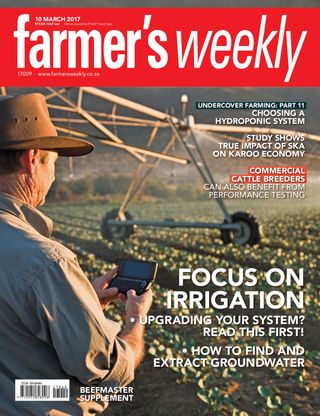
Most of South Africa’s water comes from groundwater reserves, according to Frans Putter, a geologist from Potchefstroom. Annelie Coleman spoke to him about groundwater exploration.

Population growth and climate change are likely to have significant financial, socio-economic and ecological consequences for already scarce water resources. Most of South Africa’s water supply comes from groundwater sources, and almost two-thirds of the population depend on it for domestic water needs, according to the Department of Water and Sanitation (DWS).
“Groundwater is an essential freshwater resource and forms a critical buffer during periods of drought,” says registered professional geologist, Frans Putter, owner of Putter Geological Services.
LEGISLATION
Groundwater is utilised for a range of purposes, including irrigation, household use and general agriculture.
In South Africa, water use is governed by the National Water Act (No. 36 of 1998).
The purpose of the act is to ensure sustainable use of water for the benefit of all users.
No permission is needed to drill or register a bore hole. However, once a bore hole has been drilled and water found, the water use needs to be registered in terms of the act, according to Frans.
“However, the requirement to register the water use or not is based on the intended uses and limits. In terms of current SA legislation, reasonable use of groundwater taken from an aquifer on a property for, among others, domestic use, small scale gardening not earmarked for commercial purposes, and watering of animals don’t have to be registered.” Should a person use more than 10 kilolitres of groundwater / day (10 000â„“/day) for a ‘non- commercial small garden’, water use should be registered. This use nevertheless falls within the ambit of the so-called ‘general authorisation’, provided for by existing legislation, and serves as blanket permission. No licence is consequently needed, he explains.

Denne historien er fra 10 March 2017-utgaven av Farmer's Weekly.
Abonner på Magzter GOLD for å få tilgang til tusenvis av kuraterte premiumhistorier og over 9000 magasiner og aviser.
Allerede abonnent? Logg på
FLERE HISTORIER FRA Farmer's Weekly
Farmer's Weekly
How AFGRI uses technology to unlock farm finance from asset to market
As modern farming becomes more capital-intensive and digitally driven, AFGRI is reinventing agricultural finance by linking technology directly to lending decisions.

5 mins
January 16-23, 2026

Farmer's Weekly
Adele's Mohair: a living tapestry of craft, colour and rural heritage
Octavia Avesca Spandiel spoke to Adele Cutten, founder of Adele's Mohair, to explore how a small spinning experiment grew into a thriving rural craft enterprise rooted in South Africa's rich mohair heritage.
6 mins
January 16-23, 2026
Farmer's Weekly
Cannabis and marketing in South Africa
The path from cultivation to commercial success remains complicated by regulatory ambiguity. Cultivators who master compliant marketing while delivering verifiable quality will build sustainable businesses, says Thomas Walker.
2 mins
January 16-23, 2026
Farmer's Weekly
Foot-and-mouth disease project targets waste reduction and regulatory reform
A groundbreaking research collaboration between Red Meat Industry Services, the University of Pretoria, and global animal health leader Zoetis is aiming to transform South Africa's approach to foot-and-mouth disease.
3 mins
January 16-23, 2026
Farmer's Weekly
What to expect in 2026
The world faces a complex interplay of economic, geopolitical, environmental, technological, and social pressures.
3 mins
January 16-23, 2026

Farmer's Weekly
How drones are revolutionising pest and disease detection in agriculture
Drones are reshaping modern crop protection by giving farmers a powerful new vantage point: the sky. With advanced sensors, high-resolution imaging, and artificial intelligence-driven analytics, these unmanned aerial vehicles can detect early signs of disease, water stress, and pest damage long before the human eye can. Jedrie Harmse spoke to agricultural drone specialist Monique Heydenrych.
7 mins
January 16-23, 2026
Farmer's Weekly
Generic advertising in perspective
Dr Koos Coetzee explains how industry organisations and the agriculture sector actually have the ability to prudently manage the negative perceptions surrounding generic advertising campaigns.
2 mins
January 16-23, 2026
Farmer's Weekly
The modern Merino: the benchmark breed
The Merino breed has transformed dramatically over the past seven decades-from the skin-folded wool specialists of the 1950s to today's plain-bodied, fertile, well-balanced sheep prized for their dual-purpose productivity. Yet, despite its versatility, myths persist. Willie van Heerden, manager at Merino South Africa, dispels some of these myths.
2 mins
January 16-23, 2026

Farmer's Weekly
Elsenburg Agricultural Training Institute celebrates excellence
The Elsenburg Agricultural Training Institute marked a major milestone in December 2025, conferring over 200 agricultural qualifications, including bachelor's degrees and various national certificates.
2 mins
January 16-23, 2026
Farmer's Weekly
Grain SA issues guidelines as poor-quality agri inputs threaten farmers livelihoods
Grain SA has urged South African grain and oilseed farmers to act fast when seeds, fertilisers, or agrochemicals underperform, providing clear guidelines to protect crops.
2 mins
January 16-23, 2026
Translate
Change font size