Essayer OR - Gratuit
How to Detect and Manage Groundwater Resources
Farmer's Weekly
|10 March 2017
Most of South Africa’s water comes from groundwater reserves, according to Frans Putter, a geologist from Potchefstroom. Annelie Coleman spoke to him about groundwater exploration.

Population growth and climate change are likely to have significant financial, socio-economic and ecological consequences for already scarce water resources. Most of South Africa’s water supply comes from groundwater sources, and almost two-thirds of the population depend on it for domestic water needs, according to the Department of Water and Sanitation (DWS).
“Groundwater is an essential freshwater resource and forms a critical buffer during periods of drought,” says registered professional geologist, Frans Putter, owner of Putter Geological Services.
LEGISLATION
Groundwater is utilised for a range of purposes, including irrigation, household use and general agriculture.
In South Africa, water use is governed by the National Water Act (No. 36 of 1998).
The purpose of the act is to ensure sustainable use of water for the benefit of all users.
No permission is needed to drill or register a bore hole. However, once a bore hole has been drilled and water found, the water use needs to be registered in terms of the act, according to Frans.
“However, the requirement to register the water use or not is based on the intended uses and limits. In terms of current SA legislation, reasonable use of groundwater taken from an aquifer on a property for, among others, domestic use, small scale gardening not earmarked for commercial purposes, and watering of animals don’t have to be registered.” Should a person use more than 10 kilolitres of groundwater / day (10 000â„“/day) for a ‘non- commercial small garden’, water use should be registered. This use nevertheless falls within the ambit of the so-called ‘general authorisation’, provided for by existing legislation, and serves as blanket permission. No licence is consequently needed, he explains.
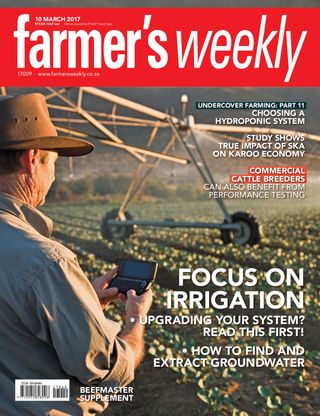

Cette histoire est tirée de l'édition 10 March 2017 de Farmer's Weekly.
Abonnez-vous à Magzter GOLD pour accéder à des milliers d'histoires premium sélectionnées et à plus de 9 000 magazines et journaux.
Déjà abonné ? Se connecter
PLUS D'HISTOIRES DE Farmer's Weekly
Farmer's Weekly
What to expect in 2026
The world faces a complex interplay of economic, geopolitical, environmental, technological, and social pressures.

3 mins
January 16-23, 2026

Farmer's Weekly
Elsenburg Agricultural Training Institute celebrates excellence
The Elsenburg Agricultural Training Institute marked a major milestone in December 2025, conferring over 200 agricultural qualifications, including bachelor's degrees and various national certificates.
2 mins
January 16-23, 2026
Farmer's Weekly
Grain SA issues guidelines as poor-quality agri inputs threaten farmers livelihoods
Grain SA has urged South African grain and oilseed farmers to act fast when seeds, fertilisers, or agrochemicals underperform, providing clear guidelines to protect crops.
2 mins
January 16-23, 2026
Farmer's Weekly
Vegetable price trends as we enter the new year
This analysis by Zama Sangweni explores how five key vegetable commodities, cabbages, carrots, onions, potatoes, and tomatoes, performed, considering recent supply volumes and consumer demand patterns.
2 mins
January 16-23, 2026
Farmer's Weekly
Joburg Fresh Produce Market needs a 'refresh'
South Africa's fresh produce markets are vital to food security, supplying up to half of the nation's fruit and vegetables. Protecting and modernising these markets is essential for a resilient, equitable food system writes Marc Wegerif, senior lecturer in Development Studies at the University of Pretoria.
4 mins
January 16-23, 2026
Farmer's Weekly
Infrastructure, policy, and finance will be the African continent's growth drivers
Africa's agricultural potential is vast, but inefficiencies in infrastructure, trade policy, and finance limit growth. Investments in transport, cold storage, irrigation, and digital trade systems, among others, are key to unlocking faster, cheaper, and more efficient agricultural trade.
3 mins
January 2-9, 2026

Farmer's Weekly
SAPPO Academy showcases skills development and small business success
The South African Pork Producers' Organisation (SAPPO) Academy, a training organisation that promotes animal, environmental, and public health in the pig industry through knowledge transfer, recently hosted a mini development symposium in Pretoria. The event included an afternoon of meaningful dialogue, strategic learning, and leadership exchange, effectively bridging academic insight with real-world industry innovation.
3 mins
January 2-9, 2026

Farmer's Weekly
Backing for SA Canegrowers as sugar imports soar
Coenie Snyman, winemaker and founder of Rock of Eye Wines, was named the 2025 Diners Club Winemaker of the Year for his Rock of Eye Cabernet Sauvignon 2022, while Marnich Aucamp, assistant winemaker at Stellenbosch Vineyards, won the Young Winemaker of the Year award for his Stellenbosch Vineyards Credo Chenin Blanc 2024 at a gala dinner near Kleinmond in the Western Cape.
1 mins
January 2-9, 2026
Farmer's Weekly
New or used? A practical guide to second-hand farm equipment
Second-hand farm machinery can deliver excellent value, if you know what to look for. Western Cape equipment broker Debbie Smit gave Lindi Botha practical advice to help farmers decide when to buy new, when pre-owned is the smarter choice, and how to avoid the costly pitfalls that often catch buyers off-guard.
4 mins
January 2-9, 2026
Farmer's Weekly
The story of the Drakensberger beef cattle breed's evolution in Africa
The Drakensberger cattle breed has been part of the South African landscape for ages. So-called black indigenous cattle existed in South Africa as early as the 15th and 16th centuries and formed the foundation of the current Drakensberger beef cattle breed.
4 mins
January 2-9, 2026
Translate
Change font size