試す 金 - 無料
How a Tiny Brain Region Guides Generosity
Scientific American
|October 2025
Whether and how much we help others may be determined by the brain's basolateral amygdala
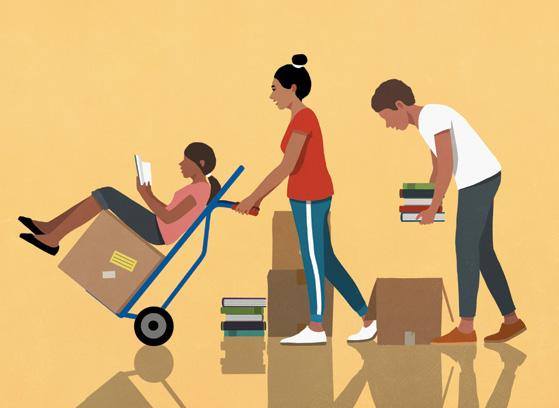
IMAGINE IT'S SATURDAY MORNING. You're sipping coffee when your best friend texts, “Any chance you could help me move today?” You sigh—there go your weekend plans—but reply, “Of course.” That afternoon you sweat as you carry boxes up a flight of stairs.
A week later a coworker you barely know mentions that she’s moving and could really use a hand. This time you hesitate. You are not as quick to offer help even though the request is nearly identical.
Why does generosity come so naturally for those we are close to but feel more like a burden when the recipient is a stranger or mere acquaintance? Psychologists call this tendency “social discounting”: we are generally more willing to make sacrifices for people to whom we feel emotionally close, and our generosity declines as the social or emotional distance to the potential recipient of help increases.
But what happens in the brain when we make these decisions? And why are some people more generous to socially distant individuals than others are? In recent research, my colleagues and I gained new insight into these questions by examining a rare population of individuals with selective damage to a part of the brain called the basolateral amygdala. Our findings suggest that this small but important structure may be essential for calibrating our generosity based on how close or distant others feel to us.
The amygdala, a small, almond-shaped region nestled deep in the brain’s temporal lobe, is traditionally known for its role in processing emotions, especially fear. But over the past few decades it has become clear that the amygdala, particularly its basolateral part, is a central hub in our social brain.

このストーリーは、Scientific American の October 2025 版からのものです。
Magzter GOLD を購読すると、厳選された何千ものプレミアム記事や、10,000 以上の雑誌や新聞にアクセスできます。
すでに購読者ですか? サインイン
Scientific American からのその他のストーリー

Scientific American
Dirty Little Secrets
Extremophile molds are invading art museums and devouring their collections. Stigma and climate change have fueled their spread

16 mins
February 2026
Scientific American
Archaeology Is Reviving the Smell of History
How reconstructing long-lost smells connects us to the past
6 mins
February 2026

Scientific American
Heal Injuries Faster
Toss out the old advice that rest is the best recovery strategy
4 mins
February 2026
Scientific American
Can a Time Capsule Outlast Geology?
A ridiculous but instructive thought experiment involving deep time, plate tectonics, erosion and the slow death of the sun
17 mins
February 2026
Scientific American
Fiery Amoeba
A newfound organism thrives in record-breaking heat
2 mins
February 2026

Scientific American
50, 100 & 150 Years
GIANT ATOMS
3 mins
February 2026
Scientific American
Nature's Tile Shop
Life keeps evolving these geometric patterns
2 mins
February 2026
Scientific American
Battle of the Breeds
A large dataset shows that some dog stereotypes are based in reality, and others might be unfair characterizations
1 min
February 2026
Scientific American
The Milky Way's Disk Keeps Getting Weirder
The disk of our galaxy is not flat but warped and waving
5 mins
February 2026
Scientific American
A Winning Loser
If the cards shown here are rearranged to form four new poker hands of five cards each, what is the low- est possible winning or tying hand?
1 min
February 2026
Listen
Translate
Change font size