
Magzter GOLDで無制限に
10,000以上の雑誌、新聞、プレミアム記事に無制限にアクセスできます。
試す 金 - 無料
Archaeology Is Reviving the Smell of History
Scientific American
|February 2026
How reconstructing long-lost smells connects us to the past
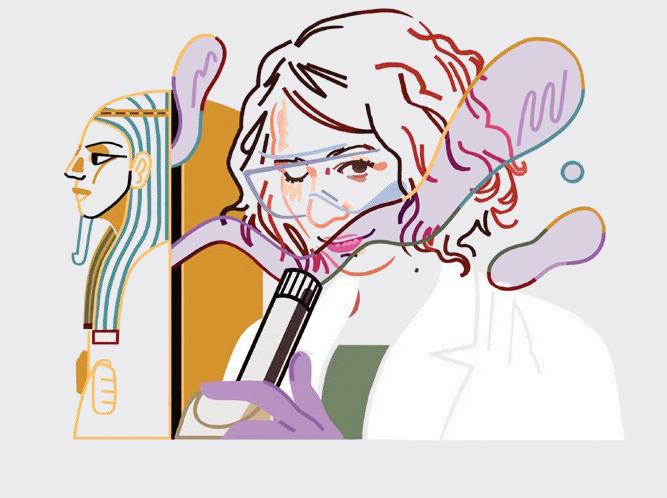
WHAT'S THE FIRST THING YOU NOTICE when you step into a museum? Is it the long-faded colors of ancient artifacts from all around the world or the hushed sounds of visitors discussing what they see? Maybe there's a replica of scratchy old fabric you can touch. Some locations might even offer an edible treat inspired by an ancient recipe. Museums allow us to indirectly experience the past by tapping into our primary senses—sight, hearing, taste, touch—but more often than not, smell is missing.
Representations of the past are often odorless. But smell probably played a huge role in many historical realities, says Barbara Huber, an archaeochemist at the Max Planck Institute of Geoanthropology in Germany. The conspicuous absence of scent in our study of history (not counting the musty tang of many museums) has inspired Huber and a growing community of chemists and archaeologists to track down some molecular remnants that can let us smell the past. For example, she created Scent of the Afterlife, a mix of aromas that captures the range of smells that would have accompanied mummification processes in ancient Egypt. Some of the recent advances in the quest to catch a whiff of history are featured in a new collection co-edited by Huber, Scents of Arabia: Interdisciplinary Approaches to Ancient Olfactory Worlds (Archaeopress, 2025).
SCIENTIFIC AMERICAN spoke to Huber about the “science of smell” and its significance to our understanding of lives long gone. An edited transcript of the interview follows.
We know smell is linked to very specific areas of the brain. What are these areas, and why does that link make olfactory interactions so important throughout history?

このストーリーは、Scientific American の February 2026 版からのものです。
Magzter GOLD を購読すると、厳選された何千ものプレミアム記事や、10,000 以上の雑誌や新聞にアクセスできます。
すでに購読者ですか? サインイン
Scientific American からのその他のストーリー

Scientific American
The Quiet Math Problem That Runs the Planet
How Diffie-Hellman key exchange secures everything from your text messages to government secrets

7 mins
May 2026

Scientific American
The Fog of Science
Did an adversary just invent a world-changing weapon, or are they making it up? DARPA is building an AI to instantly call their bluff
4 mins
May 2026
Scientific American
The Hubble Space Telescope Is Still Awesome
Hubble is going strong despite its decades in space and next-generation successors
4 mins
May 2026

Scientific American
Meet America's Native Bees
Scientists estimate there are about 4,000 species of native bees in the U.S.
5 mins
May 2026

Scientific American
The Chemistry of Desire
Inside the secretive laboratories where scientists build novel molecules to make luxury fragrance feel like pure emotion
5 mins
May 2026
Scientific American
Scanning the Stone
As ore gets harder to find, the mining industry is turning to subatomic-particle sensors to push deep underground
8 mins
May 2026

Scientific American
YOUR HEART IN FLAMES
Inflammation may be the true cause of cardiovascular diseaseand there's a drug to treat it
13 mins
May 2026
Scientific American
Ancient Lexicon
Stone Age art may reveal a 40,000-year-old precursor to writing
2 mins
May 2026

Scientific American
Thermal Breakthrough
A new super heat conductor challenges fundamental physics
2 mins
May 2026
Scientific American
How to Vacation in Space
Planned orbital hotels promise luxury, but can they deliver?
4 mins
May 2026
Listen
Translate
Change font size