
Magzter GOLDで無制限に
10,000以上の雑誌、新聞、プレミアム記事に無制限にアクセスできます。
THE QUEST TO FIND THE EDGE OF THE SOLAR SYSTEM
BBC Science Focus
|November 2025
NASA's newly launched IMAP mission is set to tell us more about the boundary between our Solar System and interstellar space than ever before
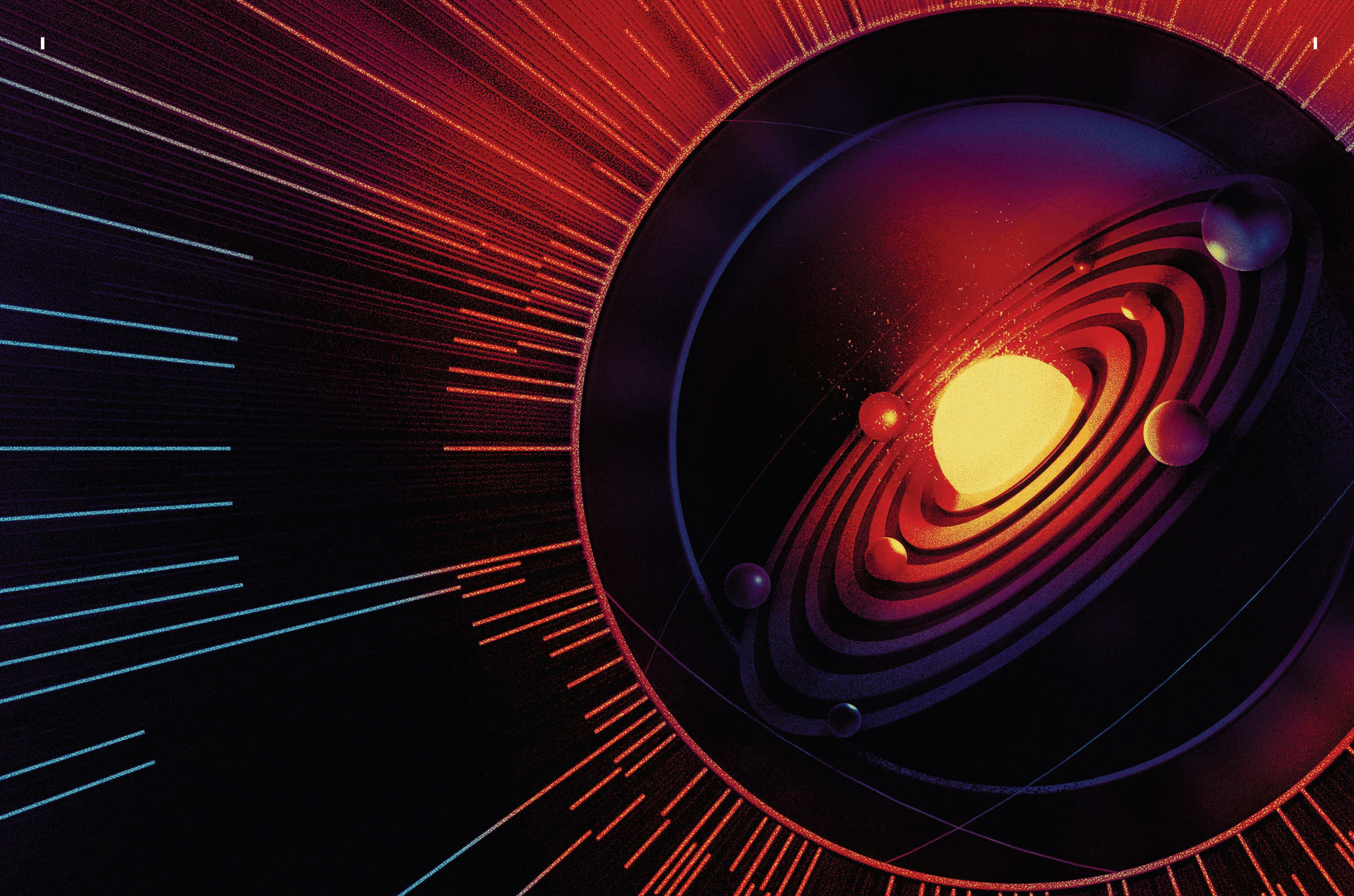
Earth exists in a bubble. Our atmosphere forms a protective barrier between everything on the planet's surface and the near-empty vastness of space. But it's not the only bubble Earth sits inside. Beyond our familiar atmospheric cocoon lies a much larger bubble, an invisible boundary carved by the Sun itself.
This bubble, known as the heliosphere, is enormous. It encompasses the entire Solar System, spanning such a vast distance that only two spacecraft have ever managed to leave it. Launched in 1977, NASA's Voyager 1 and 2 passed beyond the heliosphere into interstellar space – the region between stars – in 2012 and 2018 respectively. They're the first man-made objects to ever travel beyond the Sun's protective bubble, and are still transmitting data about the charged particles and plasma waves that can be found there.
But astronomers want to learn more about the heliosphere and what lies beyond it. What's its exact size and shape? How do solar particles emitted by the Sun interact with interstellar space once they pass through it? And how effective is it at protecting us from the high-energy cosmic rays coming in from outside?
"We're still putting together a lot of pieces about how the local interstellar medium really interacts with the heliosphere," says Dr Ralph McNutt, a physicist at Johns Hopkins University Applied Physics Laboratory (JHUAPL) in Maryland, in the US.
It's hoped a new $782 million (£580 million) NASA mission will help put more of those pieces together. The Interstellar Mapping and Acceleration Probe (IMAP) spacecraft was launched on 24 September 2025. And instead of spending decades travelling to the edge of the heliosphere, over the next few months it'll travel to a position about 1.5 million kilometres (one million miles) from Earth called Lagrange Point 1 (L1). Once there, unhindered by interference from Earth, IMAP can carry out its purpose: study the heliosphere, from afar.
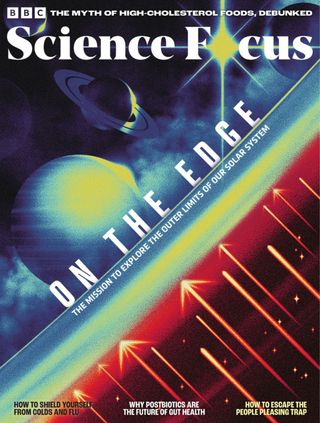

このストーリーは、BBC Science Focus の November 2025 版からのものです。
Magzter GOLD を購読すると、厳選された何千ものプレミアム記事や、10,000 以上の雑誌や新聞にアクセスできます。
すでに購読者ですか? サインイン
BBC Science Focus からのその他のストーリー

BBC Science Focus
HOW UNLIKELY IS OUR UNIVERSE?
Our understanding of the Universe has revealed that its existence, and indeed our own, relies on a particular set of rules.

1 mins
December 2025

BBC Science Focus
DOES YOUR NAME AFFECT YOUR PERSONALITY?
Research is revealing that nominative determinism isn't as easy to dismiss as you might think
5 mins
December 2025
BBC Science Focus
HOW DIFFICULT WOULD IT BE TO FLY THROUGH THE ASTEROID BELT?
In the 1980 film Star Wars: The Empire Strikes Back, Han Solo and friends try to escape pursuing imperial forces by flying through an asteroid field. Droid C-3PO remarks, \"the odds of successfully navigating an asteroid field is approximately 3,720 to 1\". The scene depicts a chaotic, dense field of rocks swirling and spinning through space. This scenario has been played out many times in the cinema.
1 min
December 2025

BBC Science Focus
HOW CAN I BE MORE PERSUASIVE?
Most of us like to think we're rational people. If someone shows us evidence that we're wrong, we'll change our minds, right? Well, not necessarily, because it's not always that simple. Being wrong feels uncomfortable and sometimes threatening. That's why changing someone's mind is often much harder than it seems.
2 mins
December 2025

BBC Science Focus
This bizarre optical illusion could teach us how animals think
By seeing which animals fall for a classic visual trick, scientists are uncovering how different brains make sense of the world
1 mins
December 2025

BBC Science Focus
LIFE AT THE PARTY
The secret that keeps the superagers so sprightly could be socialising
3 mins
December 2025

BBC Science Focus
AIN'T NO MOUNTAIN HIGH ENOUGH
Could an exoskeleton help you scale every peak with ease? Ezzy Pearson straps on some cyborg enhancements to find out
5 mins
December 2025
BBC Science Focus
A slice across the sky
The green flash slicing through the skies in this shot is a fireball.
1 min
December 2025

BBC Science Focus
TB is surging. Should we be worried?
Cases of the world's deadliest infection are climbing in the UK and US. Why is tuberculosis returning and how do we fight back?
4 mins
December 2025

BBC Science Focus
I survived the worst fire in the history of space exploration and had to keep it a secret
Astronaut Jerry Linenger opens up about one of the worst accidents in space, and the cover-up that followed
1 mins
December 2025
Listen
Translate
Change font size