試す 金 - 無料
Brain waves
The Guardian Weekly
|February 24, 2023
Orthodox theories around the causes of dementia have focused on toxic plaques. But some scientists have doggedly pursued the idea that viruses and bacteria could play a role
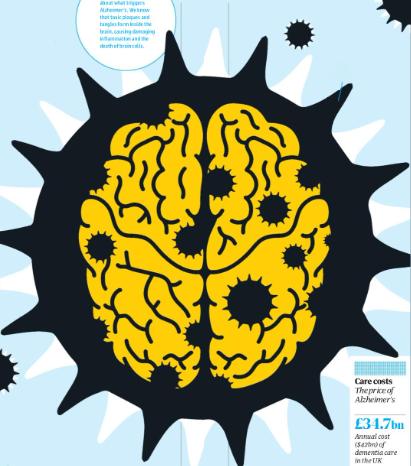
As Davangere Devanand, a neurologist at Columbia University Medical Center, combed through the reams of scientific data on Alzheimer's, he stumbled across a surprising idea - could an infection be involved in driving the disease?
"I was looking for an Alzheimer's treatment approach that had a reasonable shot of working," he says. "I found this old theory, going back 35 years, which linked herpes viruses to the disease, and there were all these indirect lines of evidence."
The further Devanand looked, the more he found. Since the mid-80s, a handful of scientists around the world had doggedly pursued the idea that either a virus or a bacterium could play a role in Alzheimer's, despite almost complete antipathy from those studying more accepted theories about the disease. Colleagues snubbed them, leading scientific journals and conferences rejected their work and funding had been threadbare, but slowly and surely, they built an increasingly compelling case.
In particular, evidence pointed towards herpes simplex virus 1 (HSV-1) - a pathogen found in 70% of the UK population, and the cause of oral herpes as a prominent suspect. Studies in the UK, France and Scandinavia suggested that people who had been infected with herpes were more likely to get Alzheimer's. When Prof Ruth Itzhaki from Oxford University's Institute of Population Ageing - who has done more than any other scientist to advance the HSV-1 theory of Alzheimer's - examined postmortem brain samples from patients, she found greater amounts of the virus's DNA than in people who had not died of the disease.

"Then there was this 2018 study from Taiwan, which was quite dramatic," says Devanand. "When people with herpes were treated with a standard antiviral drug, it decreased their risk of dementia nine-fold."

このストーリーは、The Guardian Weekly の February 24, 2023 版からのものです。
Magzter GOLD を購読すると、厳選された何千ものプレミアム記事や、10,000 以上の雑誌や新聞にアクセスできます。
すでに購読者ですか? サインイン
The Guardian Weekly からのその他のストーリー

The Guardian Weekly
I love when my enemies hate, me
Every day, Hasan Piker broadcasts a marathon Twitch stream, airing his views to 3 million followers. It has led to him becoming one of the biggest voices on the US left. But Piker's online fame has drawn vitriol towards him in real life

10 mins
January 02, 2026
The Guardian Weekly
Baseinstinct Why did Trump order airstrikes on Nigeria?
Claims that Christians face religious persecution overseas have become a major motivating force for Trump's base.
2 mins
January 02, 2026
The Guardian Weekly
Florence's outcasts A vivid and absorbing history of one of the first orphanages in Europe
Joseph Luzzi, a professor at Bard College in New York, is a Dante scholar whose books argue for the relevance of the Italian art and literature of the late middle ages and Renaissance to our own times.
1 mins
January 02, 2026

The Guardian Weekly
Need cheering up after a terrible year? I have just the story for you
Perhaps you are searching for reasons to be cheerful at the end of a particularly dispiriting year and the start of a new one that may well offer more of the same? In that case, read on.
4 mins
January 02, 2026
The Guardian Weekly
N347 Vegetable udon curry
You could also serve this with rice, but if you do, use only half the quantity of dashi, because this curry is made slightly soupier to go with the noodles.
1 mins
January 02, 2026
The Guardian Weekly
Warbling free The app that can tell birds by their songs
When Natasha Walter first became curious about the birds around her, she recorded their songs on her phone and arduously tried to match each song with online recordings.
2 mins
January 02, 2026
The Guardian Weekly
A soundtrack to all of humanity
The Nazis adopted Ode to Joy. Happy Birthday hides a tale of greed. And Putin has turned Shostakovich's Leningrad symphony into a call to arms. Is this the fate of musical utopias?
4 mins
January 02, 2026

The Guardian Weekly
Brigitte Bardot 1934 -2025
France's most sensational cultural export, who on screen epitomised youth, sex and modernity until politics and her campaigns for animal rights took over
3 mins
January 02, 2026

The Guardian Weekly
Who owns space? As the race starts to exploit the cosmos for commercial gains, we must act to preserve it for all humanity
If there is one thing we can rely on in this world, it is human hubris, and space and astronomy are no exception.
3 mins
January 02, 2026
The Guardian Weekly
Food for thought A personally inflected history of psychiatric ideas with flashes of anarchic humour
In 1973, US psychologist David Rosenhan published the results of an experiment.
3 mins
January 02, 2026
Translate
Change font size