試す 金 - 無料
Weaves of Their Lives
Outlook
|March 01, 2024
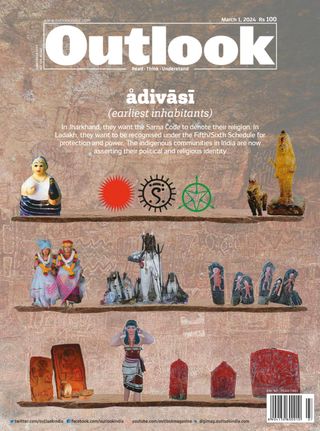
Clothing is inseparably linked to tribal identity. Each tribe has a unique design language. Every embellishment, weave, and motif has a special meaning to the community

A few years ago, a newly-erected statue of Mother Mary at Singpur village in Ranchi district sparked a controversy that echoed across Jharkhand. The reason: Mary was depicted wearing a white saree with a red border. Members of the Sarna Dharm, the faith which many tribes in Jharkhand follow, objected to the saree. Sarna elders threatened to remove the statue from the village unless the attire was changed. Dressing Mother Mary in a red and white saree—worn by Jharkhandi tribal women—was seen as a tactic to convert Sarna tribals to Christianity. The saree, a distinct marker of tribal identity, was weighted with religious and cultural meanings.“Red and white are prominent tribal colours,” says fashion designer Ashish Satyavrat, founder of Ranchi-based Johargram. “In tribal philosophy, red represents blood and sacrifice, and white symbolises peace.”
Clothing—indigenous textiles, weaves, colours, patterns, and motifs—are all inseparably linked to tribal identity. A weave is not just a weave. Stripes, shapes, and patterns are rooted in a tribe’s lived experience. Embellishments like beads, feathers, stones; motifs such as flowers, animals, mountains, or trees—none of these are random choices. Each tribe has its own special design language, which is a rich form of creative expression. It springs from “their mythology, world view, and daily life.”
There is a specific significance to every colour, fabric, weave and motif that a tribe uses. For instance, Assamese tribal textiles feature motifs drawn from the wildlife of Kaziranga, especially the deer and the rhino; the motif of the ‘‘japi’’, a headgear used for protection from the sun; and ‘‘

このストーリーは、Outlook の March 01, 2024 版からのものです。
Magzter GOLD を購読すると、厳選された何千ものプレミアム記事や、10,000 以上の雑誌や新聞にアクセスできます。
すでに購読者ですか? サインイン
Outlook からのその他のストーリー
Outlook
Goapocalypse
THE mortal remains of an arterial road skims my home on its way to downtown Anjuna, once a quiet beach village 'discovered' by the hippies, explored by backpackers, only to be jackbooted by mass tourism and finally consumed by real estate sharks.

2 mins
January 21, 2026

Outlook
A Country Penned by Writers
TO enter the country of writers, one does not need any visa or passport; one can cross the borders anywhere at any time to land themselves in the country of writers.
8 mins
January 21, 2026
Outlook
Visualising Fictional Landscapes
The moment is suspended in the silence before the first mark is made.
1 mins
January 21, 2026
Outlook
Only the Upper, No Lower Caste in MALGUDI
EVERY English teacher would recognise the pleasures, the guilt and the conflict that is the world of teaching literature in a university.
5 mins
January 21, 2026
Outlook
The Labour of Historical Fiction
I don’t know if I can pinpoint when the idea to write fiction took root in my mind, but five years into working as an oral historian of the 1947 Partition, the landscape of what would become my first novel had grown too insistent to ignore.
6 mins
January 21, 2026
Outlook
Conjuring a Landscape
A novel rarely begins with a plot.
6 mins
January 21, 2026

Outlook
The City that Remembered Us...
IN the After-Nation, the greatest crime was remembering.
1 min
January 21, 2026
Outlook
Imagined Spaces
I was talking with the Kudiyattam artist Kapila Venu recently about the magic of eyes.
5 mins
January 21, 2026
Outlook
Known and Unknown
IN an era where the gaze upon landscape has commodified into picture postcards with pristine beauty—rolling hills, serene rivers, untouched forests—the true essence of the earth demands a radical shift.
2 mins
January 21, 2026

Outlook
A Dot in Soot
A splinter in the mouth. Like a dream. A forgotten dream.
2 mins
January 21, 2026
Listen
Translate
Change font size