
Magzter GOLDで無制限に
10,000以上の雑誌、新聞、プレミアム記事に無制限にアクセスできます。
試す 金 - 無料
Modi's Trump Card: Demonetisation
Outlook
|November 21, 2016
Demonetisation is a dramatic Modistroke. And well-timed too, ahead of crucial polls.

It was barely a few hours before his address to the nation on November 8 that Prime Minister Narendra Modi took his cabinet colleagues into confidence about his dramatic decision to demonetise Rs 500 and Rs 1,000 currency notes. All senior cabinet ministers had been told to leave their mobile phones outside: it was in this secured environs that the prime minister shared his ambitious plan to curb black money and corruption with them, one that would be the talking point all over the country for days to come.
It was a momentous decision that sent shock waves down the whole system—as it was intended to do. The late evening announcement, and the narrow window offered before the order was to take effect, meant just about everybody was caught off-guard. Many wondered whether his move to bolster economy would pay off. But, in one fell swoop, Modi had sought to burnish his image as a decisive leader—a man given to big ideas and bold strokes— something that made him a hero of the middle class with a massive electoral mandate two-and-a-half years ago.
And this was an issue that resonated widely with that class. Not just that, there was some serious tactical leverage to be had beyond India’s urban centres and its black money hoards. Significantly, the initiative comes only a few months before crucial assembly polls in Uttar Pradesh and Punjab, where huge amounts of illicit funds are believed to be in circulation.
Sources close to the government let on that the demonetisation policy—pitched as a ‘surgical strike’ against black money, corruption, and fake currency notes that fund terror—was being evolved quietly for over six months. In hindsight, many of Modi’s colleagues in the party and government say there indeed had been straws in the wind about the ‘historic’ decision.
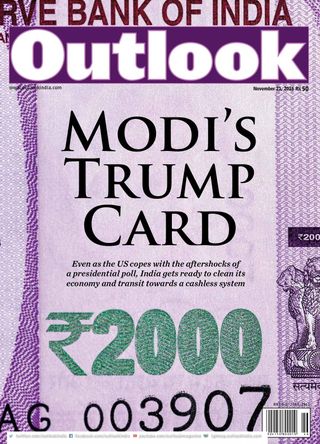

このストーリーは、Outlook の November 21, 2016 版からのものです。
Magzter GOLD を購読すると、厳選された何千ものプレミアム記事や、10,000 以上の雑誌や新聞にアクセスできます。
すでに購読者ですか? サインイン
Outlook からのその他のストーリー

Outlook
Sacred and Sublime
A road trip through Sikkim reveals how prayer flags, meditation caves and mountain monasteries weave Buddhism into the landscape

4 mins
June 22, 2026

Outlook
‘Modern Warfare is Network-centric’
In an exclusive interview with Neeraj Thakur and Saurabh Sharma, former Chief of Defence Staff (CDS) General Anil Chauhan, who recently retired, speaks in rare detail about the unfinished project of military integration, lessons from Operation Sindoor, the future of India’s warfighting strategy and the growing importance of sovereign defence technology.
7 mins
June 22, 2026

Outlook
Balancing Competing Rights
The judgement may lead to more cases being filed concerning “religious character”
5 mins
June 22, 2026

Outlook
“The Impact of AI is Only Beginning”
India’s post-1991 middle-class growth model is reaching a breaking point. Saurabh Mukherjea’s Breakpoint: The Crisis of the Middle Class and the Future of Work examines how technological disruption, stagnant wages, debt and structural weaknesses in education and employment are reshaping Indian society and work. Automation and AI are reducing demand for routine cognitive work, especially in IT services, BPOs, finance and administrative roles. Edited excerpts from an interview with Nabodita Ganguly
7 mins
June 22, 2026

Outlook
Barricade the Border
The BJP's electoral success in West Bengal underlines a significant political shift in the largest state bordering Bangladesh. It is time to fence the border to counter large-scale illegal immigration
6 mins
June 22, 2026

Outlook
‘The Cockroach Always Survives’
It started as a satire.
5 mins
June 22, 2026

Outlook
Social Ailment
Artificial intelligence-based systems are not socially neutral; they are already exposing existing socio-cultural realities
4 mins
June 22, 2026

Outlook
The Transformer
The future of work in India will depend less on whether AI replaces jobs and more on how the country prepares to utilise AI and its workforce to work alongside it
5 mins
June 22, 2026

Outlook
‘Future Wars Will be Multi-domain, AI-driven’
Operation Sindoor marked a significant moment in India’s evolving military doctrine, showcasing growing synergy between the Army, Navy and Air Force across conventional and emerging domains of warfare.
6 mins
June 22, 2026

Outlook
Constitutional Freeze
Why Section 4 of the Places of Worship Act, 1991, does not apply
4 mins
June 22, 2026
Translate
Change font size