試す 金 - 無料
90 Days on the Run or Let Loose?
Outlook
|December 5, 2016
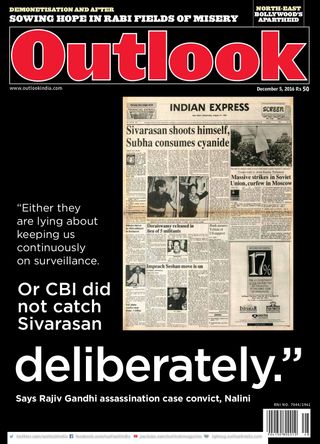
An extract from the chapter ‘Why did the CBI avoid (capturing) sivarasan?’ from Rajiv Gandhi assassination convict Nalini Murugan’s recently released memoir, Rajiv Killing: Forgotten Truths.
-

"WAS it really difficult to capture Sivarasan, the man who was named as the main accused in the case? Or was he a skilful evader?” That is a question which would have occurred to many. If you ask us, we would assert: He could have been easily caught. and it was the CBI’s investigative wing that deliberately tried to portray him as a difficult person to catch.
I am not making this accusation lightly or superficially. To be fair, this is not even my finding. All that I am saying is based on what the CBI has said, the recorded evidence placed before the court, news reports and other important documents. You must read and form your own conclusion.
On the night of May 21, 1991, the assassination of Rajiv Gandhi takes place. The next day itself, May 22, the CBI takes over the case from the Crime Branch CID and appoints a Special Investigation Team. And the hunt for the accused begins.
On May 23, at the Thanjavur bus stand, amidst great drama, they arrest a person by the name of Shankar. The next day, the newspapers carry the story, as given by the police, that Shankar is a member of the Liberation Tigers of Tamil Eelam. The newspaper reports say, “A Liberation Tiger by the name of Shankar had stayed at a lodge in Purasawalkam. His stay was paid for by Sivarasan.” So it is evident that by May 23 itself the CBI was aware of Sivarasan’s name.
This Shankar was the none other than the fourth accused and one among the 26 persons awarded the death sentence. However, he was later released by the court on the ground that “just because he was a Tiger or was in touch with Sivarasan, he cannot be held guilty of the Rajiv Gandhi murder”.

このストーリーは、Outlook の December 5, 2016 版からのものです。
Magzter GOLD を購読すると、厳選された何千ものプレミアム記事や、10,000 以上の雑誌や新聞にアクセスできます。
すでに購読者ですか? サインイン
Outlook からのその他のストーリー
Outlook
Goapocalypse
THE mortal remains of an arterial road skims my home on its way to downtown Anjuna, once a quiet beach village 'discovered' by the hippies, explored by backpackers, only to be jackbooted by mass tourism and finally consumed by real estate sharks.

2 mins
January 21, 2026

Outlook
A Country Penned by Writers
TO enter the country of writers, one does not need any visa or passport; one can cross the borders anywhere at any time to land themselves in the country of writers.
8 mins
January 21, 2026

Outlook
Visualising Fictional Landscapes
The moment is suspended in the silence before the first mark is made.
1 mins
January 21, 2026
Outlook
Only the Upper, No Lower Caste in MALGUDI
EVERY English teacher would recognise the pleasures, the guilt and the conflict that is the world of teaching literature in a university.
5 mins
January 21, 2026
Outlook
The Labour of Historical Fiction
I don’t know if I can pinpoint when the idea to write fiction took root in my mind, but five years into working as an oral historian of the 1947 Partition, the landscape of what would become my first novel had grown too insistent to ignore.
6 mins
January 21, 2026

Outlook
Conjuring a Landscape
A novel rarely begins with a plot.
6 mins
January 21, 2026

Outlook
The City that Remembered Us...
IN the After-Nation, the greatest crime was remembering.
1 min
January 21, 2026

Outlook
Imagined Spaces
I was talking with the Kudiyattam artist Kapila Venu recently about the magic of eyes.
5 mins
January 21, 2026

Outlook
Known and Unknown
IN an era where the gaze upon landscape has commodified into picture postcards with pristine beauty—rolling hills, serene rivers, untouched forests—the true essence of the earth demands a radical shift.
2 mins
January 21, 2026

Outlook
A Dot in Soot
A splinter in the mouth. Like a dream. A forgotten dream.
2 mins
January 21, 2026
Translate
Change font size