試す 金 - 無料
Driving Innovation
The Smart Manager
|March - April 2108
The US Patent and Trademark Office describes innovation as “…a word that touches every facet of our everyday culture from business to science and even the arts. Innovation is often associated with creating new things or ideas and includes improving upon old ones too. Businesses around the world have a great need to continuously innovate to stay competitive in the global marketplace and to bring consumers the latest and greatest products and services. But innovation is not defined by just a single event or even a single brilliant idea. Innovation is truly about a process, a series of steps that begins with human imagination and creativity and results in the creation of something of value for society to enjoy.”*
-

Much has been written about innovation, but there is no clarity with respect to many aspects. How do we measure the ROI of ‘coming up with’ and ‘implementing’ a particular innovation?
Companies need a consistent way to determine which ideas or initiatives to invest in and which to pass on. Typically, they use some sort of financial forecasting to help guide this decision, but this thinking is often flawed as these models are filled with assumptions and you really do not know all the ways a breakthrough idea will impact the marketplace. There is no way to model out. Your best bet is to understand how an idea enhances customer experience. If your innovation results in the improvement of any customer experience, then you very likely have a winner on your hands. The Experience Delta (the difference between a present experience and a new one resulting from an innovation) is the currency by which you should view the impact of every new idea. If you cannot clearly articulate the Experience Delta, then you are not likely to be successful in your innovation efforts.
How can companies foster a healthy innovation biome? How can they choose the right set of actions to sustain it?
Innovation starts with leadership. If the leadership of an organization visibly demonstrates that innovation is a priority, that everyone is encouraged to innovate, that the company is willing to continually try new things, and not be deterred by failure, then you can develop a culture that lets you produce one great hit after another. Think of the most innovative companies. Every single one of them has had far more failures than successes, far more misses than hits. But the leaders of these organizations have instilled a culture where risk-taking and trying new things is encouraged.
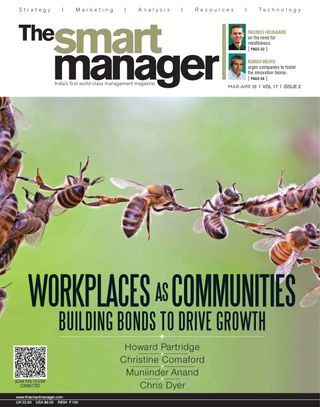

このストーリーは、The Smart Manager の March - April 2108 版からのものです。
Magzter GOLD を購読すると、厳選された何千ものプレミアム記事や、10,000 以上の雑誌や新聞にアクセスできます。
すでに購読者ですか? サインイン
The Smart Manager からのその他のストーリー

The Smart Manager
The Digital Shift
… technology will radically disrupt HR in the near future. Indeed, it is already changing the way HR works and the role it plays and opening the door to a new type of “digital HR” function.1 The rise of digital and social media is changing the dynamics of HR and creating new ways of hiring, engaging, and retaining employees.

4 mins
July-August 2017

The Smart Manager
The Story Of Telling
“The best brands are built on great stories,”* this remark by Ian Rowden best captures the strategy of diligent brand building. Much more than attractive logos or the products themselves, what builds a brand is how successfully a story is woven around it. Brand marketers have to be good storytellers indeed.
8 mins
July-August 2017

The Smart Manager
Complexity Is Simpler Than You Think
Kay Kendall and Glenn Bodinson, authors of Leading the Malcolm Baldrige Way, shatter myths about excellence models such as Baldrige and EFQM.
6 mins
March/April 2017

The Smart Manager
Proponents of Isolation Never Become Victors
Multilateralism in the political and economic space has always led to frameworks that favor the mighty. WTO was no exception. With agriculture kept out of its purview, it could never become a truly fair and free trading system. China was the only large emerging economy that exploited relative openness in low-cost manufactured goods to take full advantage of the system. Other emerging economies could at best garner minor gains.
1 mins
March/April 2017

The Smart Manager
A History Lesson (From Year One) for Trump and the Brexit Crowd: Isolationism Has Never Worked!
Professor Stephane Garelli on growing isolationism.
3 mins
March/April 2017

The Smart Manager
A Win-Win Game
Business is not a sport where some stakeholder has to lose or fare badly for others to do well. Building an atmosphere of trust and transparency between all stakeholders will help companies retain them even during adverse times.
7 mins
March/April 2017

The Smart Manager
A Sustainable Model
With a total market value of $4.3 trillion and an employment base of at least 1.3 million direct employees and millions of others indirectly employed, platforms have become an important economic force.*Companies today are constantly looking for ways to build platforms—Infosys Ltd announced its plans of monetizing its platforms to make them a $2 billion business by March 2021. But are all platform businesses successful?
9 mins
March/April 2017

The Smart Manager
Custom Made
…three in four consumers said they receive too many emails from brands, and one-fifth said they could not handle the current volume…69 per cent have ‘unfollowed’ brands on social media, closed their accounts or cancelled subscriptions.*In these times, when the market is flooded with products and services, the most efficent way to engage customers is to offer them customized content. To achieve this, brands need to focus on observing the nuances of individual preferences.
5 mins
March/April 2017

The Smart Manager
A Fresh Start
Three experts reflect on their experience of pursuing a management development course and how it reshaped their journey.
3 mins
January/February 2017

The Smart Manager
Fighting The Trolls
The number of people who feel bad reviews have the power to make or break their business has risen from 17% (2014) to 21%. * However, most are struggling to find the right solution. Along with the benefits it provides, the internet also has a dark side. Today, it has become a cesspool of hatred where users openly abuse individuals or companies without any hint of shame or guilt. This culture of trolling has tarnished the brand image of several companies. It is time organizations anticipate such situations and design strategies to combat the menace.
5 mins
January/February 2017
Translate
Change font size