
मैगज़्टर गोल्ड के साथ असीमित हो जाओ
10,000 से अधिक पत्रिकाओं, समाचार पत्रों और प्रीमियम कहानियों तक असीमित पहुंच प्राप्त करें सिर्फ
कोशिश गोल्ड - मुक्त
Changing BESS landscape in India
EPR Magazine (Electrical & Power Review)
|December 2024
Self-sufficiency in battery storage is crucial for energy security, cost reduction, and sustainability. Key policies like incentivising domestic lithium mining, supporting R&D in alternative batteries, and promoting manufacturing hubs via PLI is boosting the sector.

Battery energy storage is highly attractive in the Indian market B attractive in the Indian due to the country's rapid renewable energy expansion and need for grid stability. It offers a solution to intermittent power supply by storing solar and wind energy, ensuring reliable electricity access, reducing dependence on fossil fuels, and supporting India's energy transition and sustainability goals.
Heavy import dependency for Battery Energy Storage Systems
In the 2023 financial year, India imported $3.59 billion worth of batteries and accumulators, with $2.6 billion coming from China and $300 million from Hong Kong. India is one of the world's biggest importers of lithium-ion batteries, and imports them from countries like China, Japan, and South Korea.
Lithium cell imports by India have surged in recent years, driven by demand in electronics, electric vehicles, and renewable energy storage. Recent trends indicate high demand due to ambitious renewable energy and EV targets. This dependence highlights the need for domestic manufacturing and raw material sourcing to achieve energy security and economic resilience India faces several challenges with lithium battery imports, impacting its energy and manufacturing sectors. First, dependency on imports increases costs, as India lacks sufficient lithium reserves and relies heavily on countries like China, which dominate the lithium-ion battery supply chain. This dependency exposes India to geopolitical risks and supply chain disruptions, affecting prices and availability. While the government has implemented policies to boost domestic battery production and research, India currently faces a significant supply-demand gap, hampering its renewable energy adoption and electric vehicle expansion goals.
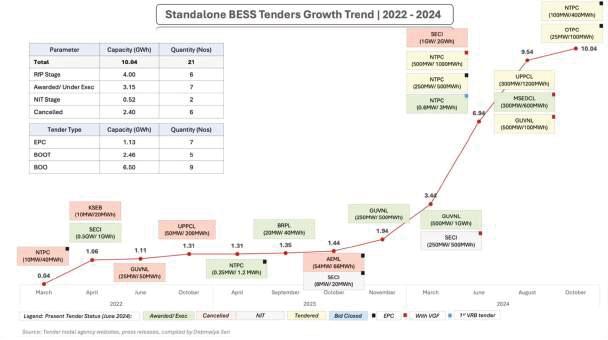 Need for self-sufficiency

यह कहानी EPR Magazine (Electrical & Power Review) के December 2024 संस्करण से ली गई है।
हजारों चुनिंदा प्रीमियम कहानियों और 10,000 से अधिक पत्रिकाओं और समाचार पत्रों तक पहुंचने के लिए मैगज़्टर गोल्ड की सदस्यता लें।
क्या आप पहले से ही ग्राहक हैं? साइन इन करें
EPR Magazine (Electrical & Power Review) से और कहानियाँ
EPR Magazine (Electrical & Power Review)
Low-voltage earthing systems and bonding
Earthing is the connection of a conductive part to the local earth. The connection to the local earth can be intentional, unintentional, or accidental, and permanent or temporary.

5 mins
January 2026

EPR Magazine (Electrical & Power Review)
AEW achieves milestone of 50 lakh+ smart meter deployments
Allied Engineering Works has achieved the milestone of 50 lakh+ smart meter deployments under RDSS. Ashutosh Goel, shares more insights with EPR. Let us hear him.
3 mins
January 2026

EPR Magazine (Electrical & Power Review)
Industry adopts XLPE-based EHV cables for better performance
Polycab has entered a transition phase in its product offerings, aligning with industry trends. Anurag Agarwal shares more with EPR.
2 mins
January 2026

EPR Magazine (Electrical & Power Review)
V Cables offers high-conductivity products, durable insulation for consistent power delivery
The addition of renewables has brought economic benefits for the power industry. Puttaraju Gowda from V Cables shares insights with EPR.
2 mins
January 2026

EPR Magazine (Electrical & Power Review)
NBC Bearings intensifies anti-counterfeiting drive with major raids in Delhi and Bengaluru
Over ₹2 crore in fake bearings and production gear were recovered.
2 mins
January 2026

EPR Magazine (Electrical & Power Review)
K-LITE illuminating landscapes with high-quality architectural luminaires
Operating through state-of-the-art manufacturing facilities, K-LITE focuses on sustainable and energy-efficient LED technology.
1 mins
January 2026

EPR Magazine (Electrical & Power Review)
Renewables at scale demand deeper investments
The growing penetration of renewables into the power ecosystem has raised concerns about grid stability, but has benefited the renewable industry as a whole. The concerns can be addressed through collective efforts by stakeholders and through increasing investment in the sector. Akshay Hirandani from Serentica Renewables expresses his opinion.
2 mins
January 2026
EPR Magazine (Electrical & Power Review)
Integrating AI and sustainable energy for urban power
The integration of Artificial Intelligence (AI) with renewable energy is emerging as a defining force in shaping the future of urban power infrastructure.
1 mins
January 2026

EPR Magazine (Electrical & Power Review)
AMI to energies next phase of power sector revolution in India
Advanced Metering Infrastructure is much more than the replacement of conventional meters with smart meters. It is an integrated system comprising smart meters, communication networks (cellular, RF or PLC), headend systems (HES), meter data management systems (MDMS), and consumer-facing digital platforms.
2 mins
January 2026

EPR Magazine (Electrical & Power Review)
IT ALL BEGAN WITH SMART METERS
Smart metering frameworks, renewable energy integration and data-driven grid management are redefining city power networks.
7 mins
January 2026
Listen
Translate
Change font size