
मैगज़्टर गोल्ड के साथ असीमित हो जाओ
10,000 से अधिक पत्रिकाओं, समाचार पत्रों और प्रीमियम कहानियों तक असीमित पहुंच प्राप्त करें सिर्फ
कोशिश गोल्ड - मुक्त
POWER OF PAAN
Down To Earth
|June 16, 2024
Betel leaves are not just an integral part of India's culture, but also hold many benefits. Add them to your list of healthy greens

THERE WAS a time when heart-shaped leaves of betel (Piper betle) were served after dinner in nearly every household. Panwaris, or paan sellers, would set up shop on street corners and offer customised beedas (quids); or people would just buy the leaves and prepare them at home with ingredients such as areca nut, slaked lime, cardamom, cloves, fennel, saffron, coconut and gulkand (a sweet preserve of rose petals). A beeda after a meal was believed to aid digestion and freshen the breath.
It was so popular that people believed knowing the "correct" way to eat paan was the epitome of cultured life. The saying "Bandar ko diya paan, lagaa roti sa chabaan" (if you give paan to a monkey, he will eat it like a roti) is used to refer to a lack of finesse in behaviour.
However, think of paan nowadays, and it is likely to conjure an image of red spit-covered walls-a mess made by tobacco chewers who use betel leaves to wrap and flavour the intoxicant. Traditionally, the leaf would be chewed and swallowed, but when used with tobacco, the saliva has to be spat out. This practice is considered to have begun around the 16th century when tobacco was introduced in the country by Portuguese invaders.
The name "betel" was also first used in the 16th century by the Portuguese, most probably derived from vetila-the Malay word for leaf. The Malayalam and Tamil names for betel leaf are also similar-sounding, vettila and vettilai, respectively. In Kannada, betel is taamboola, in Manipuri kwa and in Marathi naagavaela.
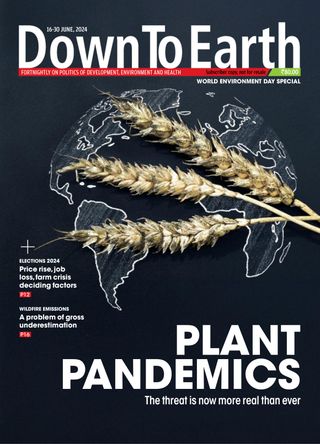

यह कहानी Down To Earth के June 16, 2024 संस्करण से ली गई है।
हजारों चुनिंदा प्रीमियम कहानियों और 10,000 से अधिक पत्रिकाओं और समाचार पत्रों तक पहुंचने के लिए मैगज़्टर गोल्ड की सदस्यता लें।
क्या आप पहले से ही ग्राहक हैं? साइन इन करें
Down To Earth से और कहानियाँ

Down To Earth
THINK TWICE BEFORE FELLING SAL TREES
Many trees considered to be affected by sal borer in the 1990s are still alive today

1 mins
February 16, 2026

Down To Earth
EDGE OF SURVIVAL
Caste divides deny marginalised communities land, resources and essential aid, leaving them more vulnerable to climate disasters
6 mins
February 16, 2026

Down To Earth
A WISH LIST?
Union Budget for 2026-27 conveys the impression of a roll-call of intentions and ambitious proposals, with little detail on their formulation
6 mins
February 16, 2026
Down To Earth
Break down the gender wall
THE RULING National Democratic Alliance (NDA) government has been heavily invested in the goal to make India a developed economy by 2047.
2 mins
February 16, 2026

Down To Earth
MENSTRUAL HEALTH, NOW A FUNDAMENTAL RIGHT
In a landmark judgement, the Supreme Court has recognised menstrual health and hygiene as a fundamental right under Article 21 of the Constitution of India, which guarantees the right to life and dignity.
8 mins
February 16, 2026

Down To Earth
Of devolution and new disasters
The 16th Finance Commission pushes for changes in view of new fiscal and climatic conditions
11 mins
February 16, 2026
Down To Earth
Rising risks of plastics
NEGATIVE IMPACTS on human health due to emissions linked to the plastic lifecycle could double by 2040, according to a study published in The Lancet Planetary Health in January.
1 min
February 16, 2026

Down To Earth
GAP BETWEEN EPIDEMICS NARROWING
A watershed-based and landscape-level approach is needed to address forest degradation
2 mins
February 16, 2026
Down To Earth
WAITING TO STRIKE
Sal heartwood borer is considered the biggest threat to forestry in India, especially to the sal tree, where it lives and breeds.
11 mins
February 16, 2026
Down To Earth
A SPRING DELIGHT
Mustard flowers are not meant only for the eyes. Invite them to your plate once in a while
3 mins
February 16, 2026
Listen
Translate
Change font size