
मैगज़्टर गोल्ड के साथ असीमित हो जाओ
10,000 से अधिक पत्रिकाओं, समाचार पत्रों और प्रीमियम कहानियों तक असीमित पहुंच प्राप्त करें सिर्फ
Build your EYEPIECE COLLECTION
BBC Sky at Night Magazine
|December 2023
Great eyepieces are crucial to any astronomical setup. Here Tim Jardine arms you with the info you need to choose the best ones to invest in

Many new telescope packages come with a basic eyepiece or two, good enough to help you get started with the hobby and familiarise yourself with your equipment. Plenty of experienced astronomers will hold fond memories of their first view of Jupiter or Saturn through these starter eyepieces. But it doesn't take long until you start wondering... how much better would the view be through a different lens?
It's fair to say, though, that the choices on offer can be bewildering. Especially given the nomenclature: you might hear of Plössls, orthoscopics, radians and Naglers, or even Kellners and Erfles, and find each costing anywhere between £25 to an eye-watering £1,000 plus - which is perhaps more than the telescope itself!
However, if you can decipher all these terms, you should be able to build a well-chosen selection of four or five eyepieces that will provide high-quality views of everything the night sky has to offer for many years to come.
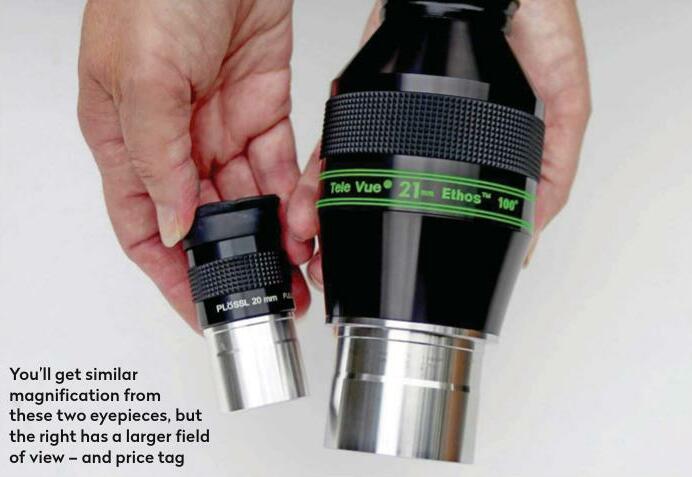
Types of eyepiece
Wide fields of view offer an immersive, but expensive, option
There are a great many types of eyepiece on offer, but essentially, the difference between them is the apparent field of view. This is measured in degrees as seen by the observer. The human eye can see around 180° in the horizontal plane, and so the closer to this an eyepiece gets, the more immersive your viewing experience will be. Generally, the wider the view on offer, the more complicated the eyepiece's design and the higher the price.
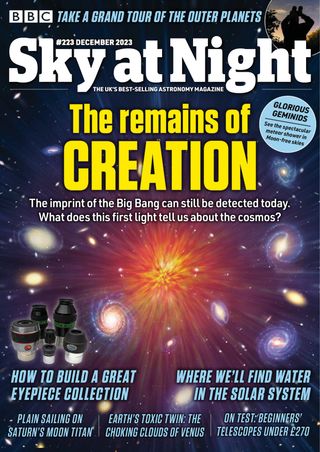

यह कहानी BBC Sky at Night Magazine के December 2023 संस्करण से ली गई है।
हजारों चुनिंदा प्रीमियम कहानियों और 10,000 से अधिक पत्रिकाओं और समाचार पत्रों तक पहुंचने के लिए मैगज़्टर गोल्ड की सदस्यता लें।
क्या आप पहले से ही ग्राहक हैं? साइन इन करें
BBC Sky at Night Magazine से और कहानियाँ
BBC Sky at Night Magazine
MOONWATCH
January's top lunar feature to observe

2 mins
January 2026
BBC Sky at Night Magazine
Speed up your processing workflow
How to use Photoshop's Actions tool to drastically cut your processing time
3 mins
January 2026
BBC Sky at Night Magazine
Chasing Canada's polar lights
With solar maximum peaking and a new Moon promising dark skies, Jamie Carter travels to Churchill, Manitoba to hunt the Northern Lights - and dodge polar bears – in Canada's far north
7 mins
January 2026

BBC Sky at Night Magazine
Beyond Pluto: The search for the hidden planets
Could one – or even two - undiscovered planets lurk at the edges of our Solar System? Nicky Jenner explores how close we are to finding the elusive 'Planet 9'
6 mins
January 2026
BBC Sky at Night Magazine
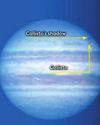
Jupiter moon events
Jupiter is a magnificent planet to observe.
2 mins
January 2026

BBC Sky at Night Magazine
What samples from space have taught us
Alastair Gunn explains what scientists have learnt in the 20 years since the first unmanned mission brought materials back from alien worlds
3 mins
January 2026
BBC Sky at Night Magazine
The Milky Way as you've never seen it before
This is the largest low-frequency radio colour image of our Galaxy ever assembled
1 min
January 2026
BBC Sky at Night Magazine
Merger of ‘impossibly' massive black holes explained
Scientists discover how enormous, fast-spinning black holes can exist after all
1 mins
January 2026
BBC Sky at Night Magazine
Lunar occultation of the Pleiades
BEST TIME TO SEE: 27 January from 20:30 UT
1 min
January 2026
BBC Sky at Night Magazine
The Universe's expansion may be slowing down
New study suggests current theories of dark energy could be wrong
1 mins
January 2026
Translate
Change font size