يحاول ذهب - حر
Build your EYEPIECE COLLECTION
December 2023
|BBC Sky at Night Magazine
Great eyepieces are crucial to any astronomical setup. Here Tim Jardine arms you with the info you need to choose the best ones to invest in

Many new telescope packages come with a basic eyepiece or two, good enough to help you get started with the hobby and familiarise yourself with your equipment. Plenty of experienced astronomers will hold fond memories of their first view of Jupiter or Saturn through these starter eyepieces. But it doesn't take long until you start wondering... how much better would the view be through a different lens?
It's fair to say, though, that the choices on offer can be bewildering. Especially given the nomenclature: you might hear of Plössls, orthoscopics, radians and Naglers, or even Kellners and Erfles, and find each costing anywhere between £25 to an eye-watering £1,000 plus - which is perhaps more than the telescope itself!
However, if you can decipher all these terms, you should be able to build a well-chosen selection of four or five eyepieces that will provide high-quality views of everything the night sky has to offer for many years to come.
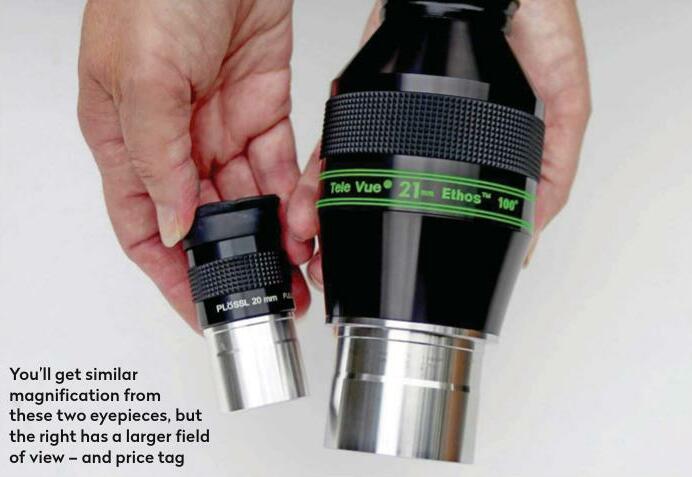
Types of eyepiece
Wide fields of view offer an immersive, but expensive, option
There are a great many types of eyepiece on offer, but essentially, the difference between them is the apparent field of view. This is measured in degrees as seen by the observer. The human eye can see around 180° in the horizontal plane, and so the closer to this an eyepiece gets, the more immersive your viewing experience will be. Generally, the wider the view on offer, the more complicated the eyepiece's design and the higher the price.

هذه القصة من طبعة December 2023 من BBC Sky at Night Magazine.
اشترك في Magzter GOLD للوصول إلى آلاف القصص المتميزة المنسقة، وأكثر من 9000 مجلة وصحيفة.
هل أنت مشترك بالفعل؟ تسجيل الدخول
المزيد من القصص من BBC Sky at Night Magazine

BBC Sky at Night Magazine
Crush: Close Encounters with Gravity
Gravity is something that we're all innately familiar with. It keeps our feet on the ground, fights against a rocket trying to leave Earth and governs the movement of the planets and stars.

1 mins
April 2026

BBC Sky at Night Magazine
Exploring the Universe
There's no shortage of children's books about astronomy.
2 mins
April 2026
BBC Sky at Night Magazine
Make your Milky Way images pop
Simple, free processing techniques using FastStone Image Viewer
3 mins
April 2026

BBC Sky at Night Magazine
Nightfaring: In Search of the Disappearing Darkness
This book is a manifesto for dark skies, written as a travel memoir.
1 mins
April 2026

BBC Sky at Night Magazine
Flying saucers- The making of a modern myth
Our obsession with UFOs goes back further than you might think. Robert Pateman traces how early science fiction, dubious sightings and an alien-mad media led to the 1950s saucer fever
9 mins
April 2026

BBC Sky at Night Magazine
STAR OF THE MONTH
Alphecca, the brightest jewel in the Crown
1 min
April 2026

BBC Sky at Night Magazine
How to use a planisphere
Navigate the sky with the original stargazer's tool. No batteries, apps or Wi-Fi required!
3 mins
April 2026

BBC Sky at Night Magazine
Why rockets don't launch straight up
For a rocket to get its payload into space, it has to follow a curved path. But what would happen if it didn't?
2 mins
April 2026

BBC Sky at Night Magazine
Q&A WITH A DARK MATTER SPECIALIST
Dark matter makes up 27 per cent of all matter in the Universe. So why is it so hard to find? Meet one of the people making a map that leads us to it
3 mins
April 2026

BBC Sky at Night Magazine
Why I want to put a hotel on the Moon
Bored of the beach? Sick of city breaks? Step this way. Space entrepreneur Skyler Chan explains how he'll build a holiday destination on the Moon by 2030
2 mins
April 2026
Translate
Change font size