कोशिश गोल्ड - मुक्त
DARK MATTER: IS IT TIME WE GAVE UP LOOKING FOR IT?
BBC Science Focus
|August 2022
After decades of looking for dark matter and coming up short, some researchers say we should take the possibility of a new theory of gravity more seriously

Two cosmic anomalies tell us that something big is missing from our model of the Universe. First, stars in the outer regions of a typical galaxy are orbiting the centre too fast for the galaxy's gravity to hold onto them. By rights, they should fly off into intergalactic space.
The second anomaly is that you are reading these words that is, galaxies like the Milky Way, and therefore you, exist. According to the standard picture of galaxy formation, regions of the cooling debris of the Big Bang that were slightly denser than average would have had slightly stronger gravity and pulled in material faster, enhancing their gravity so they pulled in matter even faster, and so on. But this process akin to the rich getting ever richer - could not have built galaxies as big as our Milky Way in the 13.8 billion years that the Universe has existed.
Confronted with these anomalies, most astronomers postulated that the Universe contains about five times as much invisible matter as visible stars and galaxies. It is the extra gravity of such 'dark matter', they claim, that holds onto stars in galaxies and sped up galaxy formation. However, an equally logical possibility is that, on cosmic scales, gravity is stronger than Newton would have predicted.

यह कहानी BBC Science Focus के August 2022 संस्करण से ली गई है।
हजारों चुनिंदा प्रीमियम कहानियों और 10,000 से अधिक पत्रिकाओं और समाचार पत्रों तक पहुंचने के लिए मैगज़्टर गोल्ड की सदस्यता लें।
क्या आप पहले से ही ग्राहक हैं? साइन इन करें
BBC Science Focus से और कहानियाँ

BBC Science Focus
HEALTH: Eating oats could lower your cholesterol in just two days
The health benefits of a two-day porridge diet lasted for weeks afterwards

1 mins
April 2026

BBC Science Focus
Most people are too sure they can identify fake human faces
Even 'super recognisers' struggle with the challenge. Can you do better?
1 min
April 2026

BBC Science Focus
WHAT'S THE WORST THING YOU CAN DO FOR THE PLANET ONLINE?
Human beings can barely move a muscle without some kind of deleterious effect on the environment around us.
2 mins
April 2026
BBC Science Focus
A bug in the system
The complex arrangement of equipment you see here is part of a particle accelerator.
1 min
April 2026

BBC Science Focus
Snug as a bug in a rug
At first glance, you might feel envious of this little leafhopper, swaddled beneath the folds of what appears to be a luxurious fur blanket.
1 min
April 2026

BBC Science Focus
WHY DO WE ROOT FOR THE VILLAIN IN MOVIES?
Whether it's Darth Vader or Cruella de Vil, we all have a favourite movie villain.
1 mins
April 2026

BBC Science Focus
A TURN TO DISPERSE
Why a fart walk after dinner does more than release your gas
3 mins
April 2026
BBC Science Focus
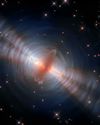
Hatching a nebula
Welcome to the Egg Nebula, an enigmatic structure formed by ejected stardust in the Cygnus constellation around 1,000 light-years from Earth.
1 min
April 2026

BBC Science Focus
7 TIMES AI GOT IT SPECTACULARLY WRONG
For the past four years, AI has been reshaping how we work and live. But its failures are proving just as transformative as its triumphs
8 mins
April 2026
BBC Science Focus
CHARLES ADCOCK, VIA EMAIL: COULD DARK MATTER BE ALL AROUND PLANET EARTH BUT UNDETECTABLE?
Astronomers have gathered overwhelming evidence that 80 per cent of all matter in the Universe is invisible.
1 min
April 2026
Translate
Change font size