कोशिश गोल्ड - मुक्त
Kashmir's Timeless Hamlet
Outlook
|October 11, 2024
Vishal Bhardwaj's film Haider, released ten years ago, remains as relevant now as It was then because It shows nothing Is normal’ in Kashmir

AROUND the halfway mark in Vishal Bhardwaj's Haider (2014), we enter Faraz Cinema. "Main hun diwaana tere pyaar ka, peecha na chhodunga tera," sings Salman Khan, like a dutiful stalker, on screen. A wide shot shows the Indian Army officers, as viewers, enduring varied stages of boredom-some drinking, some sleeping, some barely awake. Then, a door opens, and convicts line up in front of the screen. An officer signals the projectionist to stop; the interrogation-or the real film-has to start.
This Hamlet adaptation, much like its setting, Kashmir, inverts conventions, mocks normalcy, and distorts identities.
So a theatre, promising freedom from the captivity of mundane life, functions as a prison. The multiplicity of identities here isn't just restricted to inanimate things.
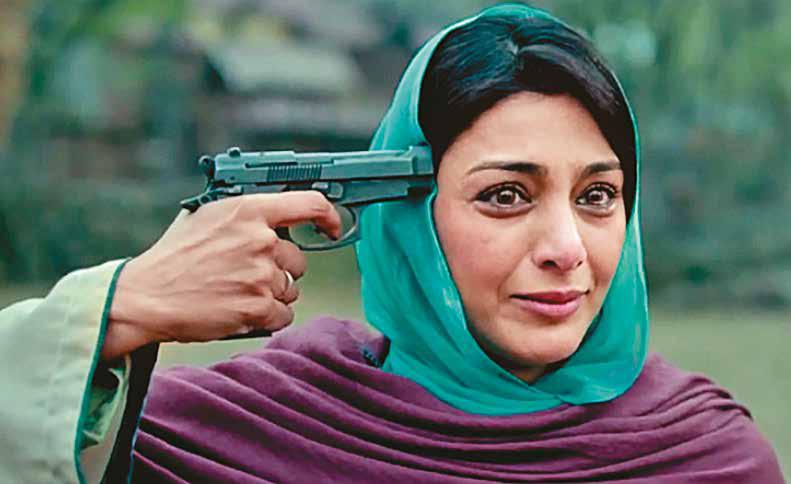 Because in the same theatre, Haider's father, "Doctor" (Narendra Jha), notices an "aasteen ka saanp"-a man whom he considered bhai, Khurram (Kay Kay Menon), morphed into the Army's informer-a brother turned betrayer. In a drama centred on a conflict-torn land, coveted by two countries, it makes poetic and perfect sense that dualities define Haider.
Consider its more literal example: the Army officials stopping and checking the IDs of regular Kashmiris, reminding them that they need permission to enter their own homes. Or making them feel, as a character says later, that "All of Kashmir is a prison". These ID checks, even more than the Faraz Cinema scene, examine and extrapolate identity and duality, as the 'correct' documents make all the difference: between allowed and detained, insider and infiltrator, home and prison.



यह कहानी Outlook के October 11, 2024 संस्करण से ली गई है।
हजारों चुनिंदा प्रीमियम कहानियों और 10,000 से अधिक पत्रिकाओं और समाचार पत्रों तक पहुंचने के लिए मैगज़्टर गोल्ड की सदस्यता लें।
क्या आप पहले से ही ग्राहक हैं? साइन इन करें
Outlook से और कहानियाँ

Outlook
The Spectacle of the Woman Accused
Media narratives—especially when women are involved—can end up amplifying suspicion and weaponising gender

7 mins
March 11, 2026

Outlook
The Stink of Epstein
Why are the rich and powerful of the world scared of what lies buried in the Jeffrey Epstein files?
6 mins
March 11, 2026

Outlook
Passing the Watermelon
Narendra Modi's presence in Israel is being read not just as a bilateral engagement, but as an endorsement of Israeli action in Gaza and the West Bank
5 mins
March 11, 2026
Outlook
For Phoolan, Who Wasn't a Devi
“Whether or not it is the Truth is no longer relevant. The point is that it will, (if it hasn’t already) - become the Truth. Phoolan Devi, the woman has ceased to be important. (Yes of course she exists. She has eyes, ears, limbs, hair etc. Even an address now) But she is suffering from a case of Legenditis. She’s only a version of herself. There are other versions of her that are jostling for attention. Particularly Shekhar Kapur’s “Truthful” one, which we are currently being bludgeoned into believing.”–Arundhati Roy in ‘The Great Indian Rape-Trick I’, on the film Bandit Queen by Shekhar Kapur based on Phoolan, whom he never met because he didn’t think he needed to meet her. The film was based on journalist Mala Sen’s book India’s Bandit Queen: The True Story of Phoolan Devi.
5 mins
March 11, 2026

Outlook
The Chic Cartel
Women are not just victims or side characters in recent crime-and-power OTT dramas. They are complex forces-capable of empathy, strategy and ruthlessness-whose narratives demand both recognition and reckoning
5 mins
March 11, 2026

Outlook
The Hierarchy of Sympathy
In crimes against women, justice is shaped not only in courtrooms but in newsrooms where narrative determines whose suffering becomes national conscience and whose fades into procedural silence
5 mins
March 11, 2026

Outlook
Dasyu Sundari
Media accounts simultaneously cast her as victim and avenger, until a life shaped by caste violence and gendered oppression was repackaged into a consumable myth of dishonour and revenge
8 mins
March 11, 2026

Outlook
Prince Pervert
Are rumours of the death of the rule of law vastly exaggerated?
4 mins
March 11, 2026
Outlook
Together, Apart
Poonam Saxena's translations of Mannu Bhandari and Rajendra Yadav's memoirs present a portrait of the trailblazing Hindi writer-couple's marriage and of newly independent India
3 mins
March 11, 2026

Outlook
The Great Indian Rape Trick'
The trope of transforming sexual violence against women into a springboard for rage that can only be channelled through counter-violence has long served as a popular framework in cinema, both globally and in India
6 mins
March 11, 2026
Listen
Translate
Change font size