
मैगज़्टर गोल्ड के साथ असीमित हो जाओ
10,000 से अधिक पत्रिकाओं, समाचार पत्रों और प्रीमियम कहानियों तक असीमित पहुंच प्राप्त करें सिर्फ
कोशिश गोल्ड - मुक्त
The Forces That Shape Al's Uneven Progress
MIT Sloan Management Review
|winter 2026
Automation advances unevenly across tasks and roles. Understanding the friction factors that slow adoption can help leaders navigate workforce transformation strategically.

As artificial intelligence has begun to write code, pilot vehicles, and even diagnose disease, narratives of machines abruptly replacing humans have taken hold. However, the real story is slower, messier, and far more uneven. Across roles and industries, Al's emergent capabilities form what's often called a "jagged frontier," where it excels at some tasks while struggling with others. As its capabilities progress, Al is racing to fully automate some tasks while slowing to a crawl or stalling entirely for others. Leaders who understand the factors that shape this nuanced reality will be able to guide strategy and talent with clarity and steady their organizations in the process.
A 2024 analysis of Al's progress by McKinsey & Co. suggests that its unevenness shows up not just across jobs but within them, at the task level. The consultancy projects that by 2030, in its midpoint scenario, demand will fall steeply for some occupations, such as office support and customer service. This is because such roles center on tasks that Al can already handle, like entering data, processing invoices, taking orders, and responding to routine customer inquiries. However, demand will rise sharply for health professionals and other STEM-related professionals whose work centers on tasks that Al struggles to replicate, such as clinical judgment, empathetic care, and complex, nonroutine problem-solving. The dividing line isn't job title — it's task makeup. But what is it about certain tasks or roles that make them more or less amenable to automation?
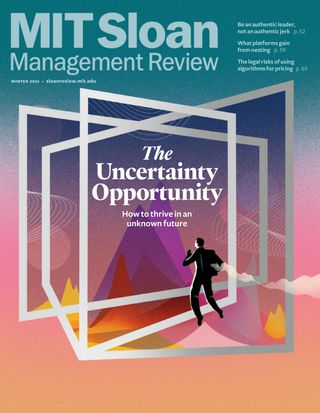

यह कहानी MIT Sloan Management Review के winter 2026 संस्करण से ली गई है।
हजारों चुनिंदा प्रीमियम कहानियों और 10,000 से अधिक पत्रिकाओं और समाचार पत्रों तक पहुंचने के लिए मैगज़्टर गोल्ड की सदस्यता लें।
क्या आप पहले से ही ग्राहक हैं? साइन इन करें
MIT Sloan Management Review से और कहानियाँ

MIT Sloan Management Review
Assess What Is Certain in a Sea of Unknowns
Understanding what won't change clarifies what might — and strengthens decision-making in volatile times.

13 mins
winter 2026

MIT Sloan Management Review
Ask Sanyin: Why Is It So Hard to Pull the Plug on a Project?
We're finding it difficult to wind down projects that no longer serve our priorities.
2 mins
winter 2026

MIT Sloan Management Review
Integrate Sustainability and Innovation to Find New Opportunities
Five common innovation practices can help leaders pursue sustainability as a growth strategy.
12 mins
winter 2026

MIT Sloan Management Review
The Case for Quiet Corporate Activism
Leaders concerned that they will be penalized for championing sustainability and diversity can still sustain their commitments.
11 mins
winter 2026

MIT Sloan Management Review
The Perils of Algorithmic Pricing
Some revenue management systems based on algorithms may lead to unintended collusion and antitrust violations.
9 mins
winter 2026

MIT Sloan Management Review
Broadening Future Perspectives at the Bank of England
Leaders at the U.K’s central bank sought to broaden their thinking about future risks and opportunities. Here’s how they built longer-term horizon-scanning capabilities and what they learned along the way.
9 mins
winter 2026

MIT Sloan Management Review
How Nesting Changes Platform Strategy
Should your platform host another platform — or be hosted by one? Here's how to think through the choices.
14 mins
winter 2026
MIT Sloan Management Review
Are You an Authentic Leader or an Authentic Jerk?
Leaders who are true to their values can inspire trust and respect, but not if \"being yourself\" becomes the problem.
13 mins
winter 2026

MIT Sloan Management Review
How to Make Scenario Planning Stick
Developing future scenarios can deepen leaders’ strategic insights. Establishing scenario planning as an ongoing capability and reaping its full benefits require linking it to other processes.
16 mins
winter 2026

MIT Sloan Management Review
A Faster Way to Build Future Scenarios
This streamlined approach to scenario planning incorporates AI and helps managers navigate future uncertainties more efficiently.
13 mins
winter 2026
Listen
Translate
Change font size