कोशिश गोल्ड - मुक्त
Doesn't Add Up
The New Yorker
|July 23, 2018
Can we bridge the gap between economics and the humanities?

What are you doing? I don’t mean what are you doing with your life, or in general, but what are you doing right now? The answer, in one respect, is simple enough: you’re reading this magazine. Obviously. From a certain economic perspective, however, you’re doing something else, something you don’t realize, something with a sneaky motive that you aren’t admitting to yourself: you are signalling. You are sending signals about the kind of person you are, or want to be. What’s that you say—you’re reading this in the bath, or on your phone in bed, or otherwise in private? Well, the same argument applies. You are acquiring the tools for a “fitness display.” This, the economist Robin Hanson and the writer-programmer Kevin Simler argue in their new book, “The Elephant in the Brain: Hidden Motives in Everyday Life” (Oxford), is an advertisement of “health, energy, vigor, coordination, and overall fitness.” Fitness displays “can be used to woo mates, of course, but they also serve other purposes like attracting allies or intimidating rivals.” So there you go: that’s what you’re doing, there in the bath with the magazine. Your rivals are right to feel intimidated.
Wait, though—surely signalling doesn’t account for everything? Hanson, in a recent podcast interview with Tyler Cowen, a colleague at George Mason University, was asked to give a “short, quick and dirty” answer to the question of how much human behavior “ultimately can be traced back to some kind of signalling.” His answer: “In a rich society like ours, well over ninety percent.” He was then asked to cite a few voluntary human activities that “have the least amount to do with signalling.” The example Hanson came up with was “scratching your butt.”
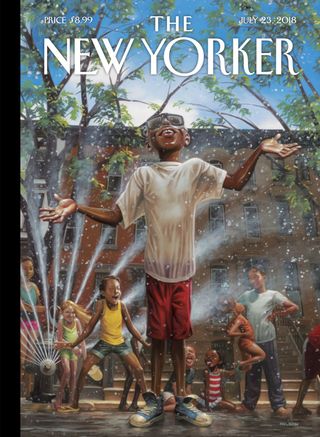

यह कहानी The New Yorker के July 23, 2018 संस्करण से ली गई है।
हजारों चुनिंदा प्रीमियम कहानियों और 10,000 से अधिक पत्रिकाओं और समाचार पत्रों तक पहुंचने के लिए मैगज़्टर गोल्ड की सदस्यता लें।
क्या आप पहले से ही ग्राहक हैं? साइन इन करें
The New Yorker से और कहानियाँ
The New Yorker
AND YOUR LITTLE DOG, TOO
When animals attack.

8 mins
December 15, 2025
The New Yorker
Katy Waldman on Mary McCarthy's "One Touch of Nature"
I first encountered Mary McCarthy not through her novels or criticism but through her political reporting. A former editor recommended that I read “The Mask of State: Watergate Portraits” before covering Paul Manafort’s arraignment in 2017. (Were we ever so young?) I loved McCarthy’s witty cameos of malefactors—behold Maurice Stans, Nixon’s erstwhile Secretary of Commerce, “a silver-haired, sideburned super-accountant and magic fundraiser, who gave a day-and-a-half-long demonstration of the athletics of evasion, showing himself very fit for a man of his age.” McCarthy’s sentences were like mousetraps, snapping shut on both visual information and something deeper, the kind of quintessence that fictional characters possess and that we often long for real people to have, too.
2 mins
December 15, 2025

The New Yorker
KILLING BORROWED TIME
Will Geese redeem noisy, lawless rock and roll?
5 mins
December 15, 2025
The New Yorker
PRISON BREAKS
A new study illuminates the origins of incarceration
13 mins
December 15, 2025
The New Yorker
UNDERSTANDING THE SCIENCE
“Everyone thinks they're on this big journey now,” Debbie said, refilling her glass.
22 mins
December 15, 2025
The New Yorker
ALL RISE
A new Afghan bakery, in New York's golden age of bread.
7 mins
December 15, 2025

The New Yorker
HOW TO LEAVE THE U.S.A.
Why fed-up Americans are going Dutch.
26 mins
December 15, 2025

The New Yorker
TRADING PLACES
The ex-bankers behind HBO's \"Industry\" are the latest British élites to dramatize their own kind.
26 mins
December 15, 2025
The New Yorker
BRIGHT LIGHTS, BIG CITY
The new Studio Museum in Harlem shows that Black art matters.
10 mins
December 15, 2025
The New Yorker
MIND OVER MATTER
Did the celebrated neurologist Oliver Sacks write his patients into case studies of his own psyche?
36 mins
December 15, 2025
Translate
Change font size