कोशिश गोल्ड - मुक्त
THE EFFECTS OF DIPLODIA EAR ROT ON MAIZE
Farmer's Weekly
|May 22 - 29, 2020
Diplodia ear rot is a notable maize disease in South Africa. Apart from causing severe damage to the crop, it can also produce a potentially fatal mycotoxicosis in cattle and sheep. It is therefore crucial that a maize producer be able to identify the disease, says Dr Belinda Janse van Rensburg, plant pathologist at the Agricultural Research Council’s Grain Crops Institute.

Diplodia ear rot, which is caused by the fungus Stenocarpella maydis, occurs worldwide. Drought in the early part of a production season, followed by rain during the late season, create favourable conditions for an epidemic, especially where high inoculum sources are present in the stubble (stover) on the soil.
S. maydis causes hardened, round, black, spore-producing structures. These can overwinter on maize stubble and produce spores in spring. After rain, or during high humidity, the structures release spores into the air; these land on maize plants and infect the base of the ear leaf junction. The disease then spreads upwards into the ear. The entire ear becomes filled with a white mycelial growth that affects grain quality. Infected kernels are light in weight and brittle, easily breaking during post-harvest handling, and eventually result in the downgrading of a consignment of maize.
A cross-section of an infected ear shows the black spore-producing bodies at the bases of the kernels. Late-season infection may occur when kernel moisture is low, but the symptoms are less obvious at this stage.
Diplodia ear rot can reoccur in certain areas. Should infected grain be mixed with healthy grain during harvesting, quality will be compromised, leading to a lower price. When early infections are present in an epidemic, yield losses can be of great economic importance.
DIPLODIOSIS
Another serious result of diplodia ear rot is that cattle or sheep that feed on diplodia-infected maize ears can become infected with diplodiosis, a nervous disorder.
Cases of diplodiosis occur from six days to two weeks after the animals are placed on lands with infected maize cobs.
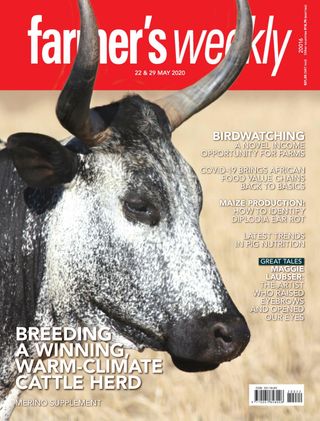

यह कहानी Farmer's Weekly के May 22 - 29, 2020 संस्करण से ली गई है।
हजारों चुनिंदा प्रीमियम कहानियों और 10,000 से अधिक पत्रिकाओं और समाचार पत्रों तक पहुंचने के लिए मैगज़्टर गोल्ड की सदस्यता लें।
क्या आप पहले से ही ग्राहक हैं? साइन इन करें
Farmer's Weekly से और कहानियाँ
Farmer's Weekly
Cash flow budgets: keeping farmers in control of liquidity, risk, and their survival
Profit doesn't guarantee a farm's survival - cash does. Cobus du Plessis explains why cash flow budgets are one of the most important yet underused financial tools on South African farms.

5 mins
February 27 - March 06, 2026

Farmer's Weekly
The toast of the Navy
The incredible story of the World War II-era Great Dane dog Nuisance being enlisted in the Royal Navy is well documented. Graham Jooste shared some entertaining anecdotes involving the canine shipmate.
6 mins
February 27 - March 06, 2026
Farmer's Weekly
Healthier soils deter destructive locusts
Locust swarms remain a serious global threat, capable of devastating crops, livelihoods and local economies across vast regions.
1 min
February 27 - March 06, 2026
Farmer's Weekly
Wheat crisis dominates Grain SA regional meetings
As the ongoing wheat crisis continues to erode producers' margins, emotions ran high at Grain SA's regional meeting in Moorreesburg in the Western Cape.
2 mins
February 27 - March 06, 2026

Farmer's Weekly
A FARMER'S EXPERIENCE
Street Wallet has been a game-changer for Mario Athanasopoulos, hydroponic production consultant and owner of Green City Farms.
1 mins
February 27 - March 06, 2026
Farmer's Weekly
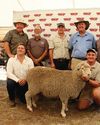
Kesieberg Merino Stud Production Sale
The Kesieberg Merino Stud Production Sale was held on the farm Leeuwfontein on 4 February on behalf of Willie and Herman Henning.
1 min
February 27 - March 06, 2026
Farmer's Weekly
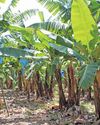
Not cheaper, just different: what you should know about farming in Mozambique
Although Mozambique is often viewed as a cheaper, easier farming location than South Africa, cost comparisons tell a more complex story. But while cross-border production presents real challenges, it also offers opportunities for complementary trade, diversification and regional food security, particularly when it comes to subtropical crops such as bananas.
10 mins
February 27 - March 06, 2026
Farmer's Weekly
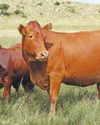
The all-rounder anchoring South Africa's beef value chain
Louis Steyl, CEO of the Bonsmara Cattle Breeders' Society of South Africa, spoke to Octavia Avesca Spandiel about how the versatile Bonsmara breed anchors the country's beef value chain, delivering balanced performance, reproductive and feed efficiency, and carcass traits across extensive and intensive systems.
6 mins
February 27 - March 06, 2026

Farmer's Weekly
THE HITCHING POST
I'm a 60-year-old white woman who loves camping, animals, the outdoors, and watching sport.
2 mins
February 27 - March 06, 2026
Farmer's Weekly
Foot-and-mouth disease in pigs
Recently, the radio news mentioned an outbreak of foot-and-mouth disease (FMD) in pigs in South Africa.
2 mins
February 27 - March 06, 2026
Translate
Change font size