
Passez à l'illimité avec Magzter GOLD
Obtenez un accès illimité à plus de 9 000 magazines, journaux et articles Premium pour seulement
Essayer OR - Gratuit
The Transformation of Prompts into Source Code
Open Source For You
|March 2026
Prompts are no longer simple text. As generative Al evolves, they are turning into engineering assets, and more specifically, code that needs to be designed, tested, versioned, and maintained.

We know of prompts as intelligent instructions that can be written quickly and modified with no need for written proof. However, as generative AI advances from experimental environments to legitimate operational settings its prompts have begun to function more like software components than regular sentences. A single change in the choice of words can lead to major output differences, impacting customer experience, business choices and regulatory compliance. Software teams have discovered that prompts contain hidden dependencies, implicit logic and failure modes that engineers commonly associate with code.
This transformation is a game changer. Text no longer serves as the material for prompts because they have turned into structured components for specific purposes with operational limits and potential dangers. The prompt that directs a model to summarise legal documents and create financial summaries requires the same control that all vital system elements need.
Today, prompts function as behaviour instructions because they determine how a model thinks, what it considers important, and what it will overlook. People use prompts to express their needs while machines apply their cognitive abilities to meet these. Prompts are no longer ordinary text; they have started turning into code!
The question now is not how to write better prompts, but how to design, test, version, and maintain them—just like any other piece of software that operates at scale.
Viewing prompt engineering through a software lens
Once prompts were recognised as engineering assets, software teams started building them by applying software development methods that require designs to be structured, readable and reusable. The process of creating prompts changed from using intuition to building systems through planned design work.
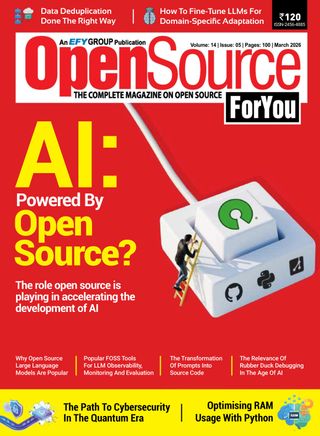

Cette histoire est tirée de l'édition March 2026 de Open Source For You.
Abonnez-vous à Magzter GOLD pour accéder à des milliers d'histoires premium sélectionnées et à plus de 9 000 magazines et journaux.
Déjà abonné ? Se connecter
PLUS D'HISTOIRES DE Open Source For You

Open Source For You
Pixxel and Sarvam join forces to build India's first orbital AI data centre
Pixxel and Sarvam have announced a strategic partnership to develop India's first orbital data centre satellite, positioning the mission as a stepping stone towards sovereign and potentially open AI infrastructure.

1 mins
June 2026
Open Source For You
Niantic Spatial open sources SPZ 4
Niantic Spatial has released SPZ 4, the latest version of its open source file format for 3D Gaussian splats, positioning it as foundational infrastructure for scalable XR, robotics, web, and creative 3D workflows.
1 min
June 2026
Open Source For You
FSFE slams NHS England's reported move to privatise open source code
The Free Software Foundation Europe (FSFE) has warned that NHS England's reported plan to switch most public source-code repositories to 'private' threatens open source principles and weakens cybersecurity transparency.
1 min
June 2026
Open Source For You
Fine-tuning AI models for empathy may undermine accuracy, warn researchers
A study by the Oxford Internet Institute, published in Nature, has found that AI models fine-tuned for warmer, more empathetic responses are 60% more likely to generate incorrect answers than their base versions-raising fresh concerns for the open-weight ecosystem.
1 min
June 2026
Open Source For You
Claude Mythos effect forces Indian banks to employ continuous cybersecurity models
Indian banks are moving decisively from periodic compliance cycles to continuous cybersecurity models, with a sharp focus on real-time vulnerability detection, continuous remediation tracking, and exposure monitoring across ‘crown jewel’ systems.
1 min
June 2026
Open Source For You
Kaltura open sources machine-readable AI skills
Kaltura has open sourced a suite of AI agent skills-structured, production-tested knowledge modules designed for AI coding agents such as Claude Code, OpenAI Codex, GitHub Copilot, and Cursor.
1 min
June 2026

Open Source For You
Pinterest turns to open source AI to cut costs by 90%
Pinterest is positioning open source AI as a core driver of cost-efficient scalability, adopting a model-agnostic strategy that blends proprietary systems with closed models alongside open source models.
1 min
June 2026
Open Source For You
Tether backs local AI tools with new grants
Tether has launched a new grants initiative aimed at developers building open source wallets, payment, decentralised infrastructure, and local-first AI tools on its open technology stack.
1 min
June 2026
Open Source For You
Menlo open sources humanoid robotics development
Menlo Research has introduced the Asimov v1 humanoid robot as an open source humanoid platform designed for builders, researchers and robotics developers, positioning humanoid robotics away from closed proprietary systems and towards reproducible engineering platforms.
1 min
June 2026
Open Source For You
Google uncovers first AI-assisted zero-day exploit
Google has warned that cybercriminals and state-backed threat actors are rapidly operationalising generative AI to develop exploits, automate malware campaigns, and scale cyberattacks targeting open source infrastructure and AI ecosystems.
1 min
June 2026
Listen
Translate
Change font size