
Passez à l'illimité avec Magzter GOLD
Obtenez un accès illimité à plus de 9 000 magazines, journaux et articles Premium pour seulement
How can we see the afterglow of th Big Bang?
BBC Sky at Night Magazine
|May 2023
Govert Schilling of cosmology's continues to explain some most confusing concepts

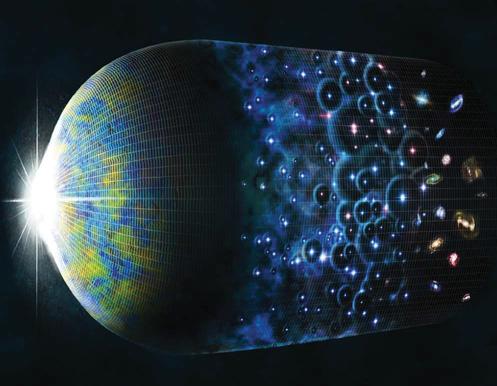
This month, we'll take a closer look at the cosmic microwave background. Sometimes called 'the afterglow of creation', this extremely faint microwave glow is considered one of the most convincing pieces of evidence for the Big Bang theory. But how is it that we are still observing this ancient light?
As we've seen in earlier parts of this series, space is expanding. Since the amount of matter in the Universe remains fairly constant, the increasing volume means that the average density of cosmic matter is decreasing over time. That means the density of the Universe must have been much higher in the distant past.
Right after the Big Bang, before there were any galaxies, stars or planets, elementary particles were packed almost shoulder to shoulder, and the corresponding temperature was unimaginably high. This hot, dense plasma produced energetic radiation. However, individual light particles - photons - have trouble traversing such plasma-filled environments, as they are continuously absorbed (and re-emitted) by charged particles like electrons. In other words: the hot, early Universe was opaque.
Cosmic treasure trove
Leftover radiation from the explosion is key to unlocking the Universe around us


Cette histoire est tirée de l'édition May 2023 de BBC Sky at Night Magazine.
Abonnez-vous à Magzter GOLD pour accéder à des milliers d'histoires premium sélectionnées et à plus de 9 000 magazines et journaux.
Déjà abonné ? Se connecter
PLUS D'HISTOIRES DE BBC Sky at Night Magazine
BBC Sky at Night Magazine
MOONWATCH
January's top lunar feature to observe

2 mins
January 2026
BBC Sky at Night Magazine
Speed up your processing workflow
How to use Photoshop's Actions tool to drastically cut your processing time
3 mins
January 2026
BBC Sky at Night Magazine
Chasing Canada's polar lights
With solar maximum peaking and a new Moon promising dark skies, Jamie Carter travels to Churchill, Manitoba to hunt the Northern Lights - and dodge polar bears – in Canada's far north
7 mins
January 2026
BBC Sky at Night Magazine
Beyond Pluto: The search for the hidden planets
Could one – or even two - undiscovered planets lurk at the edges of our Solar System? Nicky Jenner explores how close we are to finding the elusive 'Planet 9'
6 mins
January 2026
BBC Sky at Night Magazine
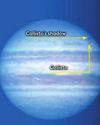
Jupiter moon events
Jupiter is a magnificent planet to observe.
2 mins
January 2026

BBC Sky at Night Magazine
What samples from space have taught us
Alastair Gunn explains what scientists have learnt in the 20 years since the first unmanned mission brought materials back from alien worlds
3 mins
January 2026
BBC Sky at Night Magazine
The Milky Way as you've never seen it before
This is the largest low-frequency radio colour image of our Galaxy ever assembled
1 min
January 2026
BBC Sky at Night Magazine
Merger of ‘impossibly' massive black holes explained
Scientists discover how enormous, fast-spinning black holes can exist after all
1 mins
January 2026
BBC Sky at Night Magazine
Lunar occultation of the Pleiades
BEST TIME TO SEE: 27 January from 20:30 UT
1 min
January 2026
BBC Sky at Night Magazine
The Universe's expansion may be slowing down
New study suggests current theories of dark energy could be wrong
1 mins
January 2026
Translate
Change font size