Essayer OR - Gratuit
Artificial hope
Edge UK
|July 2025
As the first demos of AI-generated games become playable, what's their purpose – and their cost?
-
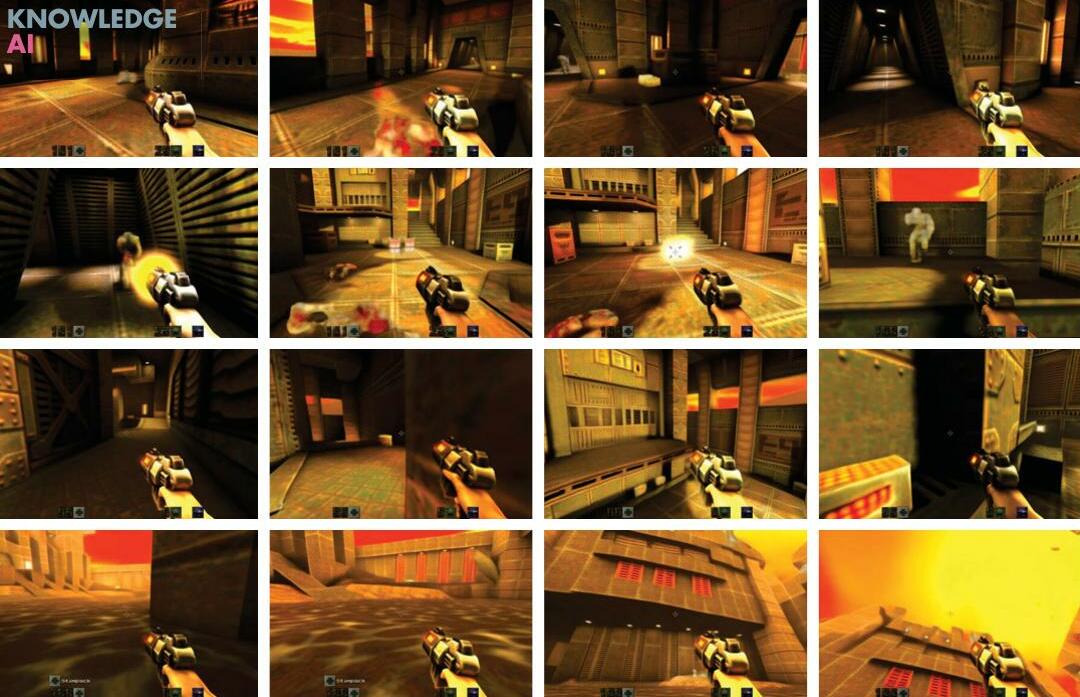
Two and half years after the arrival of ChatGPT kicked off the so-called AI revolution, the technology has been inserted with varying levels of grace and utility into every digital platform you can think of, from WhatsApp to eBay, with its stylistic tics becoming increasingly well-known even as the models improve. It remains a fixation of the Silicon Valley set, a disaster for environmentalists, and – according to OpenAI CEO Sam Altman – wildly unprofitable. But while the everyday applications of ChatGPT are widely understood, claims of its potential in game development remain rather less substantiated.
In this respect, Microsoft has led the charge of late, beginning with a full-press debut of a family of generative AI models in February. The first World and Human Action Model (WHAM), named Muse, was trained on seven years' worth of footage from Ninja Theory's otherwise very much neglected multiplayer shooter, Bleeding Edge. April saw the release of WHAMM, a much more efficient take on a similar approach, which was trained on a mere week's worth of Quake II footage and playable – sort of – in a browser.
These aren't the only Microsoft-owned games that have been used to train AI models, however. In November 2024, two companies, Descart and Etched, announced Oasis AI, which presented a gen-AI knockoff of Minecraft based on millions of hours' worth of footage of people playing the original game. The technology was not unauthorised by Microsoft or Mojang, but neither of the IP holders have made any official comment or taken action to date.
Questions of authorisation and legality aside, the experience of actually playing Oasis AI's recreation of Minecraft isn't all that different from the

Cette histoire est tirée de l'édition July 2025 de Edge UK.
Abonnez-vous à Magzter GOLD pour accéder à des milliers d'histoires premium sélectionnées et à plus de 9 000 magazines et journaux.
Déjà abonné ? Se connecter
PLUS D'HISTOIRES DE Edge UK

Edge UK
Possessor(s)
After three rounds of layoffs this year and Hyper Light Breaker’s curtailed development in early access, a lot seems to rest for Heart Machine on this plucky Metroidvania side project. The studio has an obvious knack for conjuring up fascinating fantasy worlds, but since its compact debut, Hyper Light Drifter, it’s been less obvious whether it can manage projects of a larger scale. And perhaps, on that count, even the modest Possessor(s) isn’t quite modest enough — it feels as much a victim of the company’s production woes as a showcase for its creative talent.

4 mins
January 2026

Edge UK
Street Fighter 6
Superstition might suggest that even numbers are more auspicious for the series, but it's fairer to say that Capcom learned from the mistakes of Street Fighter V and launched a fighting game that doesn't just feel like a full package, but one that has foundations to build on in future updates.
2 mins
January 2026

Edge UK
GLOOMY JUNCTURE
Finding hope in seedy alleys and dive bars
2 mins
January 2026
Edge UK
The Outer Worlds 2
There's always a risk in imitating something regarded as a classic: if it offers a template for success, it could just as easily invite unfavourable comparison. Obsidian Entertainment's Fallout: New Vegas has gained that reputation in the 15 years since its release, and while the original The Outer Worlds, led by Fallout creators Tim Cain and Leonard Boyarsky, referenced that series without aping it, the sequel zeroes in on New Vegas as its direct source of inspiration. This explains both why The Outer Worlds 2 is a success and why it can't quite stand tall as a creation with its own identity.
6 mins
January 2026

Edge UK
Lumines Arise
The pacing melds with the music, each unique track on each level passing through phases of calm and ferocity.
4 mins
January 2026

Edge UK
STRONG MUDDY VIOLENCE
What happens when you mix the tech of SnowRunner and Space Marine 2 in a co-op shooter with '80s flavour to spare? Toxic Commando has the answer
13 mins
January 2026

Edge UK
Once Upon A Katamari
Fittingly, each stage in Once Upon A Katamari takes place in the past.
2 mins
January 2026

Edge UK
FAILBETTER GAMES
The industry's finest sustainable storyteller shifts towards 'fireside menace'
7 mins
January 2026

Edge UK
DRAGON QUEST VII: REIMAGINED
Can a serious makeover preserve the original's identity?
2 mins
January 2026

Edge UK
Wreckreation
It's easy to believe that Three Fields just wants you to enjoy driving at speed in its preposterously big open world
4 mins
January 2026
Listen
Translate
Change font size