
Passez à l'illimité avec Magzter GOLD
Obtenez un accès illimité à plus de 9 000 magazines, journaux et articles Premium pour seulement
Essayer OR - Gratuit
Towards Love
Philosophy Now
|February/March 2024
George Mason on love as shared identity.
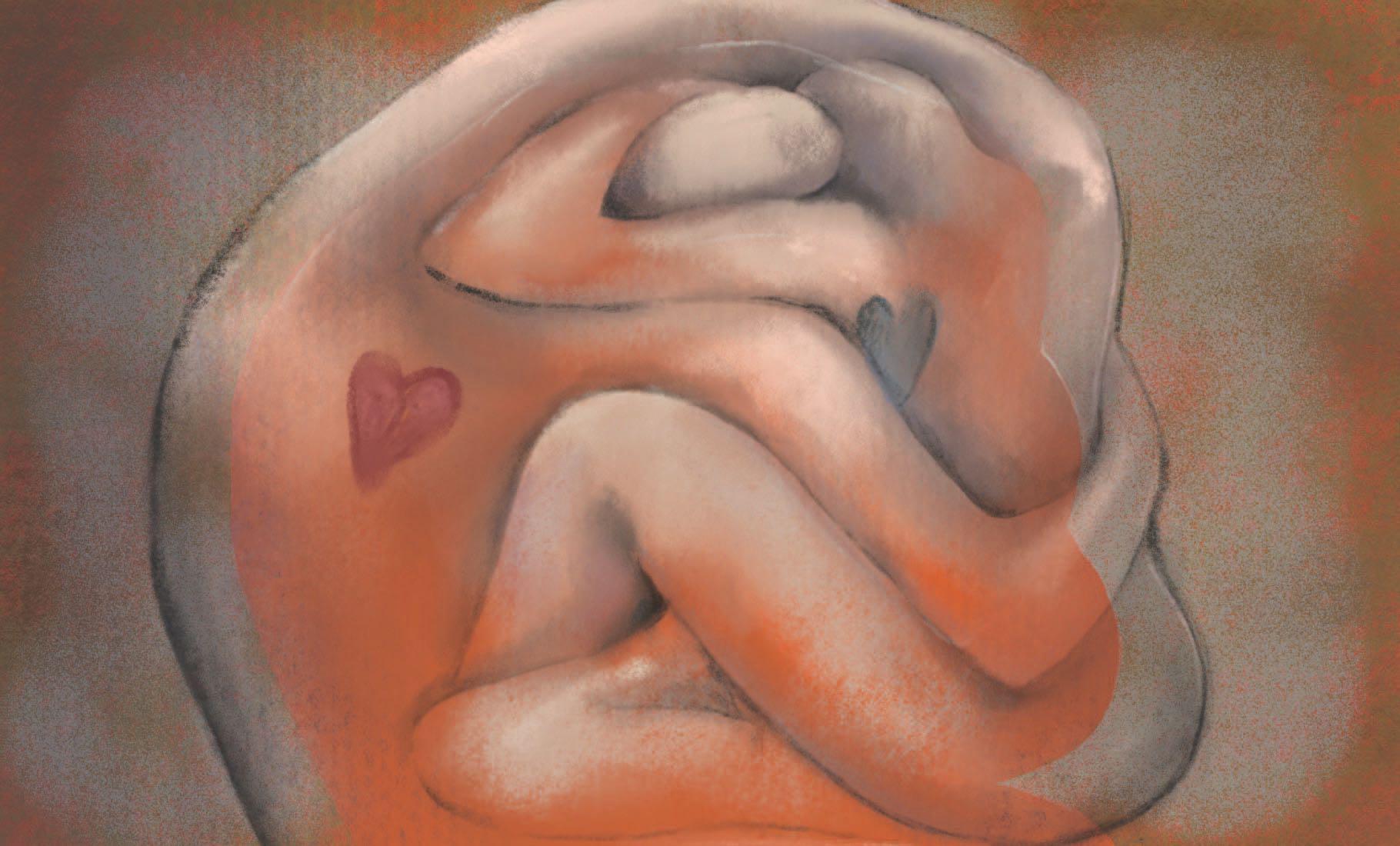
“where I does not exist, nor you, so close that your hand on my chest is my hand, so close that your eyes close as I fall asleep.”
Pablo Neruda, Sonnet XVII
In his dialogue The Symposium, Plato has Aristophanes recount his myth of the lovers. Human beings were once physically paired, Aristophanes says: creatures with two faces, four arms, four legs. In this form we were powerful enough to challenge the gods, and so Zeus split us forever in two. Condemned to this solitude, humans would wander the Earth searching for their lost halves, and on meeting them, “would throw their arms about each other, weaving themselves together, wanting to grow together.”
Aristophanes’ account speaks to a need still keenly felt today for an intimacy denied to us by the human condition: “Love is born into every human being; it calls back the halves of our original nature together; it tries to make one out of two and heal the wound of human nature.”
True, our psychological isolation is a necessary tragedy of our material individuation. We exist as physical beings, but we experience our selves as ephemeral coalitions of thought and feeling, forever bounded by flesh and bone. Words, endlessly ambiguous, are grievously imperfect vehicles for communication to another mind. Through them we give others not a window to our being and meaning, but a foundation on which to build their own; as Roland Barthes says, communication ultimately allows us representation in another’s mind, but never

Cette histoire est tirée de l'édition February/March 2024 de Philosophy Now.
Abonnez-vous à Magzter GOLD pour accéder à des milliers d'histoires premium sélectionnées et à plus de 9 000 magazines et journaux.
Déjà abonné ? Se connecter
PLUS D'HISTOIRES DE Philosophy Now

Philosophy Now
The Possibility- Bearing Animal
Raymond Tallis explores a twilight zone.

7 mins
February/March 2026

Philosophy Now
Amazing Times at the Pub Agora
John Douglas Mullen is a philosophical bar fly on the wall.
8 mins
February/March 2026

Philosophy Now
Friedrich Nietzsche (1844-1900)
Hilarius Bogbinder considers the all too human life of the notorious iconoclast.
11 mins
February/March 2026

Philosophy Now
Heisenberg's Philosophy of Quantum Mechanics
Kanan Purkayastha explains how Werner Heisenberg's 1925 paper turned the quantum theory of the early 1900s into the quantum mechanics of today.
10 mins
February/March 2026
Philosophy Now
Cicero & the Ideal of Virtue
Abdullah Shaikh explores Cicero's ideas about the core Roman principle of virtus.
13 mins
February/March 2026

Philosophy Now
ROPE
Les Jones has a Nietzschean take on a Hitchcock thriller.
6 mins
February/March 2026
Philosophy Now
What Have the Romans Ever Done For Us?
Salve! This issue's theme is Roman Philosophy. But as the rebels in Monty Python's Life of Brian asked, what have the Romans ever done for us? The question seems relevant here; we are philosophers, not archaeologists.
2 mins
February/March 2026

Philosophy Now
Paul Guyer
Paul Guyer is an American philosopher and a leading scholar of both Immanuel Kant and aesthetics. AmirAli Maleki interviews him about Kant's political and moral vision.
9 mins
February/March 2026
Philosophy Now
Identity in the Age of Connectivity
Sara Asran explores the dynamics of identity online.
6 mins
February/March 2026
Philosophy Now
A Very Short History of Critical Thinking
Luc de Brabandere summarises a long history through key figures of thought.
7 mins
February/March 2026
Listen
Translate
Change font size