Essayer OR - Gratuit
CUT YOUR SOCIAL SECURITY
Kiplinger's Personal Finance
|July 2023
Many retirees are dismayed to learn that they owe taxes on a portion of their benefits. But you can take steps to minimize the pain.

After decades of having Social Security taxes withheld from your paycheck, you may not expect to pay taxes on the benefits you've earned. But if you have other sources of income, such as a job, a pension or withdrawals from tax-deferred retirement savings plans, there's a good chance you'll pay taxes on up to 85% of your benefits. Depending on where you live, your state may tax your benefits, too (see the box on page 82).
The government started taxing a portion of Social Security benefits 40 years ago as part of an overhaul designed to shore up the program's finances. Legislation signed by President Ronald Reagan in 1983 imposed taxes on up to 50% of benefits if a retiree's income exceeded specific limits. Ten years later, President Bill Clinton signed legislation that made up to 85% of benefits taxable for retirees whose earnings exceeded a second income threshold.
FIGURING THE TAX BITE
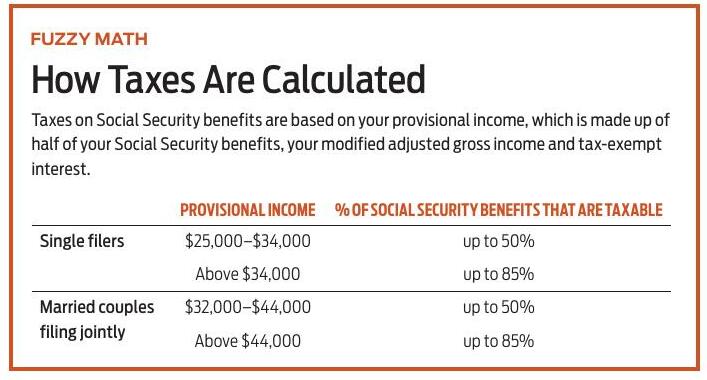
The formula is based on what Social Security defines as a beneficiary's provisional income, sometimes referred to as combined income. Your provisional income is based on half of your Social Security benefits, plus other sources that contribute to your adjusted gross income, including wages from a job, withdrawals from traditional tax-deferred accounts, and dividends, interest and capital gains from taxable investment accounts. Interest from municipal bonds, which is generally tax-free, is also included when calculating your provisional income.
If your provisional income ranges from $25,000 to $34,000 for single filers, or $32,000 to $44,000 for joint filers, up to 50% of your benefits will be taxable. If your provisional income is more than $34,000, or $44,000 for joint filers, up to 85% of your benefits will be taxable (see the box below).


Cette histoire est tirée de l'édition July 2023 de Kiplinger's Personal Finance.
Abonnez-vous à Magzter GOLD pour accéder à des milliers d'histoires premium sélectionnées et à plus de 9 000 magazines et journaux.
Déjà abonné ? Se connecter
PLUS D'HISTOIRES DE Kiplinger's Personal Finance

Kiplinger's Personal Finance
IS MONEY MAKING YOU SICK?
Research reveals a strong link between financial well-being and physical and mental health—and what you can do to keep all three in top shape.

12 mins
June 2026

Kiplinger's Personal Finance
THE BEST SMART DEVICES FOR YOUR HOME
These gadgets add comfort and convenience to your living space- and some can even save you money.
5 mins
June 2026

Kiplinger's Personal Finance
Managing the High Cost of Mental Health Care
Cases of anxiety, depression and other conditions are rising, and so is the price of treatment. These strategies can help you get care you can afford.
9 mins
June 2026

Kiplinger's Personal Finance
What This Year's Biggest Medicare Changes Mean for You
Some drug prices are falling, other costs are climbing, and new rules abound. Here's what you need to know.
5 mins
June 2026

Kiplinger's Personal Finance
THE LOWDOWN ON SMARTPHONE INSURANCE
A protection plan can provide peace of mind but may not be worth the cost.
2 mins
June 2026

Kiplinger's Personal Finance
READERS' CHOICE AWARDS 2026
We asked readers to evaluate brokers, wealth managers, credit cards, insurance companies and other financial providers. These are the products and services that stand out from the crowd.
6 mins
June 2026

Kiplinger's Personal Finance
WHERE TO FIND TOP YIELDS
Interest rates are rising along with geopolitical tensions. Pocket yields as high as 13%, depending on your tolerance for risk.
19 mins
June 2026

Kiplinger's Personal Finance
HOW TO HANDLE LOVE AND MONEY THE SECOND TIME AROUND
The financial stakes are higher and the potential pitfalls more plentiful when you say “I do-again.”
10 mins
June 2026

Kiplinger's Personal Finance
A SHIFT AWAY FROM HIGH-TAX STATES
The IRS has released new data on how taxpayers are migrating throughout the U.S., and it reveals a clear pattern: Billions of dollars in income are flowing out of high-tax states and into areas where taxes, and often overall living costs, are lower.
2 mins
June 2026
Kiplinger's Personal Finance
FIGHTING BACK AGAINST INFLATION
INFLATION seems to be going from pesky to pernicious.
1 mins
June 2026
Translate
Change font size