Essayer OR - Gratuit
Hot cockles, handball and hide-and-seek
BBC History UK
|April 2023
Nicholas Orme highlights some of the most popular children's pastimes in Tudor England - from ball games to blind man's buff - and explores their place in wider society

It was fashionable, about 60 years ago, to say that childhood was a recent invention. In the past, it was argued, children's lives were nasty, brutish and, often, short, deprived of the loving care and self-expression of modern times. That theory ignored what people in previous centuries actually thought - and wrote about children.
Human life in Tudor England was seen as a series of stages - the "seven ages of man", famously summed up by Shakespeare in As You Like It. Each age had its own character, and that of childhood - the ages of seven to 14 - was playfulness. "I am called Childhood," says a boy, in the words of Thomas More in the 1490s. "In play is all my mind, to cast a quoit, a throwing stick, and a ball... If only I could burn all my schoolbooks," he continues, "then might I lead my life always in play."
Tudor parents and educators did not, of course, approve of unrestricted play. Children had to learn good behaviour, religious duties and the skills needed for adult life. Some critics wanted to direct children's play, or even to prevent it, but play persisted nonetheless.
Children invented their own playthings. Some toys were mass-produced, to be sold in shops and at fairs. Spare time, on Sundays and the many holidays, was spent in social games. Every open space was used for activities such as running, chasing and ball games including tennis and football.
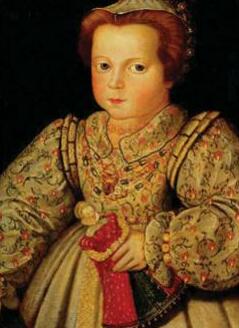
Tiny Tudors
Young children enjoyed playing with dolls-representations of themselves in miniature

Cette histoire est tirée de l'édition April 2023 de BBC History UK.
Abonnez-vous à Magzter GOLD pour accéder à des milliers d'histoires premium sélectionnées et à plus de 9 000 magazines et journaux.
Déjà abonné ? Se connecter
PLUS D'HISTOIRES DE BBC History UK

History Extra
Q&A
A selection of historical conundrums answered by experts

8 mins
March 2026

History Extra
The game's afoot
Having previously made two films starring Robert Downey Jr as Sherlock Holmes, it seems Guy Ritchie remains as fascinated as ever by Sir Arthur Conan Doyle's famous detective.
1 min
March 2026

History Extra
EXHIBITIONS
If we can count on one thing to persist throughout history, perhaps it is love, and that's exactly what Love Letters showcases.
1 min
March 2026

History Extra
Left turns
Charlotte Vosper, content producer, picks episodes of the HistoryExtra podcast related to Chinese communism
1 min
March 2026

History Extra
Direct connection
To celebrate 150 years since the first telephone call was made, Michael Kay and Coreen McGuire describe how the device reshaped social interactions in Britain - and the somewhat surprising ways it was first used
12 mins
March 2026

History Extra
Political earthquake
GRAHAM HUTCHINGS is impressed by an iconoclastic history of communism in China that makes unpleasant but ultimately important reading
5 mins
March 2026

History Extra
Money talks
JESS VENNER welcomes a wide-ranging look at how non-elite people in ancient Roman society managed to get by from day to day
2 mins
March 2026

History Extra
Blades of glory
JAMES OSBORNE discovers a game in which fantasy power is measured in skill rather than status, trading crowns and conquests for patience and craft
1 mins
March 2026

History Extra
Rock'n'roll survivor
In 1961, when Stuart Sutcliffe left The Beatles, Paul McCartney switched from guitar to bass.
1 min
March 2026

History Extra
Minor character action
Whisper it, but some of Jane Austen's most beloved characters may be just a little too familiar.
1 min
March 2026
Translate
Change font size