Essayer OR - Gratuit
Rethink the Growth Imperative
MIT Sloan Management Review
|Summer 2025
Questioning the idea that businesses must continually grow can expose new paths to resilience and sustainability.
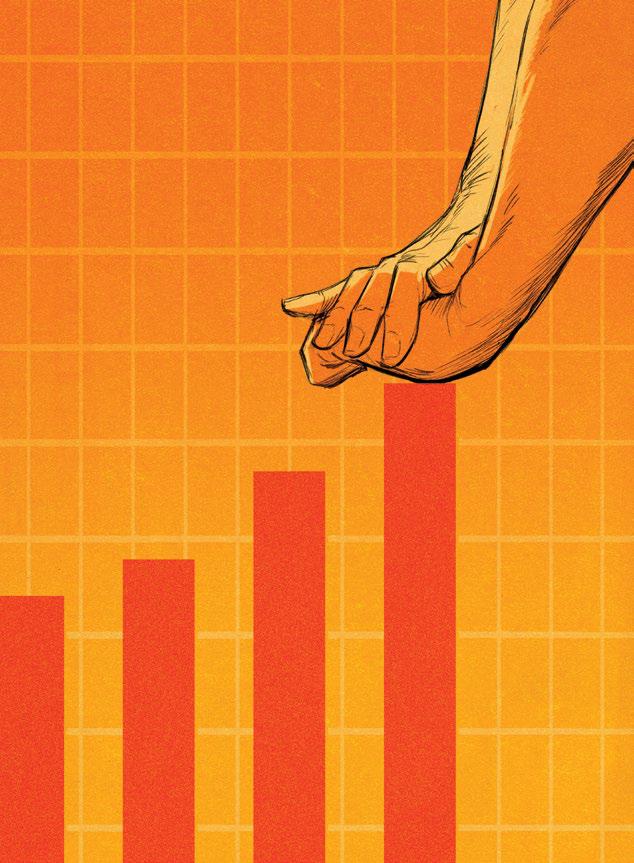
KARL-JOHAN PERRSON, THE chairman and former CEO of H&M, once asked, “What would it mean if we all consumed 20% less? I believe it would be catastrophic. It would mean 20% less jobs, 20% less taxes, 20% less money for schools, doctors, roads. The global economy would collapse. I’m firmly convinced that growth has made the world a better place today than it was 20 years ago. And it will be better in 20 years than it is today.”
Is this true? If it is, we face what writer J.B. Mac-Kinnon calls the “consumer’s dilemma.” In his book The Day the World Stops Shopping, he writes that “the planet says we consume too much: In North America, we burn the earth’s resources at a rate five times faster than they can regenerate. And despite our efforts to ‘green’ our consumption — by recycling, increasing energy efficiency, or using solar power — we have yet to see a decline in global carbon emissions. The economy says we must always consume more [but] ... the 21st century has brought a critical dilemma into sharp relief: We must stop shopping.”
The rub is that business education is predicated on a belief that the economy can and must continue to grow — a belief that manifests in corporate strategy as an imperative that companies, too, must continually grow or risk becoming irrelevant. The problem is that perpetual economic growth is not possible, and the shibboleth that growth is essential for human flourishing creates a trap that many see no way out of. Paul Farrell writes in The Wall Street Journal that “we are addicted to the myth of perpetual economic growth” and it is “killing America.” We must begin to teach about limits to growth and different kinds of growth.
Limits to Growth

Cette histoire est tirée de l'édition Summer 2025 de MIT Sloan Management Review.
Abonnez-vous à Magzter GOLD pour accéder à des milliers d'histoires premium sélectionnées et à plus de 9 000 magazines et journaux.
Déjà abonné ? Se connecter
PLUS D'HISTOIRES DE MIT Sloan Management Review

MIT Sloan Management Review
Resolve the Conflict Between Efficiency and Resilience
Rethinking performance metrics and buffers can reduce disruption even in highly streamlined operations.

10 mins
Summer 2026

MIT Sloan Management Review
Why Can’t They See That I’m Visionary?
I’ve been trying to move up to the next level and want to be considered a candidate for senior leadership roles.
2 mins
Summer 2026

MIT Sloan Management Review
The Trap That Skilled Negotiators Miss
A simple reminder can help you avoid anchoring to the first offer and set deals on your own terms.
8 mins
Summer 2026

MIT Sloan Management Review
Scaling AI With Adaptive Governance
Maximize the value of AI investments and manage emerging risks by embedding flexible oversight processes.
17 mins
Summer 2026

MIT Sloan Management Review
Rethink Responsibility in the Age of AI
As AI systems take on more decision-making, leaders need to build shared narratives instead of assigning blame.
6 mins
Summer 2026

MIT Sloan Management Review
A Three-Minute Protocol to Reduce AI Manipulation Risk
OF THE POTENTIAL WEAKNESSES OF ANY SECURITY SYSTEM, THE HUMAN layer has always posed a key risk.
1 mins
Summer 2026

MIT Sloan Management Review
Gain Consumer Insight With Generative AI
Large language models are compressing research timelines with synthetic consumers, AI-moderated interviews, and qualitative research at scale.
14 mins
Summer 2026

MIT Sloan Management Review
Does Cultural Training Help Expats Succeed?
EVERY YEAR, MULTINATIONAL CORPORATIONS invest billions in global mobility programs.
1 mins
Summer 2026

MIT Sloan Management Review
Assessing Customer Reviews
HOW SHOULD COMPANIES EFFECTIVELY use or respond to an unwieldy array of customer opinions?
2 mins
Summer 2026

MIT Sloan Management Review
How Nespresso Builds Sustainability Into Its Business Model
Jean-Christophe Jaunin became CEO of Nespresso North America, the Nestlé unit that sells coffee brewing machines and capsules, on Jan. 1, 2026, after having served as global chief customer and technology officer.
2 mins
Summer 2026
Listen
Translate
Change font size