Essayer OR - Gratuit
Building Culture From the Middle Out
MIT Sloan Management Review
|Spring 2024
Midlevel leaders are critical to fostering an organizational culture that’s healthy and vibrant.

WE HAVE ASKED THOUSANDS OF executives from around the world the same simple question: “Who is responsible for culture in your organization?” Hands go up and, almost to a person, the response is, “Everyone.”
We then ask a follow-up: “If everyone is responsible for culture in your organization, what do you do to manage it?”
Hands go down. Gazes divert. The most common answers are uninspiring: “Keep an open-door policy.” “Provide good performance reviews.” “Check in with employees.” While each of these actions may be helpful, not one is specific to culture. They are simply generic management habits — that is, none are practices specific to translating a company’s unique set of values into a lived experience for the people who work there.
Organizational culture is the set of shared values that guide how work gets done. There used to be a debate about whether culture predicts high performance or whether high performance affords leaders a strong and cohesive culture. Evidence now overwhelmingly supports the former.¹ But for a business to harness the power of culture, it needs midlevel leaders across the organization — the managers and team leaders — to go beyond believing that they are responsible for culture to actively building it.
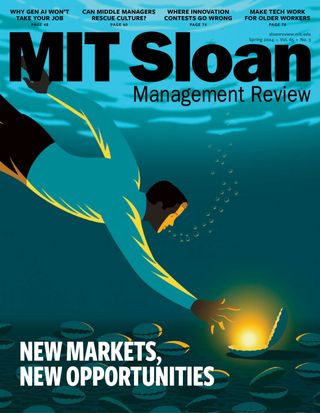

Cette histoire est tirée de l'édition Spring 2024 de MIT Sloan Management Review.
Abonnez-vous à Magzter GOLD pour accéder à des milliers d'histoires premium sélectionnées et à plus de 9 000 magazines et journaux.
Déjà abonné ? Se connecter
PLUS D'HISTOIRES DE MIT Sloan Management Review

MIT Sloan Management Review
Assess What Is Certain in a Sea of Unknowns
Understanding what won't change clarifies what might — and strengthens decision-making in volatile times.

13 mins
winter 2026

MIT Sloan Management Review
Ask Sanyin: Why Is It So Hard to Pull the Plug on a Project?
We're finding it difficult to wind down projects that no longer serve our priorities.
2 mins
winter 2026

MIT Sloan Management Review
Integrate Sustainability and Innovation to Find New Opportunities
Five common innovation practices can help leaders pursue sustainability as a growth strategy.
12 mins
winter 2026

MIT Sloan Management Review
The Case for Quiet Corporate Activism
Leaders concerned that they will be penalized for championing sustainability and diversity can still sustain their commitments.
11 mins
winter 2026

MIT Sloan Management Review
The Perils of Algorithmic Pricing
Some revenue management systems based on algorithms may lead to unintended collusion and antitrust violations.
9 mins
winter 2026

MIT Sloan Management Review
Broadening Future Perspectives at the Bank of England
Leaders at the U.K’s central bank sought to broaden their thinking about future risks and opportunities. Here’s how they built longer-term horizon-scanning capabilities and what they learned along the way.
9 mins
winter 2026

MIT Sloan Management Review
How Nesting Changes Platform Strategy
Should your platform host another platform — or be hosted by one? Here's how to think through the choices.
14 mins
winter 2026
MIT Sloan Management Review
Are You an Authentic Leader or an Authentic Jerk?
Leaders who are true to their values can inspire trust and respect, but not if \"being yourself\" becomes the problem.
13 mins
winter 2026

MIT Sloan Management Review
How to Make Scenario Planning Stick
Developing future scenarios can deepen leaders’ strategic insights. Establishing scenario planning as an ongoing capability and reaping its full benefits require linking it to other processes.
16 mins
winter 2026

MIT Sloan Management Review
A Faster Way to Build Future Scenarios
This streamlined approach to scenario planning incorporates AI and helps managers navigate future uncertainties more efficiently.
13 mins
winter 2026
Listen
Translate
Change font size