Essayer OR - Gratuit
The future of SA wool: refined infrastructure and wool traceability
Farmer's Weekly
|January 16-23, 2026
As the agriculture sector starts to adapt to the fast-paced development of technology, producers and processors need to decide what to implement and what to avoid. Henning Naudé spoke to Izak Klopper, manager of shearer training at the National Wool Growers' Association, about how shearing has changed, and what the industry can expect from new research and development from international markets.
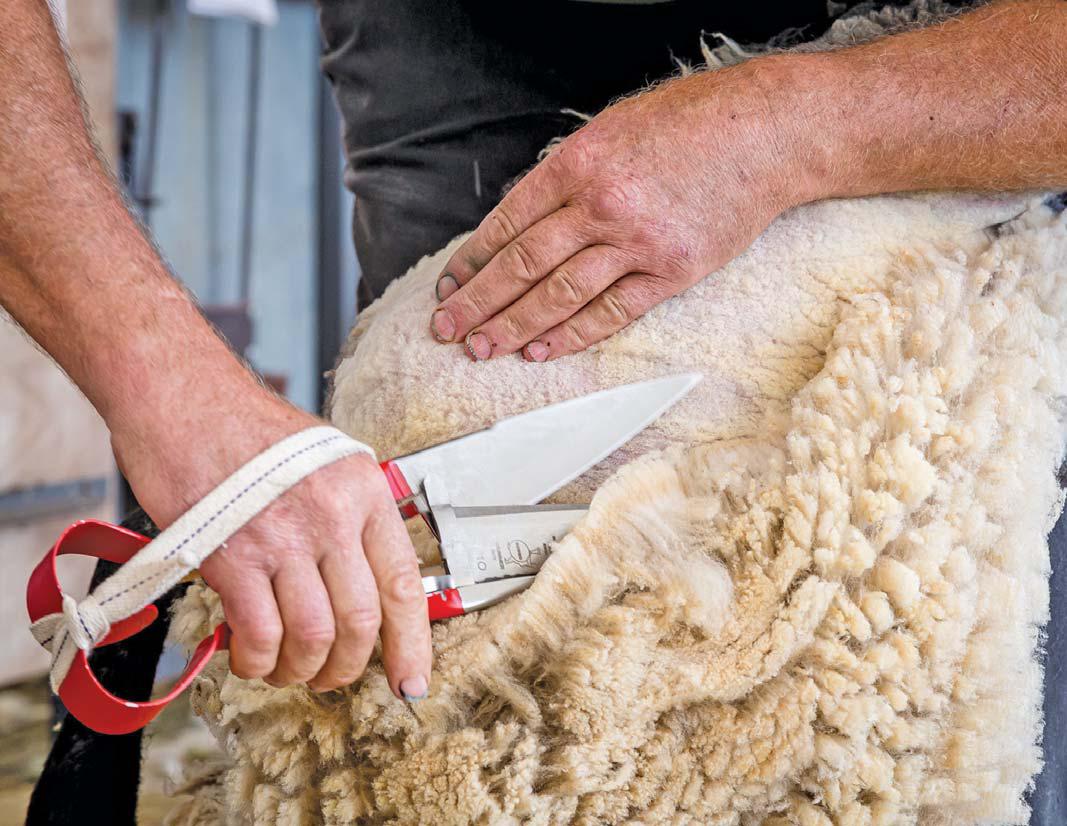
With 30 years of experience in training shearers in varying environments, Izak Klopper, manager of shearer training at the National Wool Growers' Association (NWGA), says that shearing sheds have remained productive due to the expertise shearers gain from organisations such as the NWGA, and the close relationship these organisations have with farmers. The skill level amongst well-trained shearers in South Africa is high, and many compete in international competitions. Blade shearers have done particularly well, winning multiple titles.
Klopper says: “The South African wool industry is heavily reliant on skilled shearers, and that has remained largely unchanged.”
Aside from skilled shearing, Klopper also explains that shearing shed designs have changed significantly to accommodate both physical strain and efficiency between shearers and handlers.
In the past, many shed designs moved towards raised shearing boards to increase output by allowing staff to collect wool without getting in the way of the shearer or having to bend down.
Raised boards were implemented in both straight and half-moon layouts. However, Klopper says that raised boards have recently been subject to change due to the risk they pose for the wool handlers. (Because the sheep are at torso level with the staff collecting the fleece, there is a higher chance of injury if the sheep makes sudden movements.) Flat boards are now being reconsidered in shed design.
Another significant improvement made to prevent idle time is the pen structure. Instead of having a flock enter and exit into the same pen, causing a bottleneck between shorn and woolly sheep, the holding pens are separate from the count-out pens, creating a full cycle. The entire shed is raised, and a count-out pen is built below it. Once a sheep is shorn, it is placed into a chute that feeds into the count-out pen, thus preventing the need for staff to herd sheep in and out.

Cette histoire est tirée de l'édition January 16-23, 2026 de Farmer's Weekly.
Abonnez-vous à Magzter GOLD pour accéder à des milliers d'histoires premium sélectionnées et à plus de 9 000 magazines et journaux.
Déjà abonné ? Se connecter
PLUS D'HISTOIRES DE Farmer's Weekly

Farmer's Weekly
Tropical avo smoothie
Escape to the tropics with this luxurious, creamy, and vibrant smoothie! Blending rich avocado and sweet mango with zesty lime, fragrant mint, and a punch of tangy granadilla, this recipe transforms into a nutrient-packed and silky-smooth treat.

1 min
January 16-23, 2026
Farmer's Weekly
THE HITCHING POST
I am a 60-year-old white woman who loves camping, animals, the outdoors and watching sport.
2 mins
January 16-23, 2026

Farmer's Weekly
The enduring legacy of Tiyo Soga
In the 1850s, Tiyo Soga, a Xhosa man, became the first ordained black South African minister. But as Mike Burgess writes, his legacy would also be determined by his all-round intellectual abilities honed by a solid Scottish education.
4 mins
January 16-23, 2026

Farmer's Weekly
Isuzu D-Max shows single cabs can be comfortable companions
Bakkie manufacturers don't give single cabs to the media due to them generally being regarded as workhorses without the bells and whistles from fancier double cabs. The Citizen's Charl Bosch was gobsmacked when a single cab arrived for a three-month stay.
2 mins
January 16-23, 2026
Farmer's Weekly
South Africa eyes home-grown rice as ARC expands research efforts
South Africa is taking bold steps toward reducing its dependence on rice imports by exploring the viability of home-grown upland rice. Through a major research drive led by the Agricultural Research Council's Small Grain division, scientists and industry partners are testing rice varieties capable of thriving in South Africa's diverse soils and increasingly water-scarce climate. Anelisa Gusha reports.
3 mins
January 16-23, 2026

Farmer's Weekly
Spanish tortilla
Bring the authentic flavours of Spain to your table with this robust and satisfying Spanish tortilla.
1 min
January 16-23, 2026

Farmer's Weekly
New year brings marvellous new titles
Patricia McCracken, like many of us, has settled back into the grind of the new year and picked up a diverse selection of books ranging from travel, to fiction, to non-fiction and a delightful local children's adventure.
2 mins
January 16-23, 2026
Farmer's Weekly
Nitrogen 'switch' unlocks greener crops
A ground-breaking discovery by molecular biology professors Kasper Røjkjær Andersen and Simona Radutoiu at Aarhus University in Denmark offers a significant step toward developing self-fertilising grain crops, potentially revolutionising agriculture to be greener and more climate-friendly.
1 min
January 16-23, 2026

Farmer's Weekly
Sweet prospects: the current state of litchi production in South Africa
Bram Snijder, agricultural consultant and chairperson of the South African Litchi Growers' Association, spoke to Octavia Avesca Spandiel about the litchi industry embracing new opportunities, tackling challenges, implementing innovation, and reaching markets both locally and internationally.
6 mins
January 16-23, 2026

Farmer's Weekly
How AFGRI uses technology to unlock farm finance from asset to market
As modern farming becomes more capital-intensive and digitally driven, AFGRI is reinventing agricultural finance by linking technology directly to lending decisions.
5 mins
January 16-23, 2026
Listen
Translate
Change font size