
Passez à l'illimité avec Magzter GOLD
Obtenez un accès illimité à plus de 9 000 magazines, journaux et articles Premium pour seulement
Essayer OR - Gratuit
Grit, greens, and good business: the rise of Zandile Kumalo
Farmer's Weekly
|August 01-08, 2025
Successful hydroponics farming is about more than just the ability to harvest a quality crop. As a capital intensive industry, it also requires collaboration, flexibility and negotiating skills to raise funding and establish the operation. Lindi Botha spoke to farmer Zandile Kumalo about her journey to hydroponics success.
-
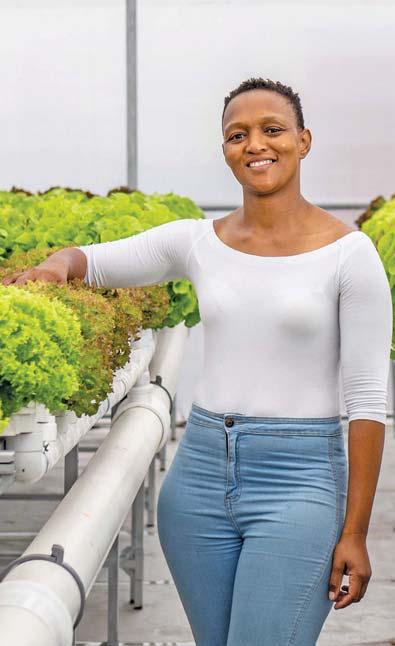
The notion of rooftop farming in a city centre is the epitome of farm to table production.
It solves one of the major challenges faced by many farmers; proximity to the market. If done in a greenhouse, it also protects the crop from the elements.
The property developers, on the other hand, are able to generate an income from unused space, provide green areas in a concrete jungle, and meet a few environmental and social commitments along the way.
IF ONLY IT WERE THAT SIMPLE
Zandile Kumalo approached 19 shopping centres before finding a property that was suitable, and agreeable to a rooftop farm.
“Most rooftops of commercial buildings in South Africa are made from corrugated iron, and can’t support the weight of a hydroponic system. Furthermore, a farm can’t afford the same rent as other tenants because of the slimmer margins, so we need to negotiate discounted rates. But we do bring benefits for the centre and it is important to be clear about that when negotiating the lease. It’s not easy to get a ‘yes’ from a shopping centre,” Kumalo points out.
In Kumalo’s search for suitable premises, she came across Morningside Shopping Centre, just as they were investigating the possibility of a rooftop farm. This two-storey building in Johannesburg was initially planned with a third level.
Although it didn’t materialise, it did mean that the roof had the necessary capacity to carry a hydroponic farm. In 2020, Kumalo entered into a joint venture with the centre to establish Neighbour Roots, and erecting the 300m² farm.
The partnership was a necessary step to make the farm a reality. Having a flexible mindset is a trait Kumalo highlights as vital for success.
“You need to have an open heart so that you can enter into partnerships when you need to. We all want full control over our businesses, but in an industry that is so capital intensive, you either work with someone, or not at all.


Cette histoire est tirée de l'édition August 01-08, 2025 de Farmer's Weekly.
Abonnez-vous à Magzter GOLD pour accéder à des milliers d'histoires premium sélectionnées et à plus de 9 000 magazines et journaux.
Déjà abonné ? Se connecter
PLUS D'HISTOIRES DE Farmer's Weekly

Farmer's Weekly
The foot-and-mouth disease threat is growing
Foot-and-mouth disease poses a growing threat to the livestock industry, especially communal farmers, with devastating economic consequences unless awareness and compliance improve, writes Shane Brody.

3 mins
January 30 - February 06, 2026

Farmer's Weekly
Shipping conditions to ease in 2026, but risk remains high
Early signs suggest a more favourable export season for South African producers, as easing global shipping congestion and improved performance by Transnet point to higher throughput at local ports. Lindi Botha reports.
2 mins
January 30 - February 06, 2026

Farmer's Weekly
A path of accelerating land reform in South Africa
Delivering the ANC's January 8th Statement a few weeks ago, President Cyril Ramaphosa noted, amongst other things, that: “Land reform remains one of the most urgent tasks of the National Democratic Revolution. While progress has been made, much more is required to give effect to the constitutional requirement for redress and equitable access to land.”
2 mins
January 30 - February 06, 2026
Farmer's Weekly
Reflections on 2025 and the policy space for 2026
The year 2025 was a year characterised initially by a wave of misinformation, particularly relating to legislation and tariff issues. This year some big moves are expected in the trade space.
3 mins
January 30 - February 06, 2026

Farmer's Weekly
From planning to peak lay: building a profitable egg business
Mpumalanga poultry farmer Lebogang Mashego spoke to Octavia Avesca Spandiel, and shared practical insights on planning, building systems that work, breed choice, feed management, and markets to build a profitable and sustainable egg business.
5 mins
January 30 - February 06, 2026

Farmer's Weekly
Impofu Wind Farm becomes a canvas for community connection through Enel's Blowing Art Initiative
Enel Green Power South Africa has introduced the Blowing Art Initiative at the Impofu Wind Farm in the Eastern Cape, a creative community project that turns renewable energy infrastructure into a living gallery.
2 mins
January 30 - February 06, 2026

Farmer's Weekly
Geely is intent on hanging around
Having fallen off the radar around a decade ago following a short local stint, Chinese manufacturer Geely has announced its proposed return to South Africa towards the end of 2026. The Citizen's Jaco van der Merwe reports.
4 mins
January 30 - February 06, 2026

Farmer's Weekly
Great reads to enjoy during ‘me-time'
Patricia McCracken has plucked an assortment of fascinating titles covering different areas of interest, from coastal exploration and dining in the wild, to African traditions surrounding love and marriage.
3 mins
January 30 - February 06, 2026
Farmer's Weekly
Thokoman Peanut Butter marks 25-year milestone with R500 000 commitment to food security
Thokoman Peanut Butter, one of South Africa's biggest producers of peanut butter, celebrates 25 years of consistent quality and community support, marking the occasion with a significant R500 000 partnership with Hot 102.7's Hot Cares initiative for 2026.
2 mins
January 30 - February 06, 2026
Farmer's Weekly
South Africa's famous wandering hippo
From 1928 to 1931, a hippopotamus trekked 1 600km from what was then northern Natal to the Eastern Cape's Keiskamma River near Peddie, where it was shot dead by a posse of farmers. As Mike Burgess writes, this journey would immortalise the hippo in South African history.
3 mins
January 30 - February 06, 2026
Listen
Translate
Change font size