
Passez à l'illimité avec Magzter GOLD
Obtenez un accès illimité à plus de 9 000 magazines, journaux et articles Premium pour seulement
Red Dragon Rising
BBC Sky at Night Magazine
|November 2017
China is quickly and quietly becoming a dominant space power. Ash Dove-Jay explores what the Chinese have already achieved, what do they plan to do, and what distinguishes them from other spacefaring nations.

Next year, the Chinese National Space Administration (CNSA) marks its 25th anniversary. Since 1993 it has matured at an incredible pace. In terms of its breadth and depth of capabilities, CNSA already rivals ESA and is perhaps a decade behind NASA, entities that were established 42 and 60 years ago respectively.
The backbone of CNSA is its main contractor, the state-owned Chinese Aerospace Science and Technology Corporation (CASC). CASC has revenues in excess of £34 billion, nearly 200,000 employees, and is predominately focused on space engineering in one form or another. To give a sense of scale, that is equivalent to Lockheed Martin and Northrop Grumman combined.
Over the past decade, CNSA and CASC have successfully launched more than 150 orbital rockets, which carried around 200 spacecraft and satellites. Two of the spacecraft launched were Tiangong-1 and 2 (Heavenly Palace 1 and 2), small test-bed space stations that demonstrated a suite of technologies and capabilities, and hosted three of the five manned space missions launched. Three of the spacecraft launched were their Chang’e family of lunar probes. Chang’e-3 dispensed a lander and the very successful Yutu (Jade Rabbit) lunar rover, and Chang’e-2 went on deeper into space to conduct a flyby mission, passing within 3km of the 9.5km-wide asteroid 4179 Toutatis.
China has also brought online major space based infrastructure, including satellite television, weather forecasting and – most notably – its own GPS service using the BeiDou navigation satellite system. Though originally looking to cooperate with Europe on the Galileo satellite navigation programme, China, dissatisfied with its level of involvement, in 2006 decided to develop its own system independently.
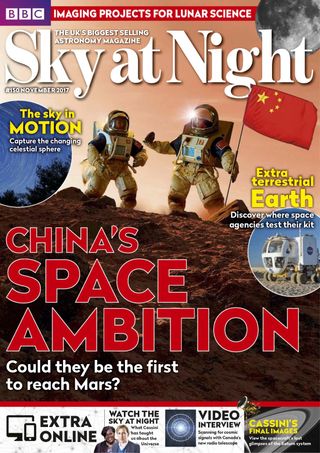

Cette histoire est tirée de l'édition November 2017 de BBC Sky at Night Magazine.
Abonnez-vous à Magzter GOLD pour accéder à des milliers d'histoires premium sélectionnées et à plus de 9 000 magazines et journaux.
Déjà abonné ? Se connecter
PLUS D'HISTOIRES DE BBC Sky at Night Magazine
BBC Sky at Night Magazine
MOONWATCH
January's top lunar feature to observe

2 mins
January 2026

BBC Sky at Night Magazine
Speed up your processing workflow
How to use Photoshop's Actions tool to drastically cut your processing time
3 mins
January 2026

BBC Sky at Night Magazine
Chasing Canada's polar lights
With solar maximum peaking and a new Moon promising dark skies, Jamie Carter travels to Churchill, Manitoba to hunt the Northern Lights - and dodge polar bears – in Canada's far north
7 mins
January 2026
BBC Sky at Night Magazine
Beyond Pluto: The search for the hidden planets
Could one – or even two - undiscovered planets lurk at the edges of our Solar System? Nicky Jenner explores how close we are to finding the elusive 'Planet 9'
6 mins
January 2026

BBC Sky at Night Magazine
Jupiter moon events
Jupiter is a magnificent planet to observe.
2 mins
January 2026

BBC Sky at Night Magazine
What samples from space have taught us
Alastair Gunn explains what scientists have learnt in the 20 years since the first unmanned mission brought materials back from alien worlds
3 mins
January 2026
BBC Sky at Night Magazine
The Milky Way as you've never seen it before
This is the largest low-frequency radio colour image of our Galaxy ever assembled
1 min
January 2026

BBC Sky at Night Magazine
Merger of ‘impossibly' massive black holes explained
Scientists discover how enormous, fast-spinning black holes can exist after all
1 mins
January 2026
BBC Sky at Night Magazine
Lunar occultation of the Pleiades
BEST TIME TO SEE: 27 January from 20:30 UT
1 min
January 2026
BBC Sky at Night Magazine
The Universe's expansion may be slowing down
New study suggests current theories of dark energy could be wrong
1 mins
January 2026
Translate
Change font size