
Passez à l'illimité avec Magzter GOLD
Obtenez un accès illimité à plus de 9 000 magazines, journaux et articles Premium pour seulement
A Time Of Tumult
BBC Sky at Night Magazine
|March 2017
Elizabeth Pearson investigates how the Solar System was transformed 3.9 billion years ago.

When the Solar System first formed 4.5 billion years ago it was a violent place. But quickly, by 4.4 billion years or so ago, the planets had calmed into a familiar configuration – several rocky inner worlds surrounded by gas giants ringed by icy objects. Then, four billion years ago, something catastrophic happened. The planets were thrown once more into chaos, and the face of the Solar System changed forever. This period of upheaval reveals startling truths about the evolution of our home planetary system,and perhaps the origins of life itself.
In the Solar System’s first hundred million years or so, the beginnings of planets clumped together from the dust of a boiling protoplanetary disc around our young star. Frequently the young planets would collide and grow larger, though sometimes they would be destroyed entirely. To start, this early Solar System was much like it is today, but there were several key differences.
“Today, we have giant planets from Jupiter at about 5 AU from the Sun to Neptune at about 30 AU,” says William Bottke from the Southwest Research Institute in Boulder, Colorado; 1 AU is the distance between the Earth and the Sun. “Modelling work shows the ice giants Neptune and Uranus would never have reached their current sizes if they had to form in the current configuration of the planets. Studies suggested instead that all these bodies formed between about 5 and 20 AU. Beyond that lies the Kuiper Belt. What’s interesting about the Kuiper Belt now is that a lot of objects have very special orbits, called resonances. It’s very hard to get them into these resonances.”
Synced surprise
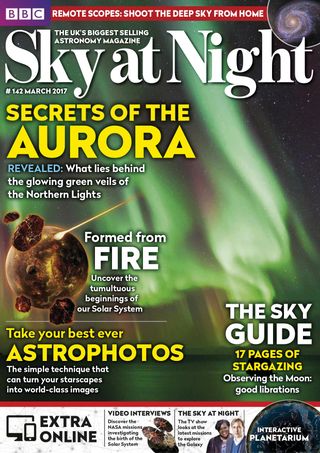

Cette histoire est tirée de l'édition March 2017 de BBC Sky at Night Magazine.
Abonnez-vous à Magzter GOLD pour accéder à des milliers d'histoires premium sélectionnées et à plus de 9 000 magazines et journaux.
Déjà abonné ? Se connecter
PLUS D'HISTOIRES DE BBC Sky at Night Magazine
BBC Sky at Night Magazine
MOONWATCH
January's top lunar feature to observe

2 mins
January 2026
BBC Sky at Night Magazine
Speed up your processing workflow
How to use Photoshop's Actions tool to drastically cut your processing time
3 mins
January 2026
BBC Sky at Night Magazine
Chasing Canada's polar lights
With solar maximum peaking and a new Moon promising dark skies, Jamie Carter travels to Churchill, Manitoba to hunt the Northern Lights - and dodge polar bears – in Canada's far north
7 mins
January 2026

BBC Sky at Night Magazine
Beyond Pluto: The search for the hidden planets
Could one – or even two - undiscovered planets lurk at the edges of our Solar System? Nicky Jenner explores how close we are to finding the elusive 'Planet 9'
6 mins
January 2026
BBC Sky at Night Magazine
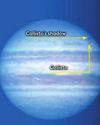
Jupiter moon events
Jupiter is a magnificent planet to observe.
2 mins
January 2026

BBC Sky at Night Magazine
What samples from space have taught us
Alastair Gunn explains what scientists have learnt in the 20 years since the first unmanned mission brought materials back from alien worlds
3 mins
January 2026
BBC Sky at Night Magazine
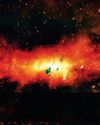
The Milky Way as you've never seen it before
This is the largest low-frequency radio colour image of our Galaxy ever assembled
1 min
January 2026

BBC Sky at Night Magazine
Merger of ‘impossibly' massive black holes explained
Scientists discover how enormous, fast-spinning black holes can exist after all
1 mins
January 2026
BBC Sky at Night Magazine
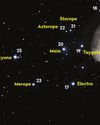
Lunar occultation of the Pleiades
BEST TIME TO SEE: 27 January from 20:30 UT
1 min
January 2026
BBC Sky at Night Magazine
The Universe's expansion may be slowing down
New study suggests current theories of dark energy could be wrong
1 mins
January 2026
Translate
Change font size