
Passez à l'illimité avec Magzter GOLD
Obtenez un accès illimité à plus de 9 000 magazines, journaux et articles Premium pour seulement
The Satisfaction Trap
The Atlantic
|March 2022
No matter what we achieve or attain, our biology always leaves us wanting more. But there's a way out.

I glanced into my teenage daughter’s bedroom one spring afternoon last year, expecting to find her staring absentmindedly at the Zoom screen that passed for high school during the pandemic. Instead, she was laughing uproariously at a video she had found. I asked her what she was looking at. “It’s an old man dancing like a chicken and singing,” she told me.
I came over to her laptop, not being above watching someone making an idiot of himself for 15 seconds of social-media fame. What I found instead was the septuagenarian rock star Mick Jagger, in a fairly recent concert, croaking out the Rolling Stones’ megahit “(I Can’t Get No) Satisfaction”—a song that debuted on the charts when I was a year old—for probably the millionth time. An audience of tens of thousands of what looked to be mostly Baby Boomers and Gen Xers sang along rapturously.
“Is this serious?” she asked. “Do people your age actually like this?” I took umbrage, but had to admit it was a legitimate question. “Kind of,” I answered. It wasn’t just the music, or even the performance, I assured her. To my mind, the longevity of that particular song— No. 2 on Rolling Stone magazine’s original list of the “500 Greatest Songs of All Time”—has a lot to do with a deep truth it speaks.
As we wind our way through life, I explained, satisfaction—the joy from fulfillment of our wishes or expectations—is evanescent. No matter what we achieve, see, acquire, or do, it seems to slip from our grasp.
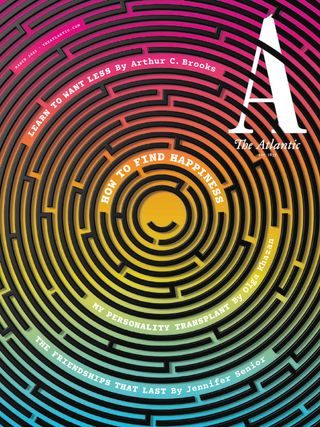

Cette histoire est tirée de l'édition March 2022 de The Atlantic.
Abonnez-vous à Magzter GOLD pour accéder à des milliers d'histoires premium sélectionnées et à plus de 9 000 magazines et journaux.
Déjà abonné ? Se connecter
PLUS D'HISTOIRES DE The Atlantic

The Atlantic
You Had to Be There
An emerging field of history asks if we can ever really understand how our forebears experienced love, anger, fear, and sorrow.

23 mins
January 2026

The Atlantic
By the Horns
The week before the biggest bullfight of her career, in Cádiz, Spain, this past July, 24-year-old Miriam Cabas posted a carefully produced video on Instagram.
1 mins
January 2026

The Atlantic
The New German War Machine
After World War II, Germany embraced pacifism as a form of atonement. Now the country is arming itself again.
18 mins
January 2026
The Atlantic
The Eloquence
The prime minister was watching a disaster movie when we found him.
4 mins
January 2026

The Atlantic
What's for Dinner, Mom?
The women who want to change the way America eats
12 mins
January 2026

The Atlantic
How Terror Works
A 1947 German novel explores the sometimes corrosive, sometimes energizing nature of fear.
8 mins
January 2026

The Atlantic
Yesterday's Idea of a Modern Man
Sam Shepard, a self-made cowboy, was also a poet of masculine angst.
7 mins
January 2026

The Atlantic
ACCOMMODATION NATION
America's colleges have an extra-time-on-tests problem.
11 mins
January 2026

The Atlantic
Respect the Drummer
A new history of rock, told through its overlooked heroes
5 mins
January 2026

The Atlantic
THE MOST POWERFUL MAN IN SCIENCE
WHY IS ROBERT F. KENNEDY JR. SO CONVINCED HE'S RIGHT?
42 mins
January 2026
Translate
Change font size