
Mit Magzter GOLD unbegrenztes Potenzial nutzen
Erhalten Sie unbegrenzten Zugriff auf über 9.000 Zeitschriften, Zeitungen und Premium-Artikel für nur
Versuchen GOLD - Frei
The Satisfaction Trap
The Atlantic
|March 2022
No matter what we achieve or attain, our biology always leaves us wanting more. But there's a way out.

I glanced into my teenage daughter’s bedroom one spring afternoon last year, expecting to find her staring absentmindedly at the Zoom screen that passed for high school during the pandemic. Instead, she was laughing uproariously at a video she had found. I asked her what she was looking at. “It’s an old man dancing like a chicken and singing,” she told me.
I came over to her laptop, not being above watching someone making an idiot of himself for 15 seconds of social-media fame. What I found instead was the septuagenarian rock star Mick Jagger, in a fairly recent concert, croaking out the Rolling Stones’ megahit “(I Can’t Get No) Satisfaction”—a song that debuted on the charts when I was a year old—for probably the millionth time. An audience of tens of thousands of what looked to be mostly Baby Boomers and Gen Xers sang along rapturously.
“Is this serious?” she asked. “Do people your age actually like this?” I took umbrage, but had to admit it was a legitimate question. “Kind of,” I answered. It wasn’t just the music, or even the performance, I assured her. To my mind, the longevity of that particular song— No. 2 on Rolling Stone magazine’s original list of the “500 Greatest Songs of All Time”—has a lot to do with a deep truth it speaks.
As we wind our way through life, I explained, satisfaction—the joy from fulfillment of our wishes or expectations—is evanescent. No matter what we achieve, see, acquire, or do, it seems to slip from our grasp.
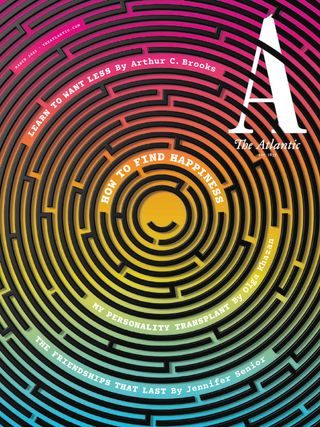

Diese Geschichte stammt aus der March 2022-Ausgabe von The Atlantic.
Abonnieren Sie Magzter GOLD, um auf Tausende kuratierter Premium-Geschichten und über 9.000 Zeitschriften und Zeitungen zuzugreifen.
Sie sind bereits Abonnent? Anmelden
WEITERE GESCHICHTEN VON The Atlantic

The Atlantic
Deadlier Than Gettysburg
How the cruelty of the Confederacy's prison camps gave rise to the rules of war

10 mins
March 2026

The Atlantic
THE MAN WHO BROKE PHYSICS
One of the pleasures of watching Ilia Malinin, apart from his indifference to gravity, is to witness him becoming.
16 mins
March 2026

The Atlantic
How Toni Morrison Saw History
In her novels, she located the missing story of Black America.
12 mins
March 2026

The Atlantic
The Madness of Lord Tennyson
The Victorian poet was startlingly modern.
5 mins
March 2026

The Atlantic
THE PLOT AGAINST THE HUMANITIES
What is the Andrew W. Mellon Foundation doing to higher education?
22 mins
March 2026

The Atlantic
Why Do Democrats Hate Winning?
Ken Martin has one of those resting dread faces, as if he's bracing for someone to dump a bucket of rocks on his head.
37 mins
March 2026

The Atlantic
ROD DREHER'S DEMONS
HE DERIDES THE ENLIGHTENMENT, SECULARISM, AND THE MODERN WORLD. CONSERVATIVES-INCLUDING THE VICE PRESIDENT-ARE JOINING HIM ON A MARCH BACK TO THE MIDDLE AGES.
20 mins
March 2026

The Atlantic
Every Nation for Itself
President Trump wants to return to the 19th century's international order. He will leave America less prosperous—and the whole world less secure.
19 mins
March 2026

The Atlantic
The Secrets of Indigenous Art
Major exhibits are upending the way people understand Native American and Aboriginal artists.
14 mins
March 2026

The Atlantic
The Novel as Extended Op-Ed
If anyone could write good fiction about immigration, it would probably be Lionel Shriver. Instead, her latest book goes off the rails.
10 mins
March 2026
Translate
Change font size