Essayer OR - Gratuit
Creep feed 101: The basic principles
Stockfarm
|March 2020
The saying that you must first learn to crawl before you can walk, applies to many facets of life.

This concept also applies to feeding both large and small stock. A calf or lamb is in fact monogastric until its rumen has developed to the extent where it can digest roughage. Until then, creep feed should form part of the animal’s nutrition programme.
In the first few months of the calf or lamb’s development, the rumen is not yet fully developed and the animal cannot digest roughage. Although the calf or lamb is born with four stomachs, the rumen is bypassed and nutrients are digested in the abomasum. Frederick van der Walt, a technical adviser at Veekos SA, says the calf or lamb’s feed conversion is very efficient during this stage, and an effort should, therefore, be made to facilitate the animal’s growth so that it can reach its full genetic potential.
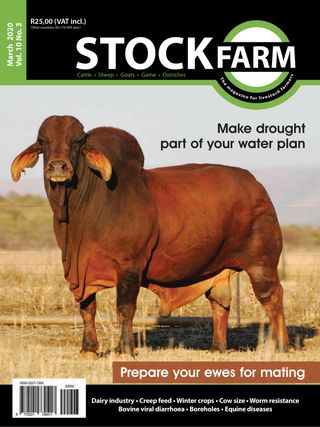

Cette histoire est tirée de l'édition March 2020 de Stockfarm.
Abonnez-vous à Magzter GOLD pour accéder à des milliers d'histoires premium sélectionnées et à plus de 9 000 magazines et journaux.
Déjà abonné ? Se connecter
PLUS D'HISTOIRES DE Stockfarm
Stockfarm
Tackle mastitis in dairy COWS
Mastitis is one of the most significant challenges in the dairy industry, reducing milk yield and overall profitability.

5 mins
February 2026
Stockfarm
Ewe nutrition for a healthy lamb crop
Producers widely acknowledge that the success of any sheep enterprise depends heavily on the potential and management of the farm’s female animals.
4 mins
February 2026
Stockfarm
Does chop length really matter?
Chop length is a critical factor in producing successful silage. Mistakes made during this initial stage can have lasting, irreparable effects.
2 mins
February 2026
Stockfarm
Place these ticks on your autumn watch list
Heavy tick infestations and an increase in the incidence of tickborne diseases such as redwater, gallsickness, and heartwater remain a serious challenge for livestock producers in South Africa, particularly when environmental conditions favour these parasites. Effective control strategies and sound management practices are therefore essential.
2 mins
February 2026
Stockfarm
The grazing paradox: Towards better data
Producers are often under pressure to reassess their grazing strategies and consider dramatic management changes aimed at sustainability.
5 mins
February 2026

Stockfarm
Shearer training for improved performance
Lungani Maqakalana has sheep shearing in his blood. Both his father and uncle were shearers, and from a young age he aspired to follow in their footsteps.
4 mins
February 2026
Stockfarm
Misuse of an employer's property
An employer's property is an integral part of the business infrastructure. Any loss, damage, accidental misuse, intentional misuse, or waste of this property constitutes serious misconduct, placing unnecessary strain on the employer to repair or replace it.
2 mins
February 2026
Stockfarm
The dynamics of the South African lucerne hay industry: Grading and quality
In the January issue of Stockfarm, part one of this series explored the role of lucerne hay in South Africa's animal feed industry.
5 mins
February 2026
Stockfarm
Functional efficiency in small stock
Functional efficiency, the combination of structural soundness, adaptability, mobility, mothering ability, and reproductive capability, is as important as genetic merit for economically important, measurable traits.
3 mins
February 2026
Stockfarm
Managing breeding stock and unsold weaner calves
Persistent outbreaks of foot-and-mouth disease (FMD) have dealt a severe blow to the South African cattle industry.
1 mins
February 2026
Translate
Change font size