Intentar ORO - Gratis
Trane meets the Motor City
Stereophile
|September 2024
Detroit became a destination for migrating African Americans early, starting with the Underground Railroad; the city's proximity to Canada was convenient for those seeking to escape Southern slavery.

The mass human movement accelerated with the Great Migration, which started about 1910, when millions of African Americans left the Jim Crow South for northern cities. The same human movement that brought the blues to Chicago and jazz to New York City took both to Detroit.
In all those cities, the 1920s was a time of ballrooms and big music halls. In Detroit, "society bands" black and white played through-composed, jazz-inflected music, according to a narrative put together by Cliff Coleman and Jim Ruffner for the local jazz museum.' The proliferation of orchestra chairs meant that skilled musicians familiar with a range of musical styles could find work, especially if they read music.
It also meant that Detroit was ready when, in 1927, Don Redman, who had been the chief arranger for Fletcher Henderson's band, moved to the city to lead William McKinney's Cotton Pickers, the resident Black jazz orchestra at Detroit's Graystone Ballroom.
The Pickers soon became an important touring band, with a national reputation. Big-name orchestras like Duke Ellington's and Fletcher Henderson's started to visit the city; on Monday nights, the national bands would "battle" local bands, according to Coleman and Ruffner's account.
As the '20s yielded to the '30s and beyond, there was a shift across the country away from big bands and toward smaller groups, for obvious economic reasons. In Detroit, this shift was aggravated by other factors, including riots and the decimation of Paradise Valley by so-called urban renewal (a story familiar from other cities including, notably, Memphis). The ballrooms shut down, and entertainment moved into smaller venues throughout the city.
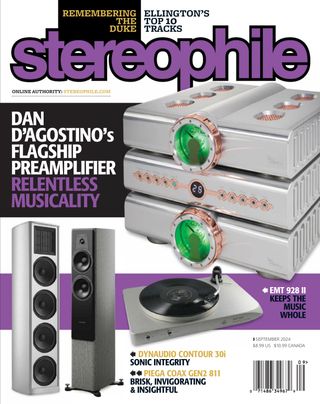

Esta historia es de la edición September 2024 de Stereophile.
Suscríbete a Magzter GOLD para acceder a miles de historias premium seleccionadas y a más de 9000 revistas y periódicos.
¿Ya eres suscriptor? Iniciar sesión
MÁS HISTORIAS DE Stereophile
Stereophile
Wattson Emerson Digital
My story with Wattson Audio began about three years ago. It was my first encounter with a network bridge, at least within the context of our hobby.

12 mins
April 2026
Stereophile
Magico S2
When I was about 12 years old, my mother and I watched a movie on TV in which a ship closed in on a swimmer.
12 mins
April 2026

Stereophile
Current events
Hi-fi dealerships need to find creative new ways to get customers into their stores—to stoke their interest and to help new people feel welcome.
3 mins
April 2026
Stereophile
You can never have too much Trane on vinyl
As I listened to the newly remastered edition of John Coltrane's Complete 1961 Village Vanguard Recordings, I read through some critics' takes, which make it apparent just how far critics tend to trail the musicians they cover, the great ones at least.
3 mins
April 2026
Stereophile
HiFi Rose RD160
Lord knows I try to keep an open mind, but those good-measuring delta-sigma chip DACs rub me the wrong way.
13 mins
April 2026

Stereophile
MANUFACTURERS' COMMENTS
We extend our sincere thanks to Stereophile and to Jason Victor Serinus for their deeply engaged and perceptive evaluation of the M10. It is especially meaningful to see the amplifier’s core principles—control, stability, dynamic authority, and system matching through precise feedback and bias management—so clearly experienced and conveyed in listening.
2 mins
April 2026

Stereophile
LAiV Audio's Harmony GaNM monoblock
The first thing I noticed about the LAiV Audio GaNM monoblock amplifier¹ is its unusual shape and size; it occupies space differently than the other, more basic amplifiers on my rack.
11 mins
April 2026

Stereophile
RECORD REVIEWS
There are times when songwriters, particularly those who have been at it for a while, need a jolt, a shock to the system that gets their creative juices flowing again.
3 mins
April 2026
Stereophile
The Nighthawk soars
When people ask me what I do for a living, I reply that I'm a turntable setter upper.
11 mins
April 2026

Stereophile
Engagement vs sound quality
The more I listen to gear I'm reviewing as well as other people's hi-fis-the more I believe in intangibles. One of these intangibles is the art of system building.
12 mins
April 2026
Listen
Translate
Change font size