
Vuélvete ilimitado con Magzter GOLD
Obtenga acceso ilimitado a más de 9000 revistas, periódicos e historias Premium por solo
Intentar ORO - Gratis
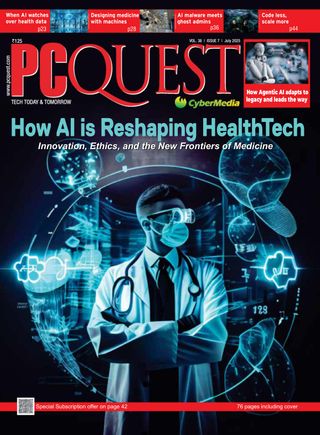
The shift from treatment to prevention
PCQuest
|July 2025
What if your watch knew you were sick before you did? AI in healthcare is doing just that—spotting diseases before they strike. From data to diagnosis, it’s turning doctors into futurists and prevention into power. Is the future already here? Well, the countdown has begun!

Imagine a doctor diagnosing your risk of a disease before you show even a single symptom. No stethoscope, no waiting for test results. Just data. Cold, clean, clinical and yet, profoundly human in what it enables. That's not science fiction. That's preventive healthcare, reimagined by Artificial Intelligence (AI).
For decades, medicine has largely been about damage control. A patient walks in, something's broken, and doctors try to fix it. But now, with machine learning (ML), data integration, and predictive algorithms, healthcare is starting to flip the scriptfrom reactive to proactive.
At the heart of this revolution? Prediction. Prevention. Personalization.
AI meets data and the results are wild
- AI is nothing without data. But healthcare is practically drowning in it.
- Smartwatches track your heartbeat, stress, and even sleep cycles.
- Electronic health records (EHRs) store a lifetime of diagnoses, prescriptions, and lab results.
- Genomic tests tell you what diseases might be written in your DNA.
- Environment and lifestyle data add layers like air quality, income level, job stress.
Put all that into an Al model, and you've got a system that can do something most human doctors can't: spot subtle patterns, long before the first symptom.
Take diabetes. Machine learning models trained on thousands of health profiles are already predicting Type 2 diabetes years in advance. Not after your sugar spikes. But way before—while there's still time to act.
Personal health gets personal
One-size-fits-all medicine? That's so last decade.
Today's predictive AI can customize your care plan down to the molecule. It pulls together your genetic blueprint, your daily behavior, even your social and economic conditions to create a risk profile as unique as your fingerprint.

Esta historia es de la edición July 2025 de PCQuest.
Suscríbete a Magzter GOLD para acceder a miles de historias premium seleccionadas y a más de 9000 revistas y periódicos.
¿Ya eres suscriptor? Iniciar sesión
MÁS HISTORIAS DE PCQuest

PCQuest
When Software Drives the Machine Need for Enterprise-Grade Software
Cars used to fail because of broken parts.Now they fail because of broken code. As vehicles become rolling computers, enterprise-grade software, ruthless testing, and fail-safe architecture decide one thing: whether a car keeps moving safely at 100 km/h

2 mins
March 2026

PCQuest
AI on the ground Practical use cases of AI in large enterprise operations
AI isn't a side project anymore, it's the quiet operator inside global giants. It reads invoices, senses machine fatigue, tailors every customer moment, flags risk in real time, and feeds leaders sharper instincts. Scale just got smarter
3 mins
March 2026

PCQuest
From AI experiments in 2025 to enterprise scale in 2026: Why data foundations will decide the winners
Everyone's betting big on Al, but most are burning cash instead of building value. The hidden culprit? Dirty data, clunky processes, and missing context. What if fixing your foundation, not your algorithms, was the real AI game-changer?
4 mins
March 2026

PCQuest
How automation at the periphery is accelerating digital transformation
Digital transformation is not tearing down the core anymore. It is happening at the edges. With AI and automation layered onto existing systems, companies are cutting costs, boosting productivity by up to 40%, and scaling smarter without risking operational chaos
2 mins
March 2026

PCQuest
When AI moves from chips to racks
AI performance is no longer just about faster chips. It is about how racks, power, networking, and orchestration work together. As agentic AI grows, infrastructure must become predictable, open, and built for scale from day one
4 mins
March 2026

PCQuest
Designing enterprise AI systems that stay fair
In 2026, bias is no longer treated as a communications issue or a public relations headache.
6 mins
March 2026

PCQuest
HALO smart sensor
What if bathrooms, locker rooms, and isolated spaces could become safer without adding cameras?
2 mins
March 2026

PCQuest
Building enterprise AI that doesn't discriminate
Bias in enterprise AI is not a side issue. It starts in data pipelines, training systems, product design, and engineering workflows. As AI scales, fairness, transparency, and accessibility are becoming core software requirements
4 mins
March 2026
PCQuest
Bias travels faster than code
Bias in enterprise AI is not a surface issue. It enters through data, features, model training, APIs, and UI logic, then spreads across the stack. The technical response is shifting from audits to architecture, observability, and deployment controls
6 mins
March 2026

PCQuest
How hospitals can use AI without risking patient data
With the fast pace of adoption of Artificial Intelligence (AI) and digital health systems in Indian hospitals, issues related to the security of patient data are also increasing at an equal rate.
2 mins
March 2026
Listen
Translate
Change font size