
Vuélvete ilimitado con Magzter GOLD
Obtenga acceso ilimitado a más de 9000 revistas, periódicos e historias Premium por solo
Intentar ORO - Gratis
Navigating blind spots and future threats
PCQuest
|March 2025
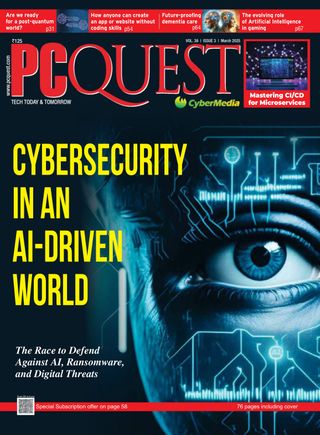
As cloud security evolves in 2025, AI-driven threats, Zero Trust challenges, and quantum risks demand a proactive approach. Organizations must embrace automation, micro-segmentation, and post-quantum cryptography to stay resilient against emerging cyber threats in hybrid environments
-

As multi-cloud and hybrid cloud strategies become the foundation of enterprise IT, the shared responsibility model has evolved significantly in 2025. Organizations are now tasked with securing increasingly complex environments, while cybercriminals leverage AI and automation to exploit vulnerabilities.
In an exclusive discussion with Abhijeet Zilpelwar, Co-founder & CTO of pi-labs, we explore the key security challenges and solutions shaping the future of cloud security.
The Evolution of the Shared Responsibility Model
Cloud security has shifted from a static, well-defined model to a more dynamic and granular framework. While cloud providers continue to enhance their security controls, enterprises remain responsible for securing their workloads, identities, and configurations. However, blind spots persist—misconfigured APIs, insufficient cloud-native logging, and fragmented identity management across multiple platforms create significant risks.
To mitigate these challenges, organizations must:
- Implement automated posture management to detect misconfigurations in real-time.
- Enforce continuous monitoring across all cloud environments.
- Unify identity and access management (IAM) policies to reduce fragmentation and strengthen security.
Strengthening Identity Access Management (IAM) and Mitigating AI-Driven Identity Fraud
As cloud workloads continue to be distributed across hybrid environments, businesses must adopt a centralized IAM strategy to enforce security policies effectively. The integration of identity federation, just-in-time access, and adaptive risk-based authentication ensures that access privileges are dynamically adjusted based on risk levels.
To enforce the least privilege principle, organizations should leverage:
- Attribute-Based Access Control (ABAC) to grant permissions based on contextual factors.

Esta historia es de la edición March 2025 de PCQuest.
Suscríbete a Magzter GOLD para acceder a miles de historias premium seleccionadas y a más de 9000 revistas y periódicos.
¿Ya eres suscriptor? Iniciar sesión
MÁS HISTORIAS DE PCQuest

PCQuest
AI on the ground Practical use cases of AI in large enterprise operations
AI isn't a side project anymore, it's the quiet operator inside global giants. It reads invoices, senses machine fatigue, tailors every customer moment, flags risk in real time, and feeds leaders sharper instincts. Scale just got smarter

3 mins
March 2026

PCQuest
From AI experiments in 2025 to enterprise scale in 2026: Why data foundations will decide the winners
Everyone's betting big on Al, but most are burning cash instead of building value. The hidden culprit? Dirty data, clunky processes, and missing context. What if fixing your foundation, not your algorithms, was the real AI game-changer?
4 mins
March 2026

PCQuest
How automation at the periphery is accelerating digital transformation
Digital transformation is not tearing down the core anymore. It is happening at the edges. With AI and automation layered onto existing systems, companies are cutting costs, boosting productivity by up to 40%, and scaling smarter without risking operational chaos
2 mins
March 2026

PCQuest
When AI moves from chips to racks
AI performance is no longer just about faster chips. It is about how racks, power, networking, and orchestration work together. As agentic AI grows, infrastructure must become predictable, open, and built for scale from day one
4 mins
March 2026

PCQuest
Designing enterprise AI systems that stay fair
In 2026, bias is no longer treated as a communications issue or a public relations headache.
6 mins
March 2026

PCQuest
HALO smart sensor
What if bathrooms, locker rooms, and isolated spaces could become safer without adding cameras?
2 mins
March 2026

PCQuest
Building enterprise AI that doesn't discriminate
Bias in enterprise AI is not a side issue. It starts in data pipelines, training systems, product design, and engineering workflows. As AI scales, fairness, transparency, and accessibility are becoming core software requirements
4 mins
March 2026

PCQuest
Bias travels faster than code
Bias in enterprise AI is not a surface issue. It enters through data, features, model training, APIs, and UI logic, then spreads across the stack. The technical response is shifting from audits to architecture, observability, and deployment controls
6 mins
March 2026

PCQuest
How hospitals can use AI without risking patient data
With the fast pace of adoption of Artificial Intelligence (AI) and digital health systems in Indian hospitals, issues related to the security of patient data are also increasing at an equal rate.
2 mins
March 2026

PCQuest
DeFi in 2026: The rise of liquidity, privacy and decentralized exchanges
DeFi's teenage years are over. Liquidity now behaves like infrastructure, privacy is baked in with zero-knowledge math, and DEXS hum like borderless trading engines. What once felt scrappy now resembles parallel financial system-without gatekeepers
3 mins
March 2026
Listen
Translate
Change font size