
Vuélvete ilimitado con Magzter GOLD
Obtenga acceso ilimitado a más de 9000 revistas, periódicos e historias Premium por solo
Intentar ORO - Gratis
Inclusive by design How tech is reshaping accessibility
PCQuest
|October 2025
From smart wheelchairs to Al Braille, India's tech institutes are building a no-code future for assistive tech. With intelligent design, wearable IoT, and deep learning, they're scripting a new chapter in accessibility, code not required
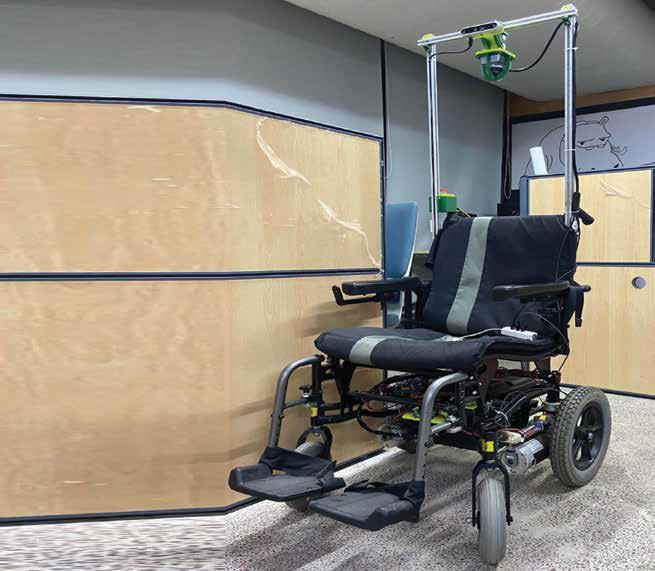
India's top technological institutes are not just designing products, they're reshaping the way disability inclusion and assistive technology are imagined, developed, and deployed. The No-Code revolution is no longer just about app development; it's about enabling millions through intelligent, inclusive systems designed for diverse needs. From Al-triggered job portals to sensor-driven voice commands, the IIT ecosystem is writing a new digital accessibility playbook.
A Distributed Network with Specialized Missions
Launched in June 2023, the National Centres of Assistive Health Technologies (NCAHT) operate across IIT Madras, IIT Delhi, AIIMS Delhi, and the National Institute of Speech and Hearing (NISH). These centers are thematic, each focusing on specific disabilities and functioning as collaborative experience zones.
- IIT Madras leads in locomotor disability, blending research with empathy. Its TTK Center for R2D2 has successfully commercialized five assistive devices, including the Saathi exoskeletal walker for cerebral palsy. Its ARC lab tackles systemic academic bias via the Disability and Discipline initiative and introduces sound-based science learning.
- IIT Delhi, the epicenter for visual impairment technologies, has developed SmartCane (used by over 150,000 globally), Tacread (a low-cost refreshable Braille display), and inclusive STEM kits. The emphasis here is both scale and user validation.
- IIT Kanpur targets learning disabilities with its award-winning AACDD app for Hindi-speaking children and wearable haptic smartwatches for the visually impaired.
- IIT Bombay addresses the aging population with neuro-degenerative assistive solutions, such as fall detectors and hand tremor control gloves.

Esta historia es de la edición October 2025 de PCQuest.
Suscríbete a Magzter GOLD para acceder a miles de historias premium seleccionadas y a más de 9000 revistas y periódicos.
¿Ya eres suscriptor? Iniciar sesión
MÁS HISTORIAS DE PCQuest

PCQuest
When Software Drives the Machine Need for Enterprise-Grade Software
Cars used to fail because of broken parts.Now they fail because of broken code. As vehicles become rolling computers, enterprise-grade software, ruthless testing, and fail-safe architecture decide one thing: whether a car keeps moving safely at 100 km/h

2 mins
March 2026

PCQuest
AI on the ground Practical use cases of AI in large enterprise operations
AI isn't a side project anymore, it's the quiet operator inside global giants. It reads invoices, senses machine fatigue, tailors every customer moment, flags risk in real time, and feeds leaders sharper instincts. Scale just got smarter
3 mins
March 2026

PCQuest
From AI experiments in 2025 to enterprise scale in 2026: Why data foundations will decide the winners
Everyone's betting big on Al, but most are burning cash instead of building value. The hidden culprit? Dirty data, clunky processes, and missing context. What if fixing your foundation, not your algorithms, was the real AI game-changer?
4 mins
March 2026

PCQuest
How automation at the periphery is accelerating digital transformation
Digital transformation is not tearing down the core anymore. It is happening at the edges. With AI and automation layered onto existing systems, companies are cutting costs, boosting productivity by up to 40%, and scaling smarter without risking operational chaos
2 mins
March 2026

PCQuest
When AI moves from chips to racks
AI performance is no longer just about faster chips. It is about how racks, power, networking, and orchestration work together. As agentic AI grows, infrastructure must become predictable, open, and built for scale from day one
4 mins
March 2026

PCQuest
Designing enterprise AI systems that stay fair
In 2026, bias is no longer treated as a communications issue or a public relations headache.
6 mins
March 2026
PCQuest
HALO smart sensor
What if bathrooms, locker rooms, and isolated spaces could become safer without adding cameras?
2 mins
March 2026

PCQuest
Building enterprise AI that doesn't discriminate
Bias in enterprise AI is not a side issue. It starts in data pipelines, training systems, product design, and engineering workflows. As AI scales, fairness, transparency, and accessibility are becoming core software requirements
4 mins
March 2026
PCQuest
Bias travels faster than code
Bias in enterprise AI is not a surface issue. It enters through data, features, model training, APIs, and UI logic, then spreads across the stack. The technical response is shifting from audits to architecture, observability, and deployment controls
6 mins
March 2026

PCQuest
How hospitals can use AI without risking patient data
With the fast pace of adoption of Artificial Intelligence (AI) and digital health systems in Indian hospitals, issues related to the security of patient data are also increasing at an equal rate.
2 mins
March 2026
Listen
Translate
Change font size