
Vuélvete ilimitado con Magzter GOLD
Obtenga acceso ilimitado a más de 9000 revistas, periódicos e historias Premium por solo
Intentar ORO - Gratis
From pilot to production The untold truth of enterprise GenAI
PCQuest
|October 2025
AI pilots impress on slides but stumble in systems. From token blowouts to trust issues, GenAI in the enterprise is more trial than triumph. Here's what recent field experience reveals about what works, what breaks, and what's coming next
-

Generative AI may be redefining what's possible in code, content, and customer interactions, but within enterprise tech, the story is more complicated.
The hype is everywhere. So are the prototypes. Yet, the vast majority of enterprise AI pilots don't survive the leap into production.
In a wide-ranging conversation with Vikrant Karnik, Executive Vice President and Head of Technology, Coforge who has overseen hundreds of generative AI deployments across industries like banking, travel, and insurance, the complexity of “AI in real life” comes into focus.
This isn't about tools or trends. It's about outcomes, and how smart teams are evolving their engineering, governance, and developer workflows to make AI actually work at scale.
The pilot graveyard: Where most GenAI projects go to die
Enterprise AI adoption often starts the same way: a successful pilot solving a niche use case. Common examples include document digitization, video transcription, or processing insurance claims. The results usually look great in isolation. But the jump from lab to production is where most of them fall apart.
Over a span of 300-plus AI pilots across multiple verticals, only 5 to 10 percent made it to full production. The bottlenecks weren't purely technical. They were rooted in business misalignment, lack of measurable outcomes, and an inability to scale responsibly.
One key insight stood out: when pilots were outcome-driven with clear business impact, they progressed. When they were built simply to showcase AI's capability, they didn't.
AI agents, cost spirals, and the rise of governance engineering
Another major friction point emerged with the growing use of autonomous agents, which are self-executing code blocks that tap into language models for reasoning and action.
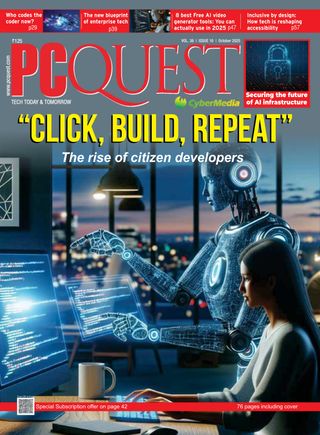

Esta historia es de la edición October 2025 de PCQuest.
Suscríbete a Magzter GOLD para acceder a miles de historias premium seleccionadas y a más de 9000 revistas y periódicos.
¿Ya eres suscriptor? Iniciar sesión
MÁS HISTORIAS DE PCQuest

PCQuest
When Software Drives the Machine Need for Enterprise-Grade Software
Cars used to fail because of broken parts.Now they fail because of broken code. As vehicles become rolling computers, enterprise-grade software, ruthless testing, and fail-safe architecture decide one thing: whether a car keeps moving safely at 100 km/h

2 mins
March 2026

PCQuest
AI on the ground Practical use cases of AI in large enterprise operations
AI isn't a side project anymore, it's the quiet operator inside global giants. It reads invoices, senses machine fatigue, tailors every customer moment, flags risk in real time, and feeds leaders sharper instincts. Scale just got smarter
3 mins
March 2026

PCQuest
From AI experiments in 2025 to enterprise scale in 2026: Why data foundations will decide the winners
Everyone's betting big on Al, but most are burning cash instead of building value. The hidden culprit? Dirty data, clunky processes, and missing context. What if fixing your foundation, not your algorithms, was the real AI game-changer?
4 mins
March 2026

PCQuest
How automation at the periphery is accelerating digital transformation
Digital transformation is not tearing down the core anymore. It is happening at the edges. With AI and automation layered onto existing systems, companies are cutting costs, boosting productivity by up to 40%, and scaling smarter without risking operational chaos
2 mins
March 2026

PCQuest
When AI moves from chips to racks
AI performance is no longer just about faster chips. It is about how racks, power, networking, and orchestration work together. As agentic AI grows, infrastructure must become predictable, open, and built for scale from day one
4 mins
March 2026

PCQuest
Designing enterprise AI systems that stay fair
In 2026, bias is no longer treated as a communications issue or a public relations headache.
6 mins
March 2026

PCQuest
HALO smart sensor
What if bathrooms, locker rooms, and isolated spaces could become safer without adding cameras?
2 mins
March 2026

PCQuest
Building enterprise AI that doesn't discriminate
Bias in enterprise AI is not a side issue. It starts in data pipelines, training systems, product design, and engineering workflows. As AI scales, fairness, transparency, and accessibility are becoming core software requirements
4 mins
March 2026

PCQuest
Bias travels faster than code
Bias in enterprise AI is not a surface issue. It enters through data, features, model training, APIs, and UI logic, then spreads across the stack. The technical response is shifting from audits to architecture, observability, and deployment controls
6 mins
March 2026

PCQuest
How hospitals can use AI without risking patient data
With the fast pace of adoption of Artificial Intelligence (AI) and digital health systems in Indian hospitals, issues related to the security of patient data are also increasing at an equal rate.
2 mins
March 2026
Listen
Translate
Change font size