
Vuélvete ilimitado con Magzter GOLD
Obtenga acceso ilimitado a más de 9000 revistas, periódicos e historias Premium por solo
Intentar ORO - Gratis
TinyML: Building Intelligence at the Edge of the Network
Open Source For You
|November 2025
TinyML is quietly changing what's possible in loT. It's making connected devices faster, more private, and more energy efficient. And thanks to open source frameworks, you don't need a PhD to get started.
-
Walk into any modern factory floor, or pick up a new wearable, and you'll notice a quiet shift happening.
Devices are no longer just collecting data and pushing it up to the cloud. Many of them are starting to make decisions on their own, right where the data is born.
That's the promise of TinyML. Instead of sending everything to a remote server, these small but clever models run on low-power chips, sometimes the size of a coin. They decide whether a vibration in a motor is 'normal' or not, recognise a short wake word like 'hey', or monitor someone's activity -- all without the internet.
For me, this is one of the most exciting evolutions in IoT. We've spent years wiring up sensors everywhere; now we're finally making those sensors smart. And what's making this shift practical for everyday developers is, unsurprisingly, open source tools.
What is TinyML and why it matters
When people first hear the term TinyML, they often imagine some watered-down version of machine learning. But it's not that at all. TinyML is about deploying fully functional ML models on microcontrollers — the same kind of chips that live inside Arduino boards, wearables, or small industrial sensors. These chips typically run on a few hundred kilobytes of memory and draw extremely low power.
Why bother running ML on something so small? The answer lies in a few practical benefits:
- No internet needed: Works in remote or unreliable networks.
- Instant response: On-device decisions mean no latency.
- Privacy: Sensitive data stays local.
- Efficiency: Saves bandwidth and battery.
In short, TinyML transforms ordinary sensors into decision-makers. Think of it as giving a basic 'brain' to the edge of the network.
The real-world challenges of TinyML
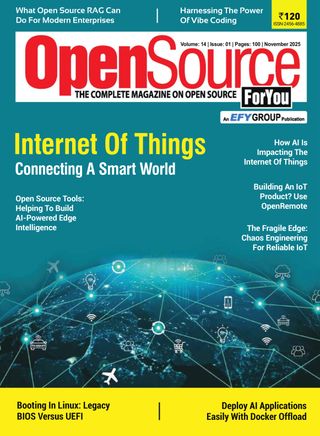

Esta historia es de la edición November 2025 de Open Source For You.
Suscríbete a Magzter GOLD para acceder a miles de historias premium seleccionadas y a más de 9000 revistas y periódicos.
¿Ya eres suscriptor? Iniciar sesión
MÁS HISTORIAS DE Open Source For You

Open Source For You
Apple acquires open source photonics startup invrs.io and hires its founder
Open source technology sits at the heart of Apple's latest acquisition.

1 min
April 2026
Open Source For You
OpenClaw adoption wave lifts China's tech stocks
OpenClaw, an open source autonomous AI agent, is driving a wave of investor enthusiasm in mainland China's stock markets, lifting shares of companies linked to the technology even as broader market sentiment remains subdued.
1 min
April 2026

Open Source For You
NVIDIA's NemoClaw could power Al-based warfare for India
NVIDIA has introduced NemoClaw, an open source, chip-agnostic AI platform designed to deploy agentic AI systems.
1 min
April 2026

Open Source For You
Microsoft flags fake Next.js repos are embedding staged backdoors inside build scripts
Attackers are seeding the open source ecosystem with malicious yet legitimatelooking Next.js repositories that embed staged backdoors inside build scripts and Microsoft dependencies, according to Microsoft.
1 min
April 2026

Open Source For You
NeoNephos expands its open source cloud ecosystem with new members
NeoNephos Foundation has expanded its pan-European open source cloud coalition with the addition of BWI GmbH as a Premier Member, SUSE LLC as a General Member, and Fraunhofer ISST as an Associate Member.
1 mins
April 2026

Open Source For You
Meta's Manus AI allows users to operate its agents through Telegram
The rise of OpenClaw is reshaping the AI agent market, compelling closed platforms to mirror features first popularised in the open source community. The latest example: Manus AI has introduced Telegrambased mobile control, a capability long central to OpenClaw's messaging-first approach.
1 min
April 2026

Open Source For You
China's DeepSeek has more than 75 million downloads on Hugging Face
Chinese AI lab DeepSeek is turning open source momentum into hardware leverage, with more than 75 million downloads of its models on Hugging Face helping Chinese AI releases surpass every other country on the platform.
1 min
April 2026

Open Source For You
Fractal's LLM Studio will help build domain-specific AI models
Fractal Analytics has launched LLM Studio, an enterprise platform designed to build, evaluate, and operate domain-specific language models using open source foundations, marking a shift away from closed, API-led AI approaches.
1 min
April 2026

Open Source For You
Monitoring Machine Learning in Production
Discover the concepts of drift and data skew, and explore online monitoring techniques that keep your machine learning model relevant.
5 mins
April 2026

Open Source For You
Managing Multi-Cloud Infrastructure: The Way Forward
Kubernetes and open source control planes make multi-cloud operations easier and help organisations build scalable and cloudagnostic infrastructure platforms.
7 mins
April 2026
Listen
Translate
Change font size