
Vuélvete ilimitado con Magzter GOLD
Obtenga acceso ilimitado a más de 9000 revistas, periódicos e historias Premium por solo
Intentar ORO - Gratis
AI On The Edge, ROBOTS ON THE FLOOR, And Engineers In The Middle
Electronics For You
|June 2026
What happens when factories adopt intelligent robots faster than universities can prepare engineers to run them? With AI shifting to the edge and automation expanding across India's manufacturing sector, the industry is beginning to shape its own training ecosystem.
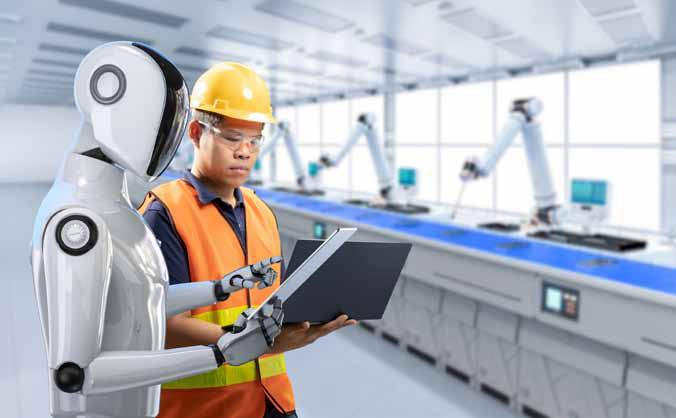
Robotics is no longer confined to the factory floor. Its impact now extends into classrooms and boardrooms alike, reshaping how engineers are trained, how courses are designed, and how companies see their role in developing talent. The recent focus on industry-led robotics labs and internships may appear like isolated initiatives, but they point to deeper structural shifts unfolding across robotics, artificial intelligence, and manufacturing, particularly in India.
At the same time, broader technology trends are accelerating adoption, edge AI is taking on a more central role, and new applications are emerging across sectors. As these forces converge, collaboration between industry and academia is becoming increasingly critical to develop an engineering workforce prepared for real-world demands. Company-led efforts fit into this larger transition, serving less as standalone programmes and more as markers of a wider transformation already underway.
What is changing in robotics right now?
Not long ago, industrial robots were evaluated with simple metrics: payload, reach, and cycle time. If those numbers were strong, the robot was considered good. But what happens when a part is slightly misaligned, a product variant changes, or a line must be reconfigured within months? That is where today’s robotics story begins.
Robots are no longer expected to simply repeat a pre-taught motion in a controlled environment. Today, they are gradually expected to sense, interpret, and adapt. Intelligence, software integration, and connectivity have become not just favourable but essential. This is a paradigm shift that is fundamentally altering the definition of ‘performance.’ Accuracy is still important. Speed is still important. But so is the ability to interface with vision systems, handle variability, and integrate with digital manufacturing systems, rather than working alone.


Esta historia es de la edición June 2026 de Electronics For You.
Suscríbete a Magzter GOLD para acceder a miles de historias premium seleccionadas y a más de 9000 revistas y periódicos.
¿Ya eres suscriptor? Iniciar sesión
MÁS HISTORIAS DE Electronics For You

Electronics For You
Global Navigation Satellite Systems With CENTIMETRE-LEVEL ACCURACY
Precision is designed, not accidental. Warehouse robots and drones require centimetre-level accuracy beyond the capability of standard global navigation satellite systems. Achieving this requires the right positioning technology, antenna design, sensor fusion, and verification. Electronics must be engineered to deliver reliable positioning in challenging environments. So how is it done?

9 mins
June 2026

Electronics For You
HIGH-SPEED Li-Fi DATA TRANSFER Using Laser Communication
A Li-Fi (light fidelity)-based optical communication system is designed to transmit digital data as light signals using a laser diode and a photodiode.
6 mins
June 2026

Electronics For You
KERALA STARTUP BUILDING HUMANOID ROBOTS FROM SCRATCH
An Indian startup is building humanoid robots in-house. The robots are trained like workers, tested in controlled spaces, corrected using feedback, and improved through repeated practice.
9 mins
June 2026

Electronics For You
THE LITHOGRAPHY ARCHITECTURE Built For Multiple Future Generations
Making computer chips is becoming harder, slower, and more expensive. A new way of generating light could help the semiconductor industry move beyond some of today’s most stubborn manufacturing limits.
6 mins
June 2026
Electronics For You
5 Interesting Reference Designs For AIR-CONDITIONER AND HVAC SYSTEMS
From smarter compressors to sensor-driven climate control, these HVAC reference designs show how cooling systems are becoming far more intelligent and efficient.
4 mins
June 2026

Electronics For You
“We Establish Robot Labs In Universities For Hands-On Exploration, Run Internships And Training Programmes”
Epson recently announced a strategic tie-up with a university to provide robotics training. EFY’s Akanksha Gaur spoke with Siva Kumar from Epson to understand the thinking behind the initiative. Here is what she discovered...
5 mins
June 2026

Electronics For You
DUSK-TO-DAWN AUTO ON/OFF LED Strip Lighting With Timer
Automatic lighting systems are widely used to improve energy efficiency and convenience in residential and commercial applications.
4 mins
June 2026
Electronics For You
The Amazing Ultra-Compact BATTERYLESS GAME BOY
The Game Boy, the legendary gaming console of the 1990s, still holds a special place in the hearts of gamers.
5 mins
June 2026

Electronics For You
Open Source Model Rocket: DESIGN AND SIMULATION
Rocket design is one of the most exciting yet complex areas of engineering.
7 mins
June 2026

Electronics For You
THE HUMAN MIRROR: Why AI’s Success Depends On OUR OWN EVOLUTION
Humanity has arrived at what may be its most significant invention. AI is no longer merely a technical challenge; it is fundamentally a human one. Built upon thousands of years of collective human effort, it holds the potential to address challenges such as longevity. Yet its ultimate direction may still be shaped by the most primitive impulses of its creators—greed and ego.
6 mins
June 2026
Listen
Translate
Change font size