
Vuélvete ilimitado con Magzter GOLD
Obtenga acceso ilimitado a más de 9000 revistas, periódicos e historias Premium por solo
Intentar ORO - Gratis
Workshop wisdom
Cycling Plus UK
|August 2025
What is cross-chaining and does it wear out components? We explain the ins and outs
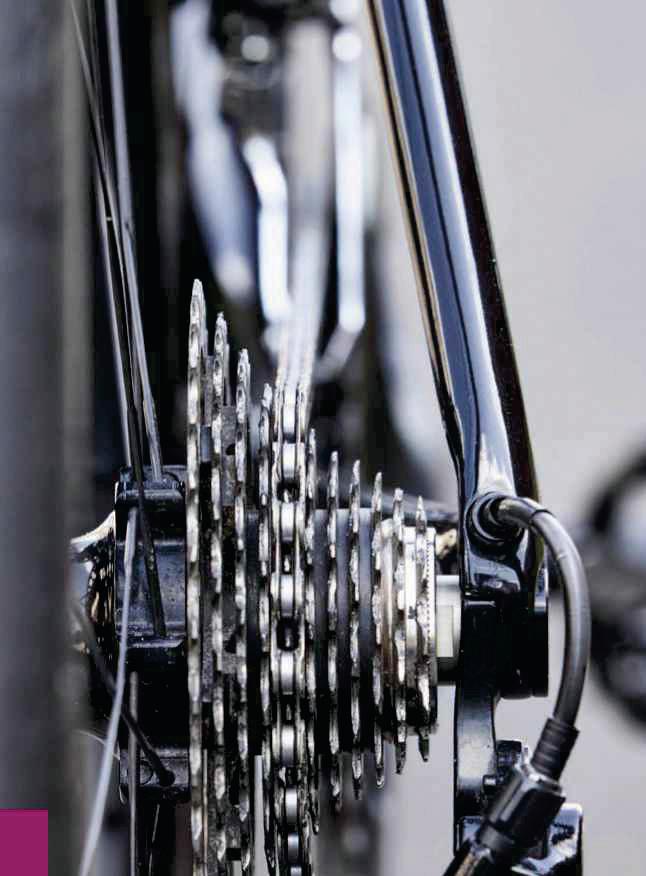
Most bikes have a range of gears to enable you to crest a climb, carve down a descent and everything in between. In theory, all of the gears are at your disposal, but on some setups, it's best to avoid using certain gear combinations to avoid what's typically referred to as 'cross-chaining'.
What is cross-chaining?
This is the act of riding in the smallest or largest cassette sprocket (the gears at the back of the bike) and the equivalent chainring (the gears at the front of the bike) at the same time.
For example, on a bike with a double chainring setup, if you're riding in the smallest cassette sprocket and the smallest chainring (1), or the largest cassette sprocket and the largest chainring (2), you're cross-chaining.
On a 2x drivetrain, it's also generally recommended to avoid riding in the second-smallest sprocket when in the small chainring.
Why is it bad?
The chain performs at its best when it's in a straight line (3). Cross-chaining makes the chain run diagonally and can force it into an extreme angle, reducing efficiency (due to the increased friction of the chain rubbing against the front derailleur or cassette teeth and the sub-optimal chainline) and potentially harming shifting performance.
The additional friction is also widely thought to lead to increased wear, but interestingly, bike-component manufacturers SRAM disagree. “Cross-chaining has no effect on chain wear. Its effect on the big cog and big ring is insignificant,” they say.

Esta historia es de la edición August 2025 de Cycling Plus UK.
Suscríbete a Magzter GOLD para acceder a miles de historias premium seleccionadas y a más de 9000 revistas y periódicos.
¿Ya eres suscriptor? Iniciar sesión
MÁS HISTORIAS DE Cycling Plus UK

Cycling Plus UK
Ask the experts
We answer your burning bike-related questions

4 mins
January 2026

Cycling Plus UK
NEWCOMER OF THE YEAR
The young Paralympian has been busy - we talk to him about his successes to date, what makes him tick and what his aspirations are for the future
4 mins
January 2026
Cycling Plus UK
Schwalbe G-One RS Pro gravel tyre
£74.99 This speedy off-road rubber impresses in almost all scenarios
4 mins
January 2026
Cycling Plus UK
Brompton Electric T Line
From £5,799 The brand's lightest e-bike yet
2 mins
January 2026
Cycling Plus UK
Samassi 3D-printed bike components
A composite saddle for £77 and a titanium computer mount for £69 from the Asian brand
1 mins
January 2026

Cycling Plus UK
Boost your ride
Performance Q&A The big cycling questions answered by our team of expert coaches, nutritionists and riders
17 mins
January 2026

Cycling Plus UK
AFFORDABLE GRAVEL BIKES
We test a trio of models built for off-road excursions, which will also cope well with the commute to work
3 mins
January 2026

Cycling Plus UK
Artistic licence?
Simon von Bromley thinks the UCI's vague new helmet regulations could cause issues
3 mins
January 2026
Cycling Plus UK
Specialized Turbo Vado SL 2 4.0
£3,099 This new model goes further, but it's heavier
5 mins
January 2026

Cycling Plus UK
RIDER OF THE YEAR '25
WE WERE PACKED TO THE RAFTERS FOR OUR THIRD ANNUAL AWARDS
1 mins
January 2026
Listen
Translate
Change font size