Intentar ORO - Gratis
Nerves Do Regenerate
Scientific American
|September 2025
Neurons, once thought to be irreparable, can grow anew—even in the brain
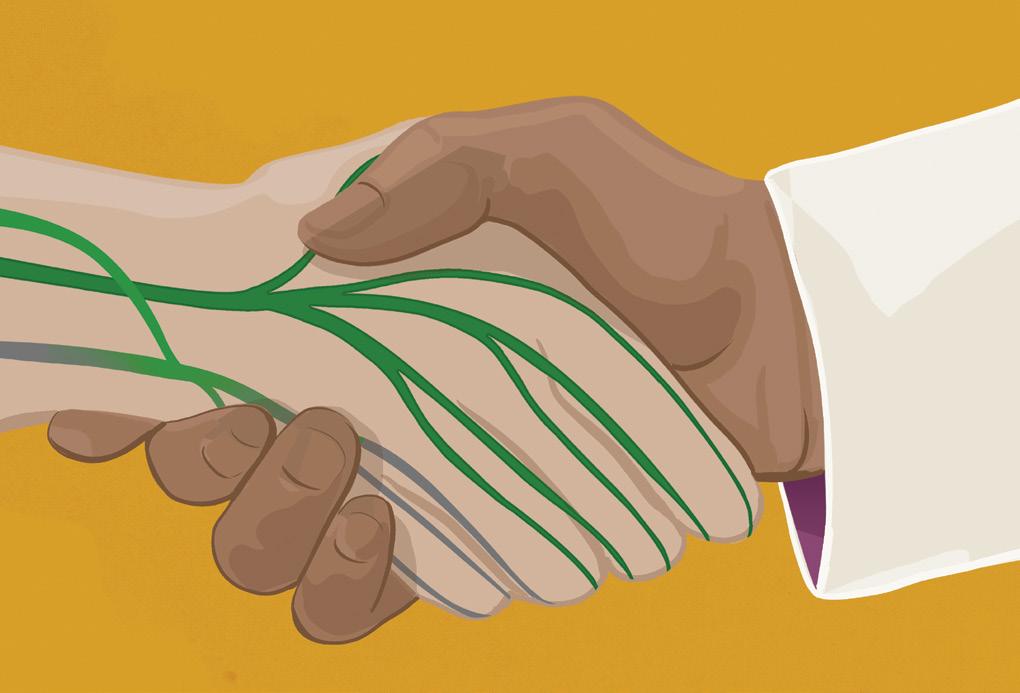
BILLIONS OF NERVE CELLS send signals coursing through our bodies, serving as conduits through which the brain performs its essential functions. For millennia physicians thought damage to nerves was irreversible. In ancient Greece, founders of modern medicine such as Hippocrates and Galen refused to operate on damaged nerves for fear of causing pain, convulsions or even death.
The dogma stood relatively still until the past two centuries, during which surgeons and scientists found evidence that neurons in the body and brain can repair themselves and regenerate after injury and that new nerve cells can grow throughout the lifespan. In recent decades this knowledge has inspired promising treatments for nerve injuries and has led researchers to investigate interventions for neurodegenerative disease.
In humans and other vertebrates, the nervous system is split into two parts: the central nervous system, composed of the spinal cord and brain, and the peripheral nervous system, which connects the brain to the rest of the body.
Attempts to suture together the ends of damaged neurons in the peripheral nervous system date back to the seventh century. It was only in the late 1800s, however, that scientists began to understand how, exactly, nerves regenerate. Through his experiments on frogs, British physiologist Augustus Waller described in detail what happens to a peripheral nerve after injury. Then, in the 1900s, the influential Spanish neuroanatomist Santiago Ramón y Cajal provided insight into how nerve regeneration occurs at the cellular level. Still, there remained fierce debate about whether stitching nerves together would harm more than help.


Esta historia es de la edición September 2025 de Scientific American.
Suscríbete a Magzter GOLD para acceder a miles de historias premium seleccionadas y a más de 9000 revistas y periódicos.
¿Ya eres suscriptor? Iniciar sesión
MÁS HISTORIAS DE Scientific American

Scientific American
Let There Be Weapons
The Department of Energy’s new Genesis Mission promises AI-accelerated discovery. Seven of its first 26 challenges focus on nuclear weapons and national security

4 mins
July/August 2026

Scientific American
How to Fix Science
The federal funding system for scientific research in the U.S. needs reform
9 mins
July/August 2026

Scientific American
Robots Can Now Fold Your Laundry
Home-helper tasks are becoming easier for robotic assistants
4 mins
July/August 2026

Scientific American
50, 100 & 150 Years
NATURAL FISSION REACTOR
3 mins
July/August 2026

Scientific American
Anna Ho
Describing the characteristics of short-lived astrophysical events
1 mins
July/August 2026

Scientific American
THE SOLILOQUY OF SCHRÖDINGER'S CAT
A MEDITATION ON LIFE AND THE VON NEUMANN–WIGNER INTERPRETATION OF QUANTUM MECHANICS
1 min
July/August 2026

Scientific American
Mikhail Kolmogorov
Developing software to reveal large genetic changes that lead to cancer
1 mins
July/August 2026

Scientific American
Jaye Gardiner
Learning how the matrix around cells and tissues impacts cancers
1 mins
July/August 2026

Scientific American
Timnit Gebru
On safeguarding independent research in the age of big tech
3 mins
July/August 2026

Scientific American
A Youthful Illusion Sharpens Memory
By making people feel as if their face is a younger version of itself, researchers can bring childhood memories into sharper focus
4 mins
July/August 2026
Listen
Translate
Change font size